A Cadillac Escalade IQ that sits unused in a DC-area garage often won’t wake. That no-start is almost always the 12-volt battery. The traction pack can still show plenty of range. The 12-volt is what brings the truck’s computers online. If it sags, the fob goes quiet. The SUV looks finished, and it usually isn’t.
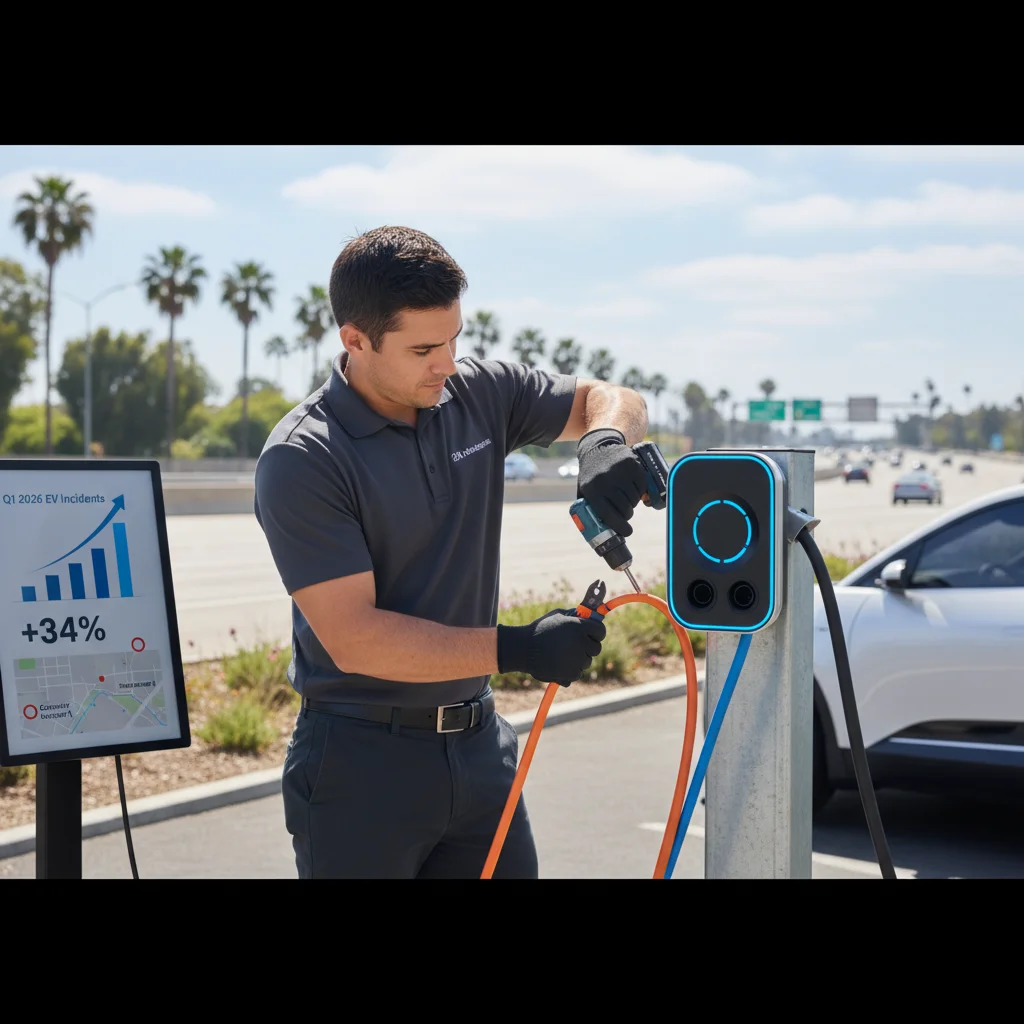
The 12-volt wakes the truck, not the pack
GM’s Ultium pack in this SUV is enormous. It still can’t start the truck by itself. Low-voltage electronics close the contactors on the high-voltage system. Those electronics run on 12 volts. A full pack behind a dead 12-volt does nothing at the button.
Gas Escalade owners expect a slow crank. This EV doesn’t crank at all. A weak 12-volt means silence. The powered eTrunk may stay shut. That’s the usual pattern after a long sit. It isn’t a failed Ultium module in most cases.
Long garage sits around this metro set it up
The most common version is a traveler coming home. You leave the Escalade IQ parked, then fly for a week. You return to a truck that won’t answer. At Dulles, MWAA has Level 2 charging in Garage 1 and Garage 2. Reagan National has complimentary Level 1 charging on Level 1 of Garages 1 and 2. Those spaces are for parking customers. A week of sitting still wears down the 12-volt. The traction pack can be fine the whole time.
WMATA park-and-ride garages show the same idle pattern. The car stays locked, connected, and sipping from the auxiliary battery. By pickup, the 12-volt is the part that quit.
Estate garages in Potomac and in McLean create the same sit. The Escalade IQ is often not the daily driver. A few quiet weeks are enough to flatten the 12-volt. Parking decks at Tysons Corner Center do it after a long workday plus overnight.
The metro sits at the fall line, with humid summer stretches above 90F. A truck that sits through that weather still needs the 12-volt awake. Winter is harder west of the District. Dulles runs colder and snowier than Reagan National. Loudoun, upper Montgomery County, and Prince William see more freeze. Recurrent Auto found a typical EV keeps about 80% range at 32F. In a parked garage, the 12-volt is still the battery keeping modules alive.
How to tell a 12-volt no-start from an empty pack
| What you notice | What it usually means |
|---|---|
| Fob dead, no interior lights, eTrunk won’t power open | 12-volt is fully down |
| Doors unlock, start button does nothing | 12-volt is low, a jump may wake it |
| Screen boots, then dies, then repeats | Modules browned out, try a 12-volt reset |
| Displays look normal and range is near zero | You need a charge, not a jump |
| Truck starts, then shows a high-voltage service warning | Dealer scan, not a simple auxiliary battery |
If the cluster still shows miles, treat it as a 12-volt job first. If it shows empty and the truck otherwise wakes, that’s a range problem. The two failures look alike from the sidewalk. They’re not the same fix.
The eTrunk can hide the jump points
Cadillac calls the under-hood storage the eTrunk. On most trims the hood is powered. It opens from the cabin or the fob when the 12-volt still has life. A flat auxiliary battery can leave that hood shut. Check the owner’s manual for the manual eTrunk release before you call a tow.
Once you’re in, GM’s Ultium jump points follow a familiar layout. Use the marked positive post and a nearby chassis ground. Don’t clip onto the battery posts themselves. Placement can change by model year. Confirm the exact points in your manual. After you connect a jump pack, wait about 60 to 90 seconds, then press start.
If you’d rather not work under a powered hood, that’s fair. The operators we connect you with handle GM trucks on site. They can jump the 12-volt. If the pack is actually empty, they bring a 240-volt Level 2 source. Native NACS, plus CCS or J1772 adapters, covers this Cadillac. Typical charging time adds 10 to 20 miles in 15 to 30 minutes. That’s time on the plug, never an arrival time.
Same Ultium family, different truck
The Escalade IQ shares Ultium battery tech with other GM EVs. It doesn’t share the Lyriq’s platform. This SUV sits on GM’s BT1 architecture, built for full-size trucks. That’s the same branch as the GMC Hummer EV and the Chevy Silverado EV. The Cadillac Lyriq uses the smaller BEV3 platform with the Blazer EV.
12-volt no-starts look similar across Ultium. Ride height, eTrunk hardware, and jump access line up with the Hummer and Silverado. They don’t line up with the Lyriq. If a shop walks you through a Lyriq procedure, pause. Pull the Escalade IQ manual for this body.
Patrols and utilities won’t charge a stranded Escalade IQ
Pepco serves the District, Montgomery County, and Prince George’s County. Dominion Energy Virginia covers most of Northern Virginia. NOVEC serves parts of Loudoun and Prince William, including much of Sterling, Ashburn, and Gainesville. None of the utility EV pages we reviewed offer a stranded-car charge. Pepco EVsmart and Dominion’s Schedule 1EV are home programs. They don’t send a truck to your garage.
On Virginia interstates, VDOT’s Safety Service Patrol handles incidents and debris. Drivers reach them through Virginia 511. Published VDOT material doesn’t describe EV charging. In Maryland, MDOT SHA’s CHART Emergency Traffic Patrol works the Baltimore/Washington area. Technicians provide tire changes, jump starts, and about one gallon of gas. Dial #77 on I-495, I-270, US-50, and MD-295. CHART doesn’t publish a mobile EV charge.
The District has no DDOT motorist-assistance patrol that we could confirm. DC drivers lean on MPD, private roadside plans, and US Park Police on the parkways. On the Baltimore-Washington Parkway, report a disabled vehicle to US Park Police at 202-610-7500. Those parkways have narrow or missing shoulders. Stay with the truck if you can do that safely.
If you stall in the 495 Express Lanes, pull to the left shoulder. Those lanes sit in the median. On the 95 and 395 Express Lanes, use the nearest shoulder. Stay in the vehicle until help arrives. Express Assist can help with minor issues and call a tow. It doesn’t charge an EV.
DC, Maryland, and Virginia codes we reviewed don’t single out an empty EV. Disabled-vehicle rules apply the same as they do to any car.
What to try, then who actually shows up
Work through the cheap checks first. Look at the key fob battery. Confirm you aren’t stuck in an accessory state. See whether interior lights answer at all. If the truck is mute, don’t keep hitting start. You’re only pulling the 12-volt down further.
A lithium jump pack on the correct posts can be enough. Give the modules 60 to 90 seconds. If it wakes, drive it and get the 12-volt tested. Repeat deaths after a jump mean the auxiliary battery is done. See the EV 12-volt replacement guide for the signs. A proper EV jump procedure matters on these trucks. Reverse polarity on the wrong point can damage modules.
If the displays show near-zero range, skip the jump debate. You need energy in the pack. Charge Pro DC is a referral line. We match you with independent local mobile rescue operators. We don’t own trucks, and we don’t set prices. The operator quotes you before any work starts, then bills you directly.
Frequently asked questions
How do you jump a Cadillac Escalade IQ?
Use the interior release or the fob to open the eTrunk. If nothing has power, find the manual hood release in the owner’s manual. Connect a jump pack to the marked positive post and a chassis ground. Wait 60 to 90 seconds, then press start. Confirm terminal locations for your model year before you clip on.
Can the Escalade IQ refuse to start with a full pack?
The Ultium pack and the 12-volt are separate systems. A full traction battery can’t close the contactors if the 12-volt is dead. Plenty of shown range doesn’t rule out a dark truck.
What if a jump doesn’t wake it?
If it still won’t start, or a high-voltage service warning stays on, stop jumping. That’s dealer diagnostic territory. The operator we send can confirm it’s the 12-volt before you tow. This SUV is a poor candidate for a rushed flatbed.
Charge Pro DC covers the District, Maryland, and Virginia. If your Escalade IQ won’t start after a garage sit, call (202) 629-0844. We’ll connect you with a local operator who quotes the job first.