A Chevy Silverado EV won’t start after a jobsite day or a garage sit. The 12-volt battery is usually the cause, not the Ultium drive pack. You can still have a healthy range number on paper. The truck still goes fully dark. No dash, no handles, no way to wake the screens.
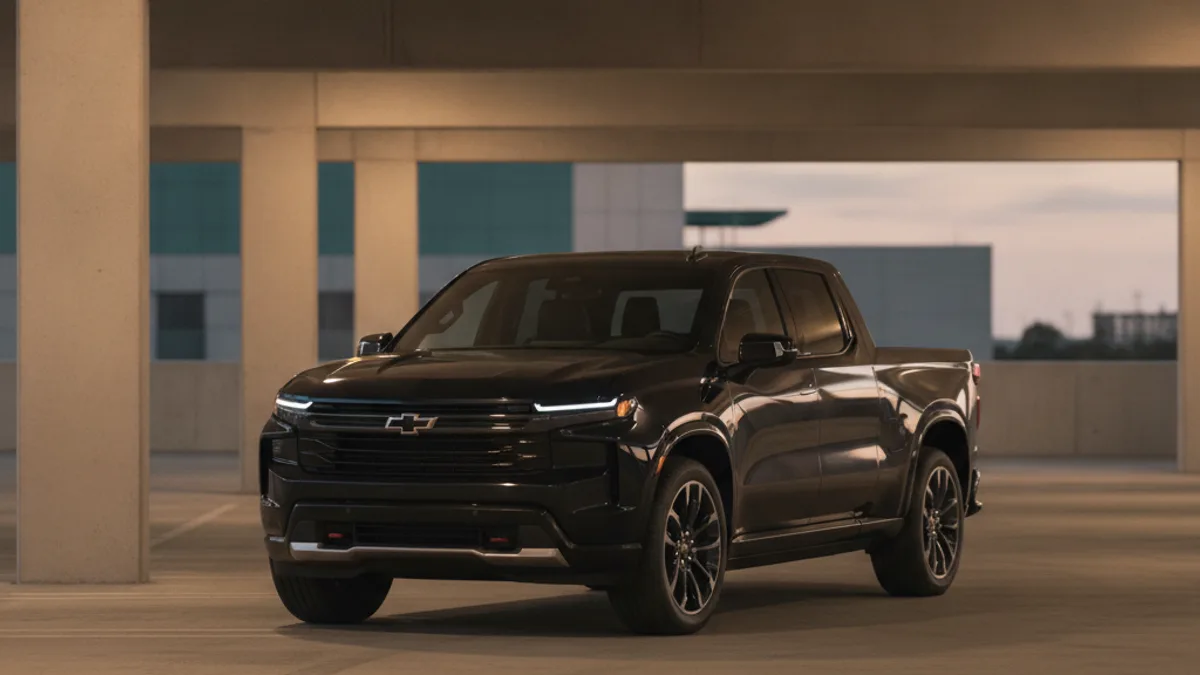
Chevy Silverado EV won’t start after it sat all day
This platform is a work truck first. That shapes how it dies in the DC area. A crew parks it at a jobsite. Lighting, tools, or a job box stay on the eTrunk outlets. The 12-volt feeds that load the whole time the truck is empty. You walk back at quitting time and the fob does nothing.
Office parking does the same thing on a slower clock. A Silverado EV sits in a garage in Tysons or Reston. It sits through a long meeting day. The alarm and connectivity modules still run. A weak 12-volt finishes the day below the voltage the computers need.
Airport parking stretches that sit into a week. Dulles has Level 2 charging in Garage 1 and Garage 2. Plenty of travelers still leave a truck in long-term parking and fly out. They come home to a truck that won’t wake. The traction pack may be fine. The 12-volt sat under a constant drain the whole trip.
WMATA park-and-ride garages show the same week-long pattern. You park, ride Metro, and retrieve the truck days later. The range readout, when you can see it, isn’t the problem. The small battery is.
Range on the dash isn’t the same as a start
The number you remember from last drive comes from the high-voltage Ultium pack. That pack moves the truck once the system is awake. The 12-volt is the one that actually boots every module. It’s what lets the contactors close. If it can’t hold voltage, the handshake never completes.
Every EV uses a DC-DC converter to step pack voltage down. It lands around 12 to 14 volts. That converter is supposed to keep the small battery topped off while the truck sits. When the converter or the 12-volt itself starts to fail, the cabin goes dark. A jump can bring the modules back. A battery at the end of its life will drop you again within days.
Don’t keep cycling the power button to clear a wall of warnings. Those stacked messages are what a low 12-volt looks like on this truck. Bringing voltage back into range is what actually clears them.
What you’ll see when the 12-volt is the problem
The no-start looks like this. Doors stop unlocking. Screens stay black. The truck won’t shift into drive even with range left. The 12-volt feeds many modules at once. You don’t get one tidy code. You get unrelated warnings all together.
Treat that stack as a voltage problem first. It usually isn’t five separate failures.
Here’s a quick map from what you see to what’s likely going on.
| Symptom | Likely cause |
|---|---|
| Dash fully dark, doors won’t unlock | 12-volt is fully discharged |
| eTrunk won’t open with fob or dash button | 12-volt is too low to run the electric release |
| Many unrelated warnings at once | Voltage dropped far enough to confuse several modules |
| Won’t shift into drive with range still showing | 12-volt can’t finish the handshake to the Ultium pack |
| No-starts return within days of a jump | 12-volt has failed and needs replacement |
You’ve jumped it more than once in a few weeks. Stop treating it as a one-off. A 12-volt that can’t hold a charge needs to be replaced. Our EV 12-volt replacement guide walks through the signs and the job. Confirm the current part and labor before you pay. Ask the shop or the operator.
Why this metro is hard on a work truck’s 12-volt
Heat and cold both add background draw. Summers here run hot and humid, with stretches above 90F. A Silverado EV sitting in a jobsite lot or a driveway still manages heat. Battery cooling and cabin soak still run. That draw is enough to push a tired 12-volt over the edge by evening.
Winter hits the western and northern suburbs harder than the District. Dulles runs colder and snowier than Reagan National. Loudoun, upper Montgomery, and Prince William see more snow and harder freezes. Cabin heat on an EV comes from the pack. Sitting still with heat or AC on burns energy without covering miles. That’s the Beltway crawl and the I-95 standstill, not a long-distance problem.
The January 2022 I-95 shutdown is the local reference for this. On January 3 and 4, snow and a crash closed about 50 miles of I-95. That stretch was near Fredericksburg, just south of this metro. Drivers sat overnight with climate control running. A Silverado EV in that kind of idle is pulling accessory power the whole time. A marginal 12-volt doesn’t recover when you finally shut down.
Trailering adds its own load. A loaded trailer asks for extra accessory power the entire drive. Park back at the yard, and a weak 12-volt may not rebound.
Apartment and older-house parking makes sits longer. Pre-1980 housing is common in Takoma Park, Annandale, Wheaton, and Washington. Older houses there often predate a wall charger, so the truck sits unplugged overnight. The 12-volt still has to cover the alarm and the telematics. Arlington, Alexandria, Silver Spring, and Hyattsville see a lot of that unplugged overnight pattern.
None of that means the Ultium pack is empty. It means the small battery did a full day’s work without a recovery charge.
Pepco, Dominion, and a patrol won’t charge this truck
Pepco serves the District, Montgomery County, and Prince George’s County. Dominion Energy Virginia serves most of Northern Virginia. NOVEC covers parts of Loudoun and Prince William, including much of Sterling, Ashburn, and Gainesville. Those utilities publish EV rates and charger rebates. None of the utility EV pages we reviewed offer a service that charges a stranded truck. It isn’t a claim about plugs on the road.
VDOT’s Safety Service Patrol covers Virginia interstates, including I-95 and I-66 in Northern Virginia. You reach help through Virginia 511. Published material describes incident clearance, debris, and short-term traffic control. It doesn’t describe EV charging, and it doesn’t describe opening a GM eTrunk.
In Maryland, MDOT SHA’s CHART Emergency Traffic Patrol covers the Baltimore and Washington area. Technicians publish tire changes, jump starts, about a gallon of gas, and radiator water. Dial #77 for a breakdown on state primary roads such as I-495, I-270, US-50, and MD-295. A CHART jump is built for a conventional 12-volt. It isn’t a published EV charging service. It may not be the right setup for an eTrunk lockout.
The District has no DDOT motorist-assistance patrol in the material we reviewed. DC drivers lean on MPD, private roadside plans, and US Park Police on the parkways.
If you’re on a National Park Service parkway, know the extra constraint. Commercial vehicles and trucks over 10,000 lb are banned on the Baltimore-Washington Parkway. They’re banned on the George Washington Memorial Parkway too. The same ban applies on Clara Barton, Rock Creek, and Suitland Parkway. Shoulders are narrow or missing. A disabled vehicle on the Baltimore-Washington Parkway is reported to US Park Police at 202-610-7500. Disabled-vehicle rules in DC, Maryland, and Virginia apply to an EV. They apply the same way they apply to any car. None of the three codes we reviewed has a separate empty-charge rule.
On the 495 Express Lanes, pull to the left shoulder. Those lanes sit in the median. On the 95 and 395 Express Lanes, pull to the nearest shoulder. Stay in the truck until help arrives. Express Assist can help with minor mechanical issues and can call a tow. It doesn’t tow, and it doesn’t publish EV charging.
A stall on the Woodrow Wilson Bridge sits at three jurisdictions at once. That’s Alexandria, Oxon Hill, and the District. The American Legion Bridge puts you between McLean and Montgomery County. Both spans are high, windy, and short on shoulder. Get the truck as far out of the lane as you can. Then call for a quoted operator. Don’t guess under the dash in traffic.
The eTrunk catch: the battery is behind an electric lid
GM put the Silverado EV’s 12-volt under the hood, inside the eTrunk. It sits on the passenger side under a plastic cover held by tabs. That’s easy with power. The eTrunk itself opens with the fob, a dash button, or a fascia button. All of those need 12-volt power. When the battery is dead, the lid that hides it won’t pop.
GM built a mechanical workaround for that lockout. Look under the dash on the driver’s side, low on the left. There’s a gray release cable with a loop. It’s in the same neighborhood as a hood release on a gas truck. Pull that cable twice. The eTrunk releases with no electrical power. It can take a second to find because it’s tucked up.
Once the lid is up, lift the plastic cover on the passenger side. A flathead screwdriver helps if the tabs are stiff. Go slow so you don’t crack the cover. The 12-volt terminals are right there.
How to wake the truck without making it worse
With the cover off, connect the positive clamp first. Use a jump pack or a donor vehicle on the Silverado’s positive terminal. Then connect the negative clamp to the negative terminal. You can also use an unpainted metal ground nearby. Wait about a minute before you try to power the truck on.
If a standard jump pack doesn’t wake it on the first try, leave it connected longer. A deeply discharged truck may need that extra time. A 12-volt that’s this far gone sometimes needs a slower top-up. That extra time helps it finish the startup handshake. For the full sequence, see our guide to jump starting an EV.
Don’t start pulling terminals to force a reset. That’s a bad idea if the truck was just serviced or left in a maintenance state. When you’re unsure, stop and get a diagnosis. Guessing under the hood is how a simple jump turns into a tow.
If the dash comes back and range is near zero, that’s a different job. The pros we connect you with can bring a 240-volt Level 2 source. Native NACS, or a CCS or J1772 adapter for non-Tesla EVs. They typically add 10 to 20 miles of range. That’s in 15 to 30 minutes of charging time. That’s charging time, not a promise of when someone arrives. The operator quotes you before any work starts and bills you directly.
Who actually shows up for a Silverado EV here
Charge Pro DC is a referral line. We match stranded EV drivers with independent local mobile rescue operators. We don’t hold a trade license. We don’t own the trucks. We don’t send our own technicians. The operator who takes the job does the 12-volt jump or the replacement on site.
On an EV roadside assistance call, the operator jumps the 12-volt. They replace it on site if it won’t hold. The quote comes first. Wait for that quote before any work starts.
The same operators handle non-Tesla EV rescue across the District, Maryland, and Virginia. This no-start shows up on GM’s other electrics too. The GMC Hummer EV 12-volt guide covers the same eTrunk lockout on a different body. The GMC Sierra EV emergency charging guide is the sibling work truck. It’s the same low-voltage idea.
If you’re near Dulles after a long-term parking sit, start with the manual release. Then call for a quoted operator who can get to Herndon. Springfield, Woodbridge, and the I-270 towns see the same jobsite-and-commute pattern. We serve the DC area, the District of Columbia, Maryland, and Virginia.
Call (202) 629-0844 when the truck is dark and the eTrunk won’t pop. The operator quotes before they start. Don’t force the fascia or pry the lid. Use the cable under the dash. Or wait for someone who’s done this wake-up before.
Frequently asked questions
Why does a Chevy Silverado EV refuse to start when the range still looks fine?
The range figure is the Ultium pack. The 12-volt is what actually boots the truck. If that small battery is dead or too weak, the startup sequence never finishes. A jump on the 12-volt is what usually brings the modules back.
How do I get to the 12-volt if the eTrunk is dead?
The battery lives in the eTrunk, passenger side, under a tabbed plastic cover. With no 12-volt, the electric release won’t fire. Use the gray looped cable under the dash on the driver’s side. Pull it twice and the lid opens mechanically.
Will a highway patrol or my utility get this truck running?
VDOT and CHART publish motorist help. They don’t publish EV charging, and they don’t publish GM eTrunk steps. Pepco, Dominion, and NOVEC don’t offer a stranded-car charge. Call a quoted local operator for a 12-volt jump. Ask for a 240-volt top-up if the pack is the problem.