A dead gas car on the Capital Beltway doesn’t need your traction pack. Jumper cables only see the small 12-volt battery in your EV. That 12-volt can sometimes jump-start a gas car. The big traction pack never joins that jumper circuit. On I-495, the safer move is usually a patrol, not your cables.
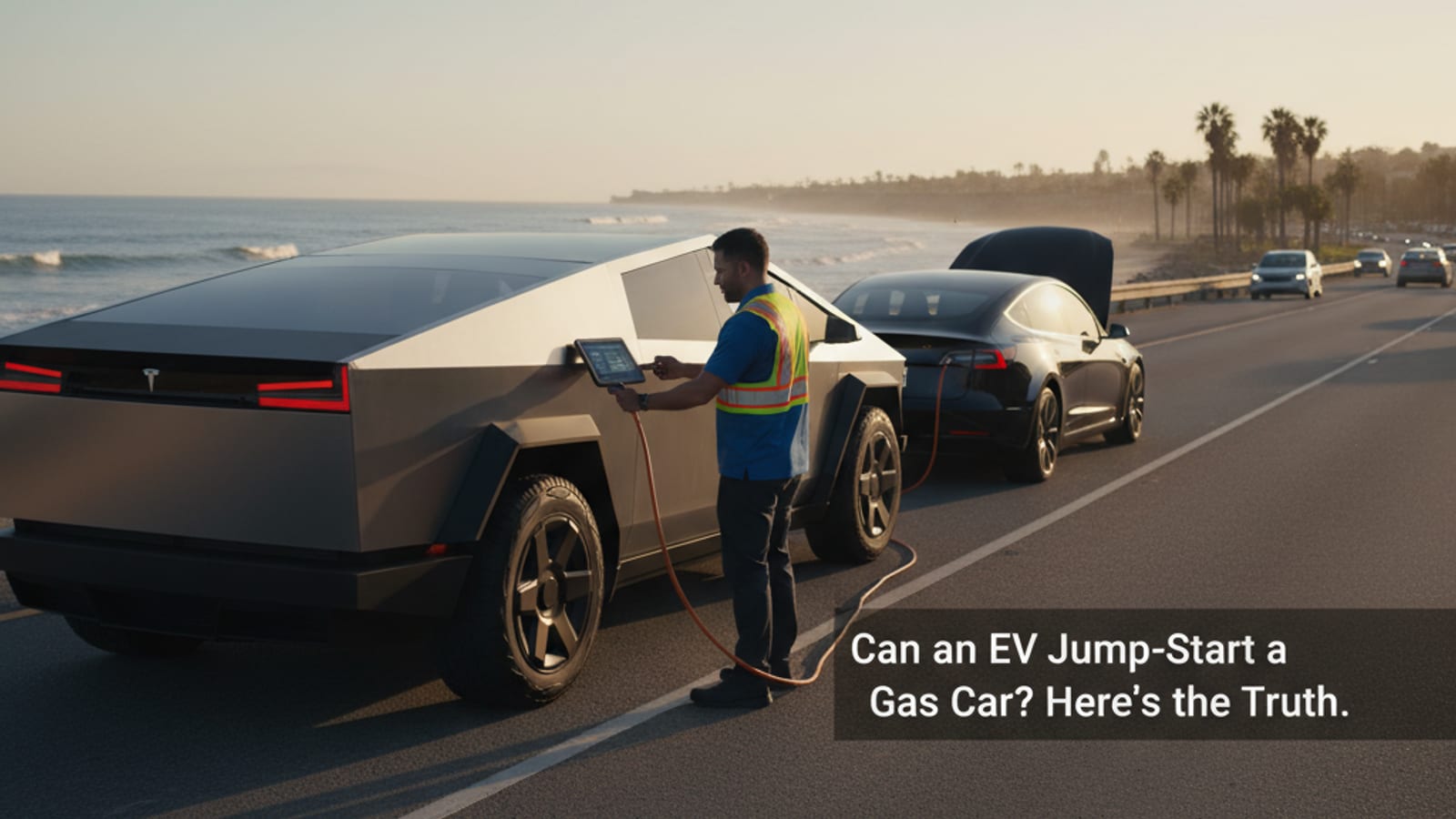
Your EV has two batteries, not one
Every EV around the District, Maryland, and Virginia carries two separate electrical systems. The high-voltage pack turns the motors, and the 12-volt battery wakes the computers. It also runs the lights, locks, and contactors in the cabin. A gasoline car uses that same 12-volt size to spin a starter. Your EV never asks the 12-volt to crank an engine. A DC-DC converter recharges the 12-volt once the car is awake.
That’s why a full traction pack can still leave you stuck. Screens stay dark, and door handles may not work. A Tysons garage sit can kill the 12-volt with the pack still full. WMATA lots and Dulles Economy parking show the same 12-volt fade after a trip. The same small battery is the only source jumper cables can tap. Those jumper cables never reach the traction pack at all.
A jump uses the 12-volt, not the pack
A jump doesn’t power the gas car’s engine. It only borrows current so the starter can turn. That current draw is short, and it’s severe. An EV 12-volt is built for modules and accessories. It isn’t built as a jump pack for a starter on the outer loop. Newer Teslas and some other EVs use a lithium 12-volt. Those units are lighter than a lead-acid starter battery. They may open a protection circuit under a starter load. They can also sag until your own car dies.
If your 12-volt dumps, you now have two disabled vehicles. One sits just off a live travel lane, and the other is yours. Tesla’s published support material generally advises against using a Tesla to jump another car. Confirm the current wording on tesla.com/support before you clip anything. Tesla-only steps are in can a Tesla jump-start another car. See the Tesla jump-risk notes for more.
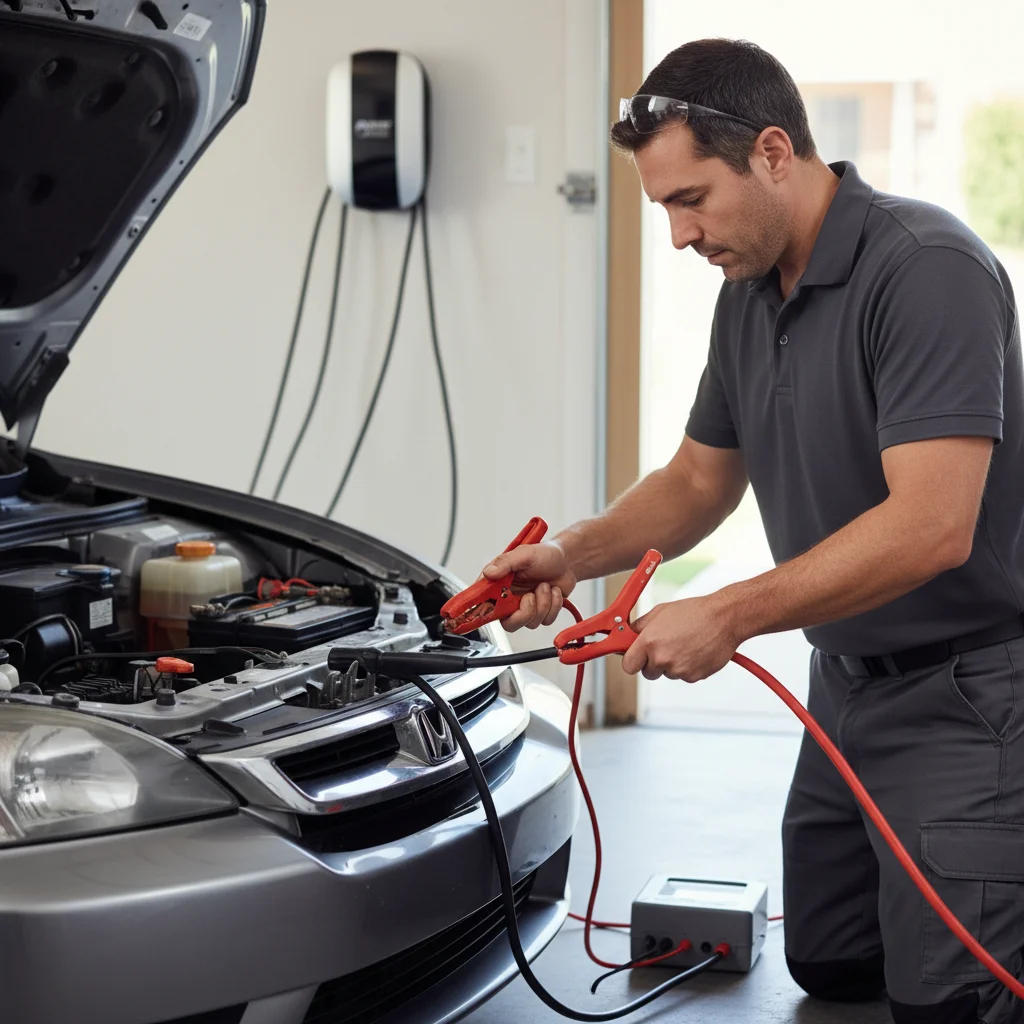
The Beltway is a poor place to try it
Shoulders on I-495 are narrow, and traffic is fast. The American Legion Bridge carries the Beltway between McLean and Montgomery County. It’s high, wind-exposed, and short on room to work. The Woodrow Wilson Bridge links Alexandria, Oxon Hill, and the District. A stall there sits in three jurisdictions at once.
On the 495 Express Lanes, pull to the left shoulder. Those lanes sit in the median, not on the right. Transurban and VDOT publish that left-side rule. Stay in the car until help arrives, per the published FAQs. On the 95 and 395 Express Lanes, pull to the nearest shoulder. Express Assist is a free roadside patrol on those lanes. It helps with minor mechanical trouble and will call a tow. It doesn’t tow, and it doesn’t charge an EV. That patrol fits a dead gas 12-volt better than your cables do.
Who actually jump-starts gas cars on I-495
Maryland’s CHART Emergency Traffic Patrol jump-starts stalled cars. Technicians also change tires and bring about one gallon of gas or radiator water. On I-495, I-270, US-50, and MD-295, dial #77. That’s the published motorist line for those state primary roads.
Virginia’s Safety Service Patrol covers interstates including I-66. Drivers reach that help through Virginia 511, not a jumper pack. VDOT’s published pages describe incident clearance, debris, and short-term traffic control. They don’t describe charging an EV at the scene. They also don’t tell you to use another driver’s Tesla as a jump box.
No DDOT motorist-assistance patrol turned up for the District. Drivers in the District rely on MPD or a private roadside plan. On the parkways, US Park Police handle disabled vehicles. On the Baltimore-Washington Parkway, call US Park Police at 202-610-7500. George Washington Memorial Parkway follows the same NPS pattern. So do Clara Barton, Rock Creek, and Suitland Parkway. Shoulders are narrow or missing on those parkways. Commercial vehicles and trucks over 10,000 lb are banned. A jumper-cable session belongs there even less than on the Beltway.
Pepco serves the District, Montgomery County, and Prince George’s County. Dominion Energy Virginia covers most of Northern Virginia. NOVEC covers parts of Loudoun and Prince William. None of the utility EV pages we reviewed offer a stranded-car charging service.
Maryland, Virginia, and DC disabled-vehicle rules treat an EV like any other stopped car. None of the three codes we reviewed has a special out-of-charge section. If you’re stopped on the shoulder with cables in your hands, you’re a disabled vehicle. Get the cars out of the live lanes.
If your EV is the one that dies
A failed jump can flatten your own 12-volt. Then the rescue you need isn’t a gas-car crank. Independent operators we connect you with jump or replace a dead 12-volt on site. They also handle Tesla and every major EV brand. If the traction pack is low, they bring a 240-volt Level 2 source. It uses a native NACS plug, or a CCS or J1772 adapter. Typical charging time is 15 to 30 minutes. That usually adds about 10 to 20 miles of range. That’s time on the plug, not an arrival time.
If you’re empty on the loop, read out of charge on the Capital Beltway. If you’re already in the median lanes, pull left, then call. To wake your own 12-volt without guessing, use how to jump start an EV. You can also request a Tesla 12-volt jump.
Charge Pro DC is a referral line for stranded EVs. We match stranded EV drivers with local mobile rescue operators. We don’t own trucks, and we don’t employ technicians. We don’t set prices, and we don’t promise an arrival time. The operator quotes you before work starts and bills you directly. Call (202) 629-0844 when your EV is the one that won’t wake.