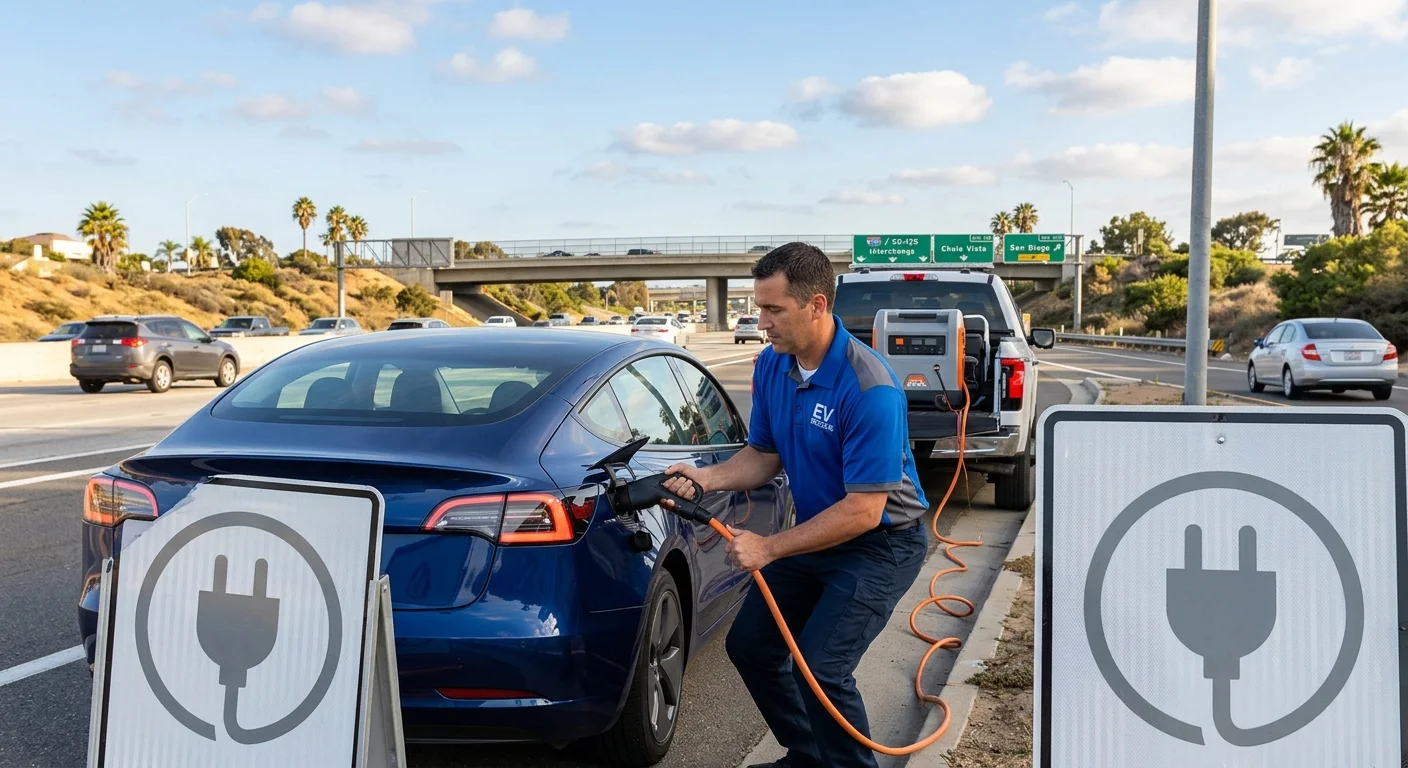
Your Alexandria EV is waiting on a public charger. You still can’t make the next stop. EV roadside assistance is the local backup. Charge Pro DC is a referral line. We match stranded drivers with independent local operators. Those operators bring a 240-volt Level 2 source to the car. A lot of owners here rent or park on the street. A home plug was never part of the commute.
Why so many Alexandria drivers live without a home plug
Alexandria is an independent Virginia city, not a Fairfax County neighborhood. It sits with Arlington in the dense inner core. That core has the highest apartment share in the metro. Census ACS 2019-2023 figures put the city at 156,788 people. About 60.6% of housing here was built before 1980. Older walk-ups and rowhouses rarely came with a dedicated EV circuit.
Old Town parking is on-street or in structured garages. Landmark and the Van Dorn area work the same way for many renters. The Eisenhower Avenue corridor is long-dwell parking, not a driveway wall box. If you live here, public charging is often the overnight plan. A stall wait still matters because home isn’t a Level 2 fallback.
Dominion Energy serves Alexandria. Named programs include Schedule 1EV, the Off-Peak Plan, and EV Charger Rewards. None of those pages describe charging a car that’s already stranded. Confirm current program details on Dominion’s site before you plan around a rate. The utility won’t roll a truck to Duke Street for an empty pack.
A charger wait is a range problem
A listed stall isn’t a promise you’ll plug in. Check live status in your car’s app, or in Tesla’s current official tools if you drive one. A pin you saved last month isn’t a live stall. Access notes and session errors change. Charge Pro DC doesn’t run those sites and doesn’t confirm Tesla’s listings.
If the queue is long, compare that wait with the energy on the dash. Sitting with climate control on burns charge without covering miles. Humid summers here make AC the default. Idle drain is real even when the car isn’t moving.
Don’t keep hunting another stall on US-1 or Duke Street because a map pin looks convenient. Compare the full driving route with the remaining energy the car shows. Include the garage entrance, not only the pin. If the margin can’t absorb a wrong ramp, stop. Searching until zero makes the roadside job harder.
Keep two currently listed sites you can actually evaluate. Then pick the remaining percent where you stop driving and request help. Set that number while you still have choices. A passenger can read the listing while you watch traffic. If you’re alone, park legally before you handle the phone. If traffic is an immediate danger, call emergency services first.
The U.S. Department of Energy’s EV resources are background only. Live station facts still come from the tool in your car. For the city overlay, see EV charging in Alexandria.
Old Town, Landmark, and the Wilson Bridge are different stops
Start with where you actually stopped. Alexandria is compact on a map and messy on the ground. Old Town garages, Landmark and Van Dorn, Eisenhower Avenue, and INOVA Alexandria Hospital are different access problems. A dropped pin beats saying you’re somewhere in the city.
If you’re near a freeway, share direction of travel and the nearest mapped exit. The corridors that matter here are I-395 and the I-495 Capital Beltway. US-1 (Richmond Highway) and Duke Street (VA-236) cut through town. The George Washington Memorial Parkway runs the river edge. An operator can’t tell an I-395 shoulder from an Old Town garage without those details.
Old Town also floods on high Potomac tides. Stormwater can leave cars sitting in water. If the car has been in standing water, say so. Don’t try to drive out on a guess. Describe what you see and stay out of the water.
The Woodrow Wilson Bridge carries the Beltway across the Potomac. The span meets Alexandria, Oxon Hill in Maryland, and the District. A stall there sits at three jurisdictions. Rules, responders, and towing authority can change at the river. If that’s your stop, don’t walk for help on the span. Read dead EV on the Woodrow Wilson Bridge first. Stay with the car when the shoulder is narrow.
On the 395 Express Lanes, pull to the nearest shoulder. Transurban’s Express Assist patrols those lanes. Published FAQs say it helps with minor mechanical issues and will call a tow. It doesn’t tow. Published material doesn’t describe EV charging. Stay in the car until help arrives.
The George Washington Memorial Parkway is an NPS road. Commercial vehicles and trucks over 10,000 lb are banned. Shoulders are narrow or missing. Report a disabled vehicle on an NPS parkway to the US Park Police at 202-610-7500.
VDOT’s Safety Service Patrol covers Virginia interstates. Drivers reach it through Virginia 511. Published material describes incident and debris clearance and short-term traffic control. It doesn’t describe EV charging. Maryland’s CHART patrol is for Maryland roadways. It doesn’t cover the Alexandria side of the Wilson Bridge.
If you left the car at Reagan National, those long-term garages sit in Arlington. A week of sitting is often a 12-volt story, not an empty pack.
Empty pack, or a 12-volt that won’t wake the car
Not every dead EV in this city is out of traction charge. A car that sat in an Old Town garage can refuse to wake. The same happens at INOVA and other long-dwell lots. The 12-volt battery may be flat. The dash may stay dark. Doors may not unlatch the usual way. The charge port may ignore the handle.
Don’t guess which battery failed. Read the exact message on the screen, if there is one. Note whether the car powers on, shifts, or opens the port. Operators in the network can jump or replace a dead 12-volt on site. They also handle Tesla and every major EV brand.
If the high-voltage pack is simply empty, a mobile 240-volt visit is the usual path. The pros we send bring a Level 2 source to the car. Tesla owners get a native NACS plug. Other EVs use a CCS or J1772 adapter. A typical session adds about 10 to 20 miles of range. Charging time is usually 15 to 30 minutes. That’s charging time, not an arrival time.
Start with EV roadside assistance if you need the referral. Use mobile EV charging when the car is safely accessible and needs energy. What to do after an EV stall in Alexandria covers the first minutes after you stop.
Some stops need transport instead of a curb charge. Access, warnings, and the vehicle decide that. The independent operator should say so after looking at the car. Use out-of-charge recovery when charging at the roadside isn’t the fit.
Don’t guess how much energy an operator can add. Don’t guess how long the work will take. Those details depend on the operator, the car, the equipment, and the stop. Confirm the proposed service and the price with the operator before you agree.
What to share so the quote matches the stop
Clear facts help the operator quote before any work starts. Charge Pro DC doesn’t set prices and doesn’t bill you. The operator quotes you, then bills you directly. Our mobile EV charging quote page explains that handoff.
Share your dropped pin, direction, and nearest exit or garage name. Mention any gate, height bar, flood water, or tight ramp you can see. Add the make and model if you know them. Include the remaining percent shown by the car. Copy the exact warning text instead of paraphrasing it. Say whether the car powers on and shifts. Say whether the charge port opens, and whether a connector is already attached. Describe what happened on the last charging attempt. Tell the operator whether you need enough energy to reach a verified stall, or another option.
Send a photo if the operator asks. Include the full warning. Don’t touch damaged charging equipment to get a better shot. If occupants aren’t in a safe spot, say that first.
Arlington, Springfield, Annandale, and Oxon Hill sit on the same inner-core pattern. Stay on the Alexandria pin if that’s where the car is.
When this backup is the better call
Call when you can’t confirm a usable public stall you can actually reach. Call when a session won’t start and more driving is a bad bet. Call when the car won’t wake in a garage. You may need a 12-volt check on site. We connect you with licensed, independent local operators. We don’t own trucks, and we don’t perform the work.
Call (202) 629-0844 and we’ll connect you with a local EV rescue operator.