Your EV just lost drive on the George Washington Memorial Parkway. The shoulder is thin or gone. This is a US Park Police stop, not a normal interstate breakdown. Commercial vehicles and trucks over 10,000 lb are banned on this National Park Service road. That ban changes who can legally reach you.
This parkway is not a Virginia interstate
VDOT’s Safety Service Patrol covers Virginia interstates such as I-95 and I-66. You reach that help through Virginia 511. VDOT published material describes incident and debris clearance and short-term traffic control. It doesn’t describe charging an empty EV.
You’re not on those roads. The George Washington Memorial Parkway is a National Park Service parkway. So are the Baltimore-Washington, Clara Barton, Rock Creek, and Suitland Parkways. They’re limited-access scenic roads with narrow or absent shoulders.
Maryland’s CHART patrol is a different agency. Dial #77 for a breakdown on SHA primary roads. That list includes I-495, I-270, US-50, and MD-295. CHART can change a tire, jump a starter, or provide about one gallon of gas. It doesn’t list charging an empty EV. If the signs still say George Washington Memorial Parkway, start with Park Police.
The District has no DDOT motorist-assistance patrol. DC drivers rely on MPD, private roadside plans, and Park Police on the parkways.
A disabled vehicle on the Baltimore-Washington Parkway goes to US Park Police. The published number there is 202-610-7500. Confirm the current Park Police contact for this parkway. Check the NPS George Washington Memorial Parkway pages, or ask the officer. If anyone is in immediate danger, call 911 first.
There’s no separate out-of-charge law in the District, Maryland, or Virginia. The ordinary disabled-vehicle rules apply to an EV the same as any car. Follow the officer.
Why an EV dies here with no room to wait
This stall isn’t proof you missed a charger. Charging-station inventory for this corridor was not verified for this page. Don’t plan around a guessed next plug.
What this parkway does have is limited access. You can’t casually turn onto a side street. Once you’re on it, you’re committed until an interchange. The pavement leaves little space to sit and think.
Two failures look the same from the driver’s seat.
One is an empty traction pack. The dash shows a low percent or zero miles. Cabin heat or AC while you sit still burns range without covering distance. That’s the Beltway-gridlock problem, then a parkway you can’t easily leave. You entered already short, and the last miles disappeared.
The other is a dead 12-volt or low-voltage battery. The car won’t wake. Doors act odd, or the screen stays dark. The high-voltage pack can still hold energy. Independent local operators can jump or replace a dead 12-volt on site. They handle Tesla and every major EV brand.
Copy the dash. Don’t rewrite it as a story. Note the percent, the estimated miles, and any low-voltage wording. Say whether the car still selects drive, steers, or holds park. Don’t test those things if the test puts you in a lane. Use the brand app if it still connects. A missing app reading isn’t a diagnosis. Report the last update time you actually saw.
Tesla tells owners to request roadside through the Tesla app. Tesla also says availability can be restricted for safety or regulatory reasons. A commercial-truck ban on an NPS parkway is that kind of limit. An in-app ticket doesn’t override Park Police.
Dominion Energy Virginia serves most of Northern Virginia. Pepco serves the District, Montgomery County, and Prince George’s County. No utility EV page reviewed for this metro offers a charge for a stranded car. Don’t wait on the power company.
If you were heading toward Arlington or Alexandria, name that destination. Then name the parkway sign beside you now.
What Park Police need, and what the operator needs
Park Police care about the hazard. The operator cares about the car.
For Park Police, lead with place and people. Say George Washington Memorial Parkway, not a guessed local road. Add northbound or southbound. Add the nearest named interchange, overpass, or park sign you can actually read. Don’t invent a mile marker you can’t see. If your map pin and the roadside sign disagree, send both. Say which side you’re on. A pin can still send help across the median. Mention a barrier, closed ramp, or drop-off when you can see it.
Stay out of the travel lanes if the car is already clear. If it isn’t, tell Park Police before you try another move. This page can’t tell you to climb out, stay seated, or roll forward. If anyone is in immediate danger, call 911. Then follow the responding officer.
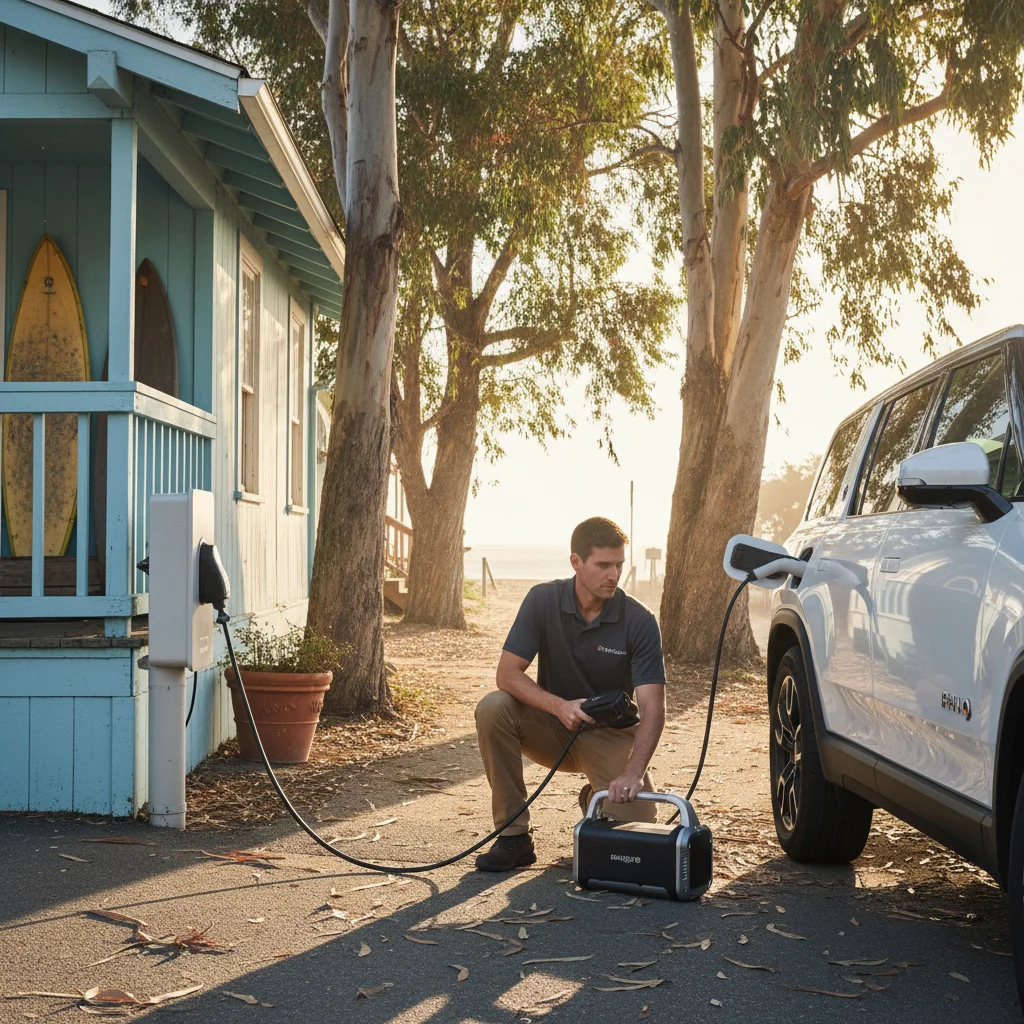
For the operator, add the vehicle. Give make, model, year, and the exact dash text. Tesla uses a native NACS plug. Other EVs may need a CCS or J1772 adapter. Ask the matched operator to confirm connector fit before anyone rolls. Not every mobile unit matches every car.
Say whether the charge port still opens. Say which side the port is on. Mention locked doors, a missing key, collision damage, or a wheel that won’t turn. Those details can force a wrecker instead of a plug. Don’t roll the EV just to make workspace. Wait unless the officer or the operator directs you.
Charge Pro DC doesn’t diagnose the car. It doesn’t send its own truck. It matches you with an independent local operator. That operator quotes you before starting and bills you directly.
EV roadside assistance is the referral path when you need a local pro. A clear scene report is what makes the next step real.
The 10,000 lb ban decides charge versus tow
This is the constraint people skip. The National Park Service bans commercial vehicles and trucks over 10,000 lb here. A mobile rescue rig is often a commercial truck. A wrecker usually is too. Park Police decide who may enter and where they may stand.
A perfect pin doesn’t prove a charger van can stop beside you. Tell Park Police, and the operator, how the last stretch looks. Live travel lane versus a scrap of shoulder. Nose in or nose out relative to any opening. Room at the charge port, and which side that port sits on.
Don’t tell the officer a charging truck is coming until two things are true. An operator has accepted the job. Park Police have a path for that vehicle. The referral line can’t authorize a commercial truck on park land.
Ask the operator on the quote call about access. Ask whether their unit can work this NPS road under the weight ban. Ask where the equipment would have to stand. Ask whether a tow off the parkway is the cleaner recovery. Charge Pro DC doesn’t decide those points. Park Police and the operator do.
If a mobile EV charge can happen where you sit, ask about output. Operators typically add about 10 to 20 miles of range. That takes about 15 to 30 minutes of charging. That’s plug time, never a promise of when someone arrives. Don’t assume those miles will finish your whole trip. Name the next stop with the operator. Home, work, or a plug you verified yourself. This page won’t guess a nearby station.
A tow enters when the car won’t accept a charge. It also applies when Park Police won’t allow a service truck to stop. The tow provider should confirm load method, destination, and price. Confirm the current rate with the yard before you pay. Charge Pro DC doesn’t set those terms. Ask the wrecker to confirm a load method that protects the motors and drivetrain. The wrecker, not the referral line, has to confirm that method.
Compare mobile EV charging or a tow when access is already settled. On this parkway, the truck ban comes first.
If the signs don’t say George Washington Memorial Parkway
The American Legion Bridge carries the Capital Beltway across the Potomac. It runs between McLean, Virginia, and Montgomery County, Maryland. Both that span and this parkway have limited shoulder. The bridge is still I-495, not an NPS parkway. Different agencies can apply. If that’s the deck under you, use the McLean EV roadside guide.
The Woodrow Wilson Bridge carries the Beltway across the Potomac. It sits between Alexandria, Virginia, Oxon Hill, Maryland, and the District. A stall there meets three jurisdictions at once. Use the Woodrow Wilson Bridge EV guide if that’s your span.
The 495 Express Lanes sit in the median. Published guidance there is to pull over to the left shoulder. Express Assist is a free roadside patrol on those lanes. It helps with minor mechanical issues and will call a tow. It doesn’t tow, and it doesn’t charge an EV. If you’re in those lanes, follow that playbook, not this one.
The Baltimore-Washington Parkway is a sister NPS road. It has the same truck ban and the same thin shoulders. If the signs say Baltimore-Washington, use that page. The published Park Police number there is 202-610-7500.
I-66 is a Virginia interstate with VDOT Safety Service Patrol coverage. In Northern Virginia, the I-66 corridor is covered. It isn’t an NPS parkway. Don’t mix that script with this one.
Call when you need a quoted local operator
Call when the EV has stopped on this parkway. Ask for a quoted charge or a quoted tow. Charge Pro DC is a referral line. It matches stranded EV drivers with independent local mobile rescue operators. It doesn’t perform the work. It doesn’t own trucks or equipment. It doesn’t employ technicians. It doesn’t set prices. It doesn’t promise an arrival time. The operator quotes you before starting and bills you directly.
Stay with the car. Keep Park Police in the loop. Then call (202) 629-0844 and we’ll connect you with a local EV rescue operator.