A low traction-battery warning calls for the current on-screen direction, a check of reachable charging, and an early decision about roadside help. It is not automatically a low-voltage battery failure. Read and save the exact message before choosing what to do.
Read the message, not the battery icon
A warning about low traction charge is not the same as a low-voltage alert. Drivers often shorten several different messages to “low battery.” That shorthand can send roadside help toward the wrong problem.
A message about low traction charge is about driving range. A message that explicitly mentions low voltage is about the 12 volt accessory battery. Treat those as separate possibilities until the Tesla or a qualified operator confirms more.
Don’t infer the cause from the battery icon alone. The active on-screen message is the first instruction to read. If the screen offers more detail, review it while safely parked. Follow the action it gives instead of relying on an old forum post or another driver’s experience.
If you are safely parked, photograph the complete message. Include any heading, supporting text, and visible symbols. Do not crop away details that may change the operator’s assessment.
For background on the 12 volt side of this, our Tesla 12 volt failure symptoms guide covers the early warning signs. For the 12 volt jump itself, our Tesla 12 volt battery jump service page describes what the operator brings.
Beltway and I-95 gridlock drain range without covering miles
The Beltway crawl and the I-95 spine through Prince William burn Tesla range without covering miles. Cabin heat on a cold night in the I-66 corridor, AC on a hot afternoon in the Anacostia Freeway, and stop-and-go on I-270 toward Gaithersburg all push the pack down while the odometer sits still.
A typical EV keeps about 80 percent of range at freezing and about 70 percent at 20F, so most lose 20 to 35 percent in real cold. Heat pumps help. Cars with a heat pump average about 83 percent retained range versus about 75 percent without. The cabin heating load is the main reason, since an EV must produce that heat from the battery.
The January 2022 I-95 shutdown near Fredericksburg is the region’s clearest example of how a stationary spell can leave a driver stuck for over 36 hours after about 14 inches of snow and a multi-truck crash. Stationary time is the real range problem across the metro, not distance.
The Beltway (I-495) and the 495, 95, and 395 Express Lanes carry the heaviest stationary spells. On the 495 Express Lanes, the lanes sit in the median, so a stopped EV pulls to the left shoulder. On the 95 and 395 Express Lanes, drivers take the nearest shoulder and stay in the car until help arrives. Express Assist on those lanes is a free patrol for minor mechanical issues. It will call a tow but does not tow.
Stretch the last range before the car stops
Once the warning fires, every choice about cabin load matters.
Turn off the cabin heat or AC if the weather allows. A Tesla Model 3 or Model Y with the heat pump off will lose less range per mile than one with the heat blasting. If it is freezing, drop the cabin set point rather than turning the system off entirely.
Drop speed. Highway speed is the single biggest range consumer. Dropping from 70 mph to 55 mph can stretch a low pack by 10 to 20 percent, depending on the car and the wind.
Avoid Sentry Mode if you have to stop. Sentry Mode draws from the 12 volt, which the DC-DC converter then tops up from the high-voltage pack. That conversion has losses. With Sentry off, more of the pack stays available for driving.
Precondition the cabin before you leave home, not while you drive. A warm battery holds range better than a cold one. If you can plug in overnight, the car starts every morning with a full pack and a preconditioned cabin.
If the message says to stop or restricts driving, do not continue merely to test the remaining distance. The car is telling you something. Treat that as a hard signal, not a suggestion.
Check whether a reachable charger remains
“Nearby” and “reachable” do not always mean the same thing. A straight-line distance on the map is not the same as the route you have to drive. Review the entire route before moving. Confirm that the charging location is accessible from your travel direction. Check the charging provider’s current status information. Also confirm that the location and equipment fit your Tesla.
Public charging around the region is uneven. Garage and surface-lot chargers in Bethesda, Silver Spring, and Rockville are well-distributed. Western Prince William and Loudoun have fewer chargers per square mile. A driver heading toward Leesburg or Gainesville needs to plan the route with the current station status, not with a pre-saved map pin.
If the car has already stopped, do not try to create distance by repeatedly moving it. Read our Tesla low battery guidance before choosing between mobile help and transport.
Know when mobile charging fits
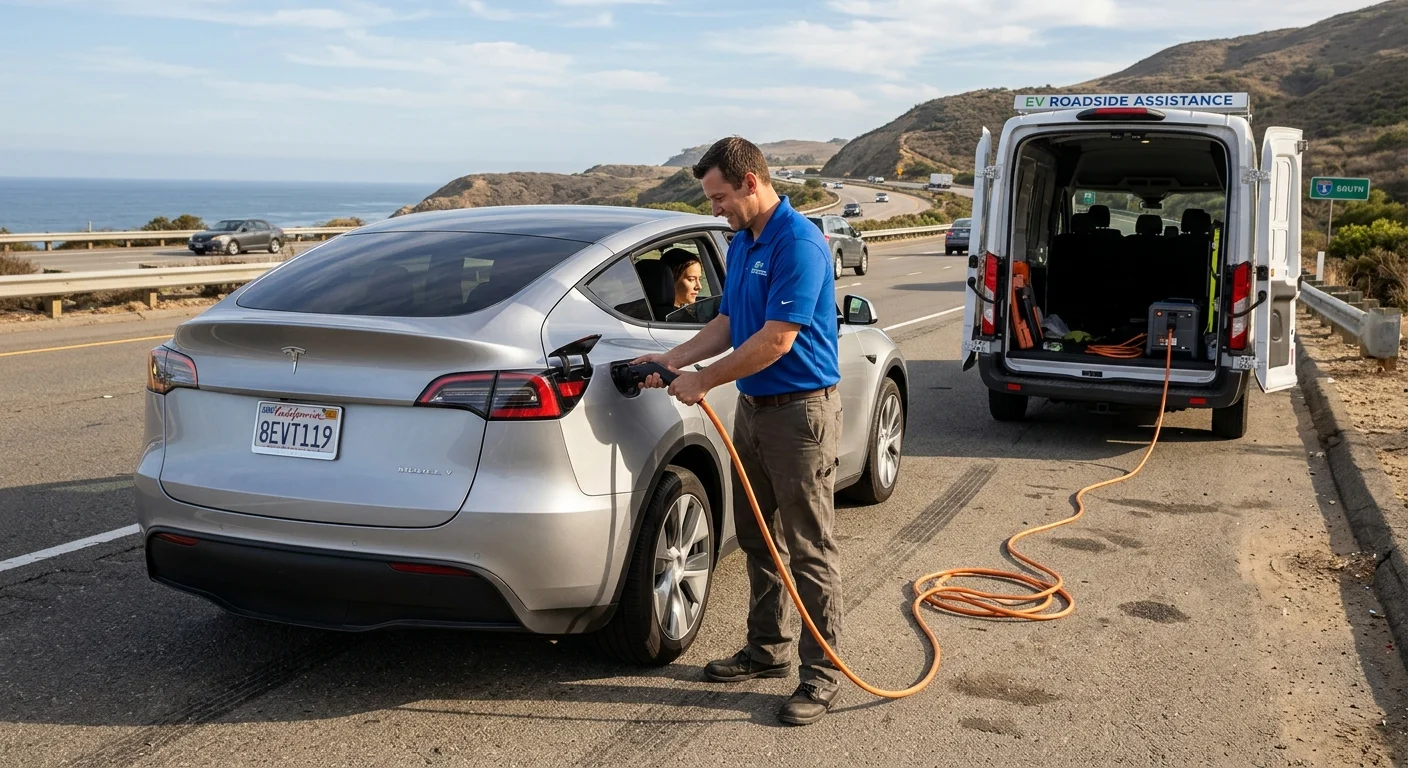
Roadside charging may fit when the Tesla is safely located and a local operator confirms that compatible service can be provided there. It is not the answer for every low battery warning. The vehicle state, site access, equipment, and the operator’s assessment all matter.
Tell the operator exactly where the car sits. Include its model, model year, displayed charge, complete warning text, and whether it can be moved. For a parking structure, share the level, entrance, gate instructions, and clearance limits. For a highway location, provide the route, direction, nearest exit, and visible landmark.
Ask what outcome the operator proposes. That may involve on-site charging, moving the vehicle toward charging, or arranging transport. Confirm the equipment and connector the operator plans to use. You should also confirm pricing, payment terms, and any warranty directly with that independent operator.
Our out-of-charge EV recovery service covers the standard mobile charge call. The operator brings a 240 volt Level 2 source. Fifteen to thirty minutes of charging adds 10 to 20 miles of range. That is charging time, not an arrival promise.
For Bethesda and Silver Spring drivers, our Bethesda EV roadside assistance page covers local dispatch. Rockville drivers have a separate page at Rockville EV roadside assistance. For the Dulles corridor, our mobile Tesla charging at Dulles Economy covers the airport long-stay pattern.
Know when transport may be the right call
Transport may be the better path when the screen restricts driving, no safe working area exists, or an operator cannot provide compatible charging at the location. It may also be considered when the Tesla will not accept a charge or cannot be moved safely.
That decision does not diagnose the main battery. A car that will not continue could present more than one issue. If you see both low-charge information and a separate low-voltage message, share both. Do not discard one because the other seems more familiar.
For Tow considerations specific to Teslas, our tow a Tesla with no power in DC, Maryland, and Virginia post walks through the towing constraints by model.
Charge Pro DC covers the District, Maryland, and Virginia. We connect you with independent operators. For a quote before work starts, call (202) 629-0844.
Frequently asked questions
How much warning does a Tesla give before the traction pack runs out?
It varies. Tesla’s warning system is conservative by design. Some drivers see a low-charge message and still have enough range to reach a charger several miles away. Others hit the wall within a few miles. What determines the gap is how the car was driven in the hours before the warning. Beltway crawl, I-95 gridlock, cabin heat or AC, and speed all compress the remaining range.
What is the difference between a low traction warning and a low voltage warning?
A low traction warning is about the high-voltage pack that drives the wheels. A low voltage warning is about the 12 volt accessory battery. The two call for different fixes. A mobile EV charge addresses the traction pack. A 12 volt jump or replacement addresses the accessory battery. Read the exact wording on the screen and share it with the operator before anyone decides which truck to send.
Does turning off Sentry Mode help when the pack is low?
Yes, a small amount. Sentry Mode draws from the 12 volt, which the DC-DC converter then tops up from the high-voltage pack. With Sentry Mode off, more of the pack stays available for driving. The savings are modest compared with dropping speed and turning off cabin heat, but every bit helps when the warning has already fired.
Can a mobile operator reach me on the Beltway or I-95 shoulder?
If you can stop safely. Get as far right as you can, set hazards, and stay clear of traffic while you call. Share your travel direction and the nearest exit. On the 495 Express Lanes, the lanes sit in the median, so the safe shoulder is on the left. The matched operator will confirm a safe reachable spot before any work begins.