Today’s Tesla charge lasts as far as the screen still says you can go. Sitting still on the Beltway or I-95 burns range without covering real distance. Heat or AC keeps drawing from the pack while you barely move. A published model range is a poor daily plan in this metro.
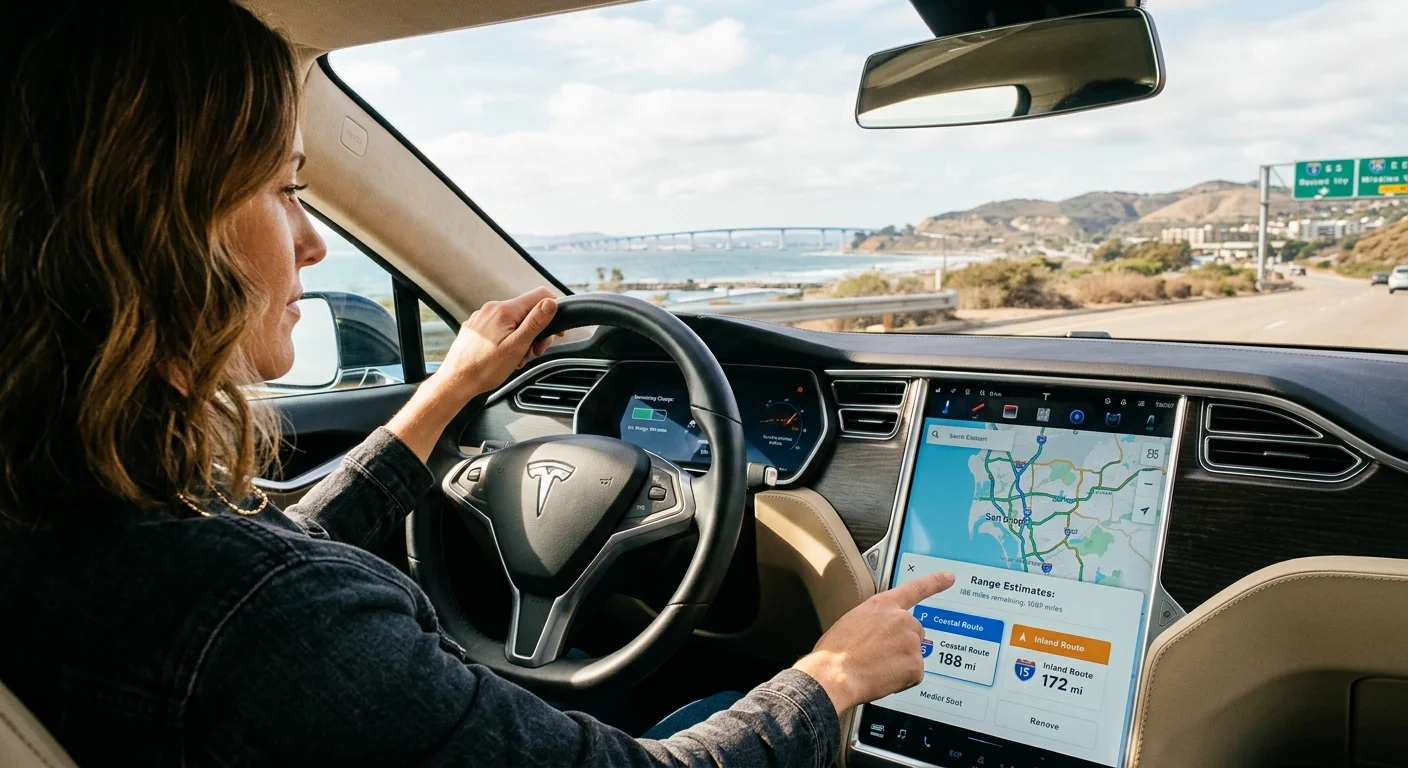
Daily leftover miles aren’t pack lifespan
People search “how long does tesla battery last in a day” and mix two problems. One is leftover range for today’s driving. The other is how long the high-voltage pack stays useful over years.
Today’s answer lives on the display in front of you. Percentage and estimated distance describe this charge, not the next decade. A low commute doesn’t prove the pack is worn out. A lifespan article doesn’t tell you if I-270 still works after a standstill.
Read how long Tesla batteries last by 2026 in this climate when you’re asking about ownership. Use this page for the commute that’s still ahead.
Start with the car you actually drive. Recheck the percentage and estimated distance after you add a stop or change the route.
Use the estimate as a plan, not a promise
Treat the displayed number as a planning input. It isn’t a guarantee. A range copied from a review or another Tesla setup may not match your car. Tesla publishes model specs, and those specs still aren’t today’s remaining drive.
Build the day around the route in the car now. Count the outbound commute, local errands, and the trip home. Count the last stretch to wherever you intend to plug in. Ending at a home 240-volt charger is a different day. Street parking after a late return is another.
The U.S. Department of Energy publishes charging-level guidance. Level 1 uses 120-volt AC. It adds about five miles of range per charging hour for a midsize EV. Level 2 uses 240-volt power and adds about 25 miles per charging hour. Actual speed still varies with pack size, charge level, and temperature. Those figures explain plug type. They don’t set today’s range.
If the estimate is already tight, change the plan while options remain. Drop a stop. Aim for a compatible charger you can still reach. Or arrange a quoted mobile top-up before the pack hits empty.
Idle time is part of the commute here
The distinctive drain in this metro isn’t a mountain pass. It’s stop-and-go on roads that look short on a map.
The Capital Beltway, I-495, loops the District through Maryland and Virginia. I-95 through Prince William stacks the same crawl toward Woodbridge and Dale City. I-66 slows inside the Beltway in peak hours. I-270 toward Germantown and Rockville adds real climbs. The land rises from the tidal Potomac toward the Piedmont.
This site has no verified universal penalty you can subtract for traffic. Don’t invent one. Watch the estimate as the car sits. If it falls while you’re barely moving, believe the car.
Cabin heat and air conditioning come from the traction pack. An EV doesn’t have engine waste heat to steal. A winter morning with the heat on spends charge on comfort, not distance. That’s the I-95 standstill problem. A humid stretch above 90F does the same with cooling.
How heat, ice and Beltway idling wear an EV battery covers long-term wear. The daily point is simpler. Idle time belongs in the commute math here.
The hard regional reference is the January 2022 I-95 shutdown. About 14 inches of snow and a multi-truck crash closed roughly 50 miles near Fredericksburg. That’s just south of this service area. The road closed the evening of January 3 and reopened the evening of January 4. Hundreds of drivers sat overnight for more than 36 hours. A milder version shows up any time Beltway traffic stops with the heat on.
Cold mornings hit harder west of the District
The metro sits on the fall line. Summers are hot and humid, with stretches above 90F. Winters swing from mild to sudden ice.
Dulles International runs colder and snowier than Reagan National. That’s a real local split. Loudoun, upper Montgomery, and Prince William see more snow and harder freezes. The District and the inner Virginia core often stay milder. A Model Y leaving Ashburn or Leesburg on a 20F morning feels that split. A Model 3 leaving a Northwest DC garage often doesn’t.
A Recurrent Auto study of more than 30,000 EVs found typical winter loss. A typical EV keeps about 80% of range at freezing, 32F. It keeps about 70% at 20F. Most lose 20 to 35% in real cold. Cabin heating is the main cause. Those figures come from that fleet study. Don’t treat them as Tesla.com specs.
Use them as a reason to recheck the in-car estimate on a cold morning. Don’t subtract a homemade percentage and call it exact.
Map the corridor you actually drive
Write the day’s destinations in order. Then name the roads between them.
A Rockville trip into the District lives on I-270 and the Beltway. A Dale City run lives on I-95. An Arlington or Alexandria hop can still lose time on the Woodrow Wilson Bridge. A McLean driver on the American Legion Bridge sits on a high, wind-exposed span. Shoulder room is limited. The Wilson Bridge carries the Beltway between Alexandria, Oxon Hill, and the District. A stall there sits in three jurisdictions at once.
The Baltimore-Washington Parkway and the George Washington Memorial Parkway are limited-access scenic roads. So are Clara Barton, Rock Creek, and Suitland Parkway. Shoulders are narrow or missing. Commercial vehicles and trucks over 10,000 lb are banned. Report a disabled vehicle on the Baltimore-Washington Parkway to the US Park Police. Check the current NPS parkway page for how to reach them.
On the 495 Express Lanes, Transurban’s published rule is to pull to the left shoulder. Those lanes sit in the median. On the 95 and 395 Express Lanes, pull to the nearest shoulder. Stay in the car until help arrives. Express Assist can help with minor mechanical issues and will call a tow. It doesn’t tow. Published material doesn’t describe charging an EV.
VDOT’s Safety Service Patrol covers I-95 and I-66 in Virginia. Drivers reach help through Virginia 511. Published material describes incident clearance, not EV charging. Maryland’s CHART patrol covers I-495, I-270, US-50, and MD-295. Dial #77 on those roads. CHART doesn’t describe EV charging either. We didn’t find a DDOT motorist-assistance patrol for the District. DC drivers use MPD, private roadside plans, and Park Police on the parkways.
None of the three codes we reviewed singles out an empty EV pack. Disabled-vehicle rules apply the same way they apply to any car. Your backup charger has to sit on the corridor you can still reach.
Where the car slept changes tomorrow’s charge
Daily range also depends on how the car spent the night. Many inner-core homes predate a wall charger. Census ACS 2019-2023 figures put Takoma Park at 90.0% pre-1980 housing. Washington is 70.3%. Ashburn is 3.1%. Apartment drivers in Arlington, Alexandria, the District, and Silver Spring often lack a home plug. Pepco, Dominion, and NOVEC don’t publish a stranded-car charging service.
MWAA publishes complimentary EV charging at Reagan National. It’s on Level 1 of Parking Garages 1 and 2. There’s no EV charging in the Dulles Economy Lot, Terminal Lot, or Valet. A week there is usually a 12-volt problem, not an empty pack. A Tesla that won’t respond after a long sit is a different problem. Share the exact warning with the operator.
Move while a charger is still in range
If the remaining estimate no longer supports the original route, stop adding destinations. Pick a compatible charger the car can still reach. Your EV is running low: save charge before you are stuck lays out that sequence. Out of charge on the Capital Beltway covers I-495. Out of charge on I-95 through Woodbridge and Dale City covers the Prince William crawl.
If no reachable charger remains, start arranging help. Charge Pro DC connects stranded EV drivers with independent local operators. We don’t charge the car, own trucks, or perform the work. The matched operator quotes you before starting and bills you directly.
Charging, a mobile top-up, or a move
If the Tesla still has usable charge and a reachable station, use it. If you can’t reach a station, ask about a mobile 240-volt top-up. The pros we connect you with bring a 240-volt Level 2 source to the car. They use a native NACS plug, or a CCS or J1772 adapter for non-Tesla EVs. They typically add 10 to 20 miles of range in 15 to 30 minutes of charging. That’s charging time, not a promise of when someone arrives.
Our out-of-charge recovery page explains the match. The Tesla roadside rescue page covers Tesla referral help. Ask the operator to explain price and payment before work starts. Charge Pro DC doesn’t set prices. You pay the operator directly.
When to call
Call when the remaining estimate no longer supports a safe trip to a reachable charger. Call when you need an operator to weigh a mobile top-up against a move. Call Charge Pro DC at (202) 629-0844. We’ll connect you with a local EV rescue operator.