Tesla Roadside is booked, and your car still won’t wake in Bethesda. EV roadside assistance in Bethesda doesn’t end with Tesla’s own queue. A local operator can jump a dead 12-volt in the garage. They can also add a 240-volt top-up on the Beltway shoulder. Charge Pro DC is a referral line. We match stranded drivers with independent operators. Those operators quote before they start and bill you directly.
Why Bethesda Teslas go quiet after snow and a long sit
Bethesda is an unincorporated community in lower Montgomery County. It’s not a city with its own motorist patrol. About 61 percent of the housing here was built before 1980. Older panels and shared garages limit fast home charging. Many Teslas in those buildings sit unplugged through a full workday. Then they face a cold start after dark.
The no-start pattern here is specific. Garage dwell, Beltway idle, and lingering snow stack on the same car. That stack is why a Tesla that was fine at noon won’t wake at 7 p.m. A car that started in the District can refuse a Bethesda driveway the next morning.
Bethesda runs a few degrees cooler than the District. Tree-lined blocks hold packed snow longer after a storm. Cabin heat comes straight from the traction pack. Recurrent Auto studied winter range across more than 30,000 EVs. A typical car keeps about 80 percent of range at freezing. It keeps about 70 percent at 20F. Heat-pump cars average a bit higher. Those are fleet figures. They aren’t Tesla’s published numbers. Sitting still with the heat on spends that reduced range without covering miles. That’s the Beltway problem in winter.
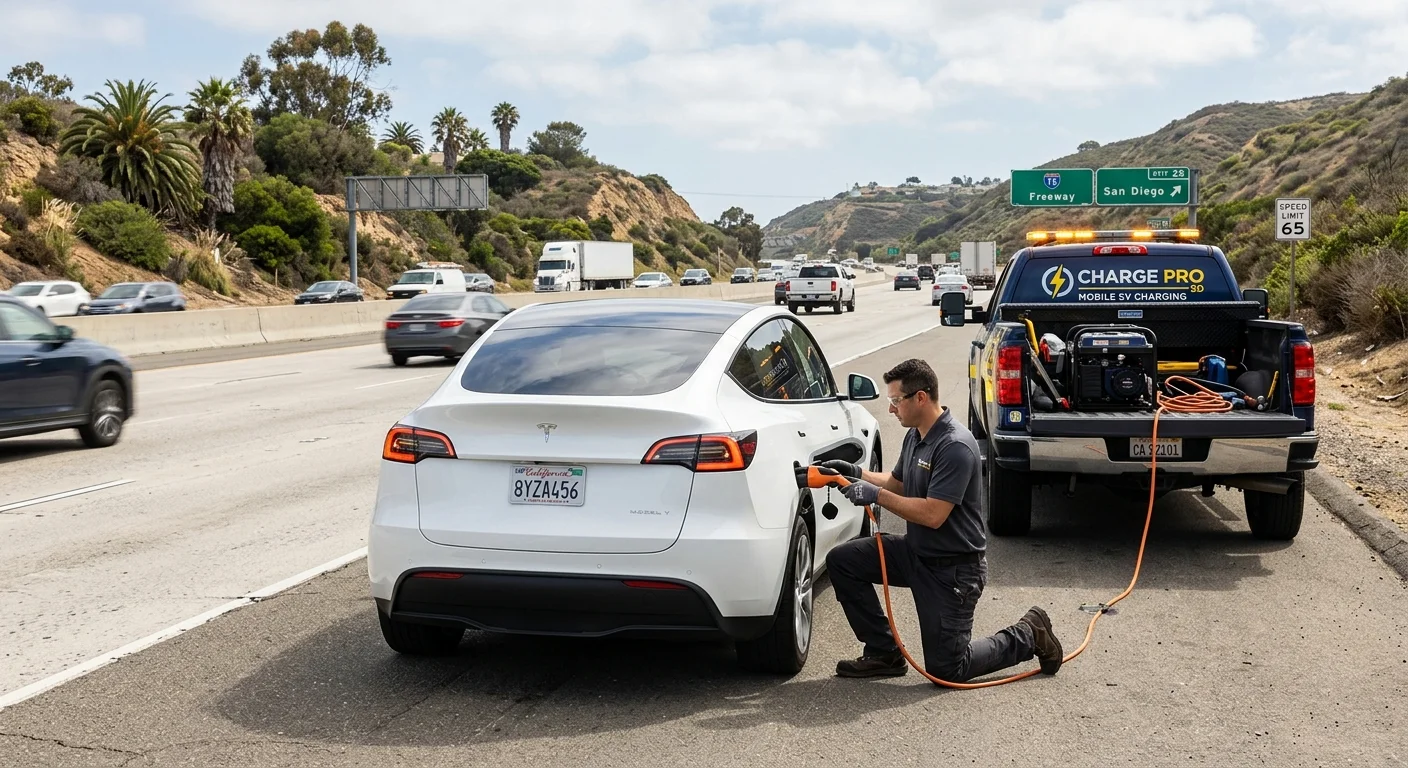
I-495 along the Bethesda frontage adds a drain that has nothing to do with trip length. Rush hour is often a crawl. Heat or AC in that crawl uses charge. The odometer barely moves. If you stall on the Beltway climb, the shoulder is narrow. Stay in the vehicle. Turn the hazards on. Don’t walk the travel lanes. A parked Tesla on that shoulder is a traffic hazard before it’s a charging problem.
Long-dwell lots make the 12-volt the weak point. Bethesda Row garages hold shoppers and diners for hours. The Metro garage holds commuters through a full shift downtown. NIH campus parking holds scientists and staff all day. So do Walter Reed National Military Medical Center and Suburban Hospital. Westfield Montgomery, still called Montgomery Mall by many locals, is another long sit. A 12-volt that rested for ten hours may not wake the computers. The main pack can still show range. The car still looks dead.
Pepco is the electric utility in Montgomery County. Pepco EVsmart helps some homes and multifamily buildings buy chargers. It doesn’t send a truck to a stranded car. If your house never got the panel work, you lean on public plugs on ordinary days. A mobile visit is the backup when the morning goes wrong.
What Tesla Roadside still does, and what it does not
Start in the Tesla app. That’s the official roadside request path. Tesla includes roadside help for a limited period on many new cars. Check the app for what you still have. Don’t assume a dispatch is included after that window.
When Tesla can send help, the job often goes to a contractor. An empty pack often ends as a tow. So does a car that won’t wake. The destination is usually a Tesla Service Center. That’s the right move for a failed high-voltage pack. It’s the slow move for a 12-volt that only needs a jump. It’s also slow when you only need a few miles. Those miles get you to a charger you already planned to use.
A booked Tesla Roadside slot doesn’t add energy. It doesn’t close contactors. It leaves you in the garage or on the shoulder. The queue stays full. Request Tesla’s help if you want the service-center path. Then call a local operator if the car needs to move now. You can keep both requests open until someone is actually assigned.
Charge Pro DC doesn’t replace Tesla Service. The Tesla roadside rescue path we offer is a match. It connects you with an independent operator at the car. Read what Tesla roadside assistance covers, and when you still call us for that split.
AAA, CHART, and a tow: what each one actually sends
AAA is a general auto club. Its contractors cover gas cars, hybrids, and EVs on the same roster. Some trucks can jump a 12-volt. Many can’t charge a traction pack. A lot of dispatches end as a tow. That’s the tool on the truck. Ask what equipment is coming before you accept the job. When AAA can’t charge your EV, who actually can walks through that split.
MDOT SHA CHART is the Maryland patrol on state primary roads. From a stall on I-495 or I-270, dial #77. Technicians change tires. They jump-start 12-volt batteries. They add gasoline for gas cars and top radiator water. CHART’s published materials don’t describe EV charging. Use them for a jump and for traffic protection. Don’t wait on CHART for a Level 2 charge. On a Beltway shoulder, CHART can still make the scene safer.
A tow is sometimes the honest call. A silent Tesla on a narrow Beltway shoulder may need a flatbed. EVs should ride on a flatbed, not a wheel-lift. That keeps the drivetrain unloaded. If the car still communicates, mobile EV charging at the pin is usually enough. You roll off under the car’s own power. The operator quotes first. You choose.
Maryland’s disabled-vehicle rules treat an empty EV like any other stalled car. We didn’t find a separate out-of-charge statute. That holds for the Maryland, Virginia, and DC codes we reviewed. You still have to get out of the live lane. Read out of charge on the Capital Beltway if you’re already on I-495 at empty.
Dead 12-volt or empty pack: tell them which one
From the driver’s seat these two failures feel the same. They’re different jobs. Naming the right one is how you get the right truck.
A dead 12-volt goes dark. Handles may not present. Screens stay black. The traction pack can still be full. This is the Bethesda Row and Metro garage failure after a long sit. It’s also the snow-morning failure on a shaded side street. Those streets run off Bradley Boulevard, Old Georgetown Road, and the blocks behind Wisconsin Avenue.
An empty traction pack is a range problem. The car still wakes. The display shows little or no distance. Cabin heat during a Beltway crawl used the miles you thought you had. A cold start after snow does the same. You need 240-volt energy in the big pack. You don’t need a jump.
Say which one you have. A Tesla 12V battery jump is the 12-volt job. A Level 2 top-up is the empty-pack job. If you’re not sure, describe the screens. Describe the charge port. Say how long the car sat. Newer Model 3 and Model Y cars use a lithium 12-volt. Older cars use lead-acid. Both fail after long sits and hard cold. If the 12-volt dies again the next morning, stop jumping it. It needs a replacement, not another boost.
Garage job or Beltway job: the pin changes the work
A Bethesda Row or Metro garage stall is an access problem. It’s an electrical problem too. The operator needs a pin they can reach. If a gate or ticket arm blocks the entrance, meet them at street level. Bring the ticket. Don’t leave the car in a fire lane. Don’t block a ramp. If the car is locked with a dead 12-volt, say that on the call. They need to bring a 12-volt jump, not only a charger.
A Beltway stall is a safety problem first. You’re on I-495 with a narrow shoulder and fast traffic. Stay in the cabin. Hazards on. Call #77 for CHART if you’re on the state roadway. Then call for the EV operator. Don’t stand behind the car. Don’t cross lanes to a wooded slope. The American Legion Bridge, just west toward McLean, is worse. It’s high, windy, and short on shoulder. Treat a stall there as a Beltway incident, not a neighborhood call.
River Road, Bradley Boulevard, and Old Georgetown Road are the in-between cases. They’re surface streets with more room than the Beltway. They have less structure than a garage. You can usually stay with the car. Leave space for the operator to park ahead of you. Keep them out of the travel lane.
What a mobile EV operator brings to the car
The pros we connect you with are licensed and insured. Charge Pro DC holds no trade license, owns no trucks, and employs no technicians. We don’t set prices. We don’t promise an arrival window. The operator brings a 240-volt Level 2 source to your bumper. Teslas get a native NACS plug. Other EVs use a CCS or J1772 adapter.
A typical top-up adds 10 to 20 miles of range. That takes 15 to 30 minutes of charging. That number is charging time only. It’s enough to leave a garage. It’s enough to clear a Beltway shoulder. It can also reach the public plug you already had in mind. It’s not a full charge.
Operators can also jump or replace a dead 12-volt on site. They handle Tesla and every major EV brand. You hear the quote before work starts. You pay that operator directly.
That’s the practical difference from a booked Tesla queue. It’s also the difference from a general tow. The work happens where the car already is. That may be Wisconsin Avenue, River Road, or the Beltway ramps. It may be NIH, Walter Reed, or a Bethesda Row garage. For Bethesda-specific charging and rescue context, use the Bethesda EV charging page.
Where these stalls cluster around Bethesda
Wisconsin Avenue, signed as MD-355, is the spine through downtown Bethesda. Old Georgetown Road and Bradley Boulevard feed the neighborhoods. River Road runs west toward Potomac. I-495 is the southern and western edge. A stall on any of those corridors is still a Bethesda-area job. It’s not a downtown District job.
Campus parking is a second cluster. NIH and Walter Reed hold cars for full shifts. Suburban Hospital does the same for staff and visitors. Westfield Montgomery is a long shop-and-sit. The Metro garage is the transit version of the same dwell. Cars that sit also drain. The 12-volt is what usually gives up first.
North Bethesda is the next community up Rockville Pike. It also sits on the I-270 spur. The pattern there is commute crawl plus high-rise garages. Pike & Rose and the North Bethesda Metro hold cars all day. Snow on side streets is less of the story. Stationary traffic on I-270 is more of it. Potomac, just west, is estate driveways and River Road. The District is warmer and sheds snow faster. Bethesda’s tree cover and slightly cooler air change the morning. A car that started fine in Northwest DC can refuse to wake. That can happen a few miles north.
How a referral call works when Tesla is booked
Keep Tesla’s request open if you still want their tow. You don’t have to cancel it to call a local operator. Tell the operator your pin and the model. Say whether the screens are alive. Say if you’re in a garage, on a side street, or on I-495. Garage access and Beltway shoulders change how they stage the truck.
Charge Pro DC matches you with an independent local operator. That operator quotes the job before anything starts. If the quote isn’t right, you can decline. If you accept, they bill you. We don’t take a second payment on the same visit.
You can reach us at (202) 629-0844. Call when Tesla Roadside is booked and the car still won’t move. Stay with the vehicle when you can do so safely. On the Beltway, that means inside the cabin with the hazards on. Wait there until the operator or CHART is with you.