Your Tesla will not wake up. The screen is dark, the door handles will not present, and nothing responds. Before you call anyone, there is one question you need to answer: is this the 12 volt battery or the high-voltage traction pack?
Those two failure modes look identical from the curb. They require completely different fixes. A wrong guess costs time and money.
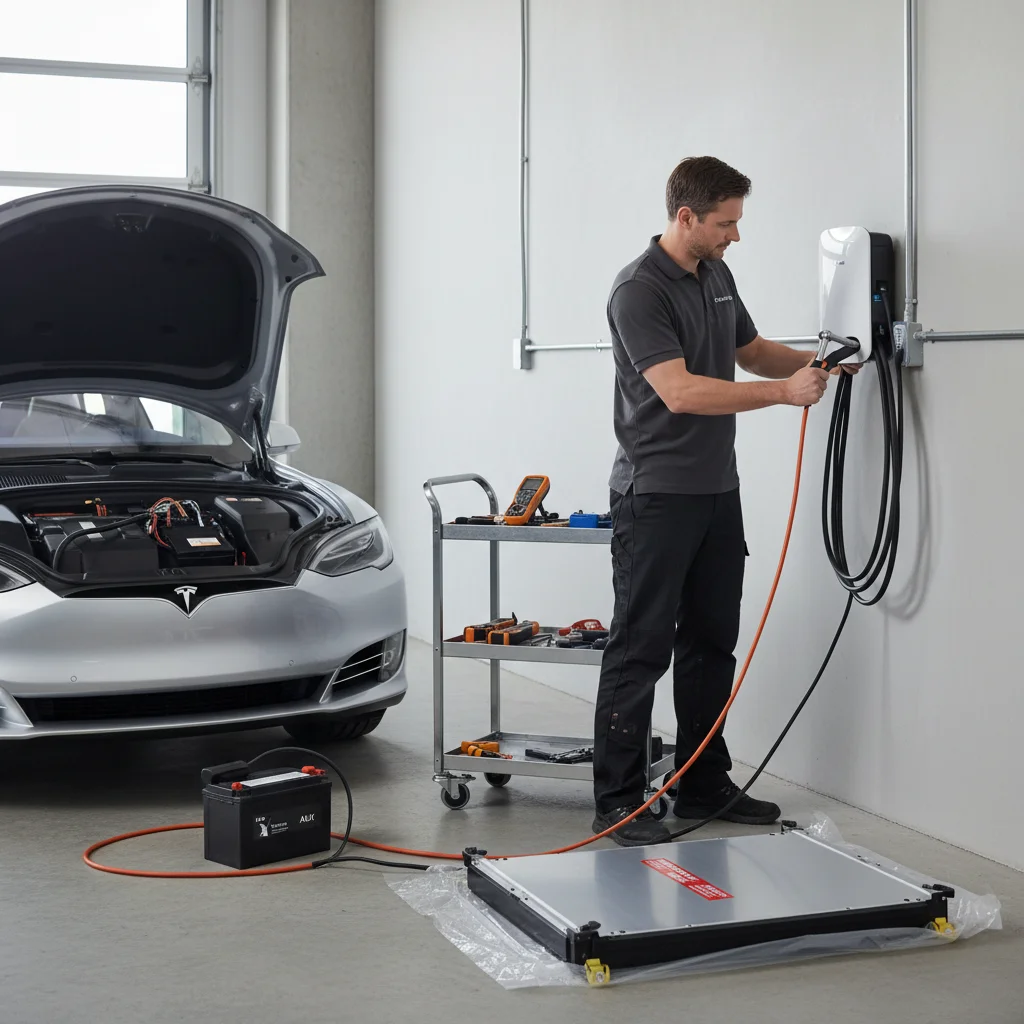
Why this question matters before you call
A Tesla runs on two separate electrical systems. The high-voltage (HV) battery under the floor powers the motor and the drivetrain. The 12 volt battery in the frunk powers the low-voltage electronics: door handles, locks, touchscreen, lights, and the relay that lets the high-voltage pack reach the motors.
Here is the part that trips drivers up. Even a fully charged HV pack leaves you stranded if the 12 volt is dead. The car cannot close the circuit between the high-voltage pack and the drivetrain without the 12 volt running. So a failed 12 volt presents almost identically to a completely drained HV pack. Dark screen, no response, locked out.
Why does this matter for who you call? If the HV pack is simply depleted, you need mobile charging delivered to your location. Our out-of-charge EV recovery service pushes enough charge into the pack to get you to a Supercharger or home. If the 12 volt has died, mobile charging does nothing for the immediate problem. You need a 12 volt jump or a battery replacement.
The split is especially important at Reagan National and Dulles. A week of airport parking here is almost always a 12 volt story, not a traction pack story. The traction pack sits at high state of charge the whole time you are gone. The 12 volt quietly drains from Sentry Mode, cabin preconditioning, and normal parasitic draw.
12 volt dead: the symptoms that point here
A dead 12 volt produces specific tells. Run through this list before you decide.
The car is completely unresponsive. Door handles on Model 3 and Model Y are flush and motor-actuated, so they will not extend. On Model S and Model X with traditional handles, the handles stay present but the car will not unlock.
The touchscreen is dark and will not boot. Not dimmed, completely off, even if you press the brake or try the app.
The Tesla app shows the car as asleep or unreachable. Not “no signal.” The car simply does not respond to wake commands. The app cannot ping it.
You hear nothing when you approach. No chime, no fan spin-up, no click from the door relay. Silence.
Your key card and phone key do not work. The NFC reader and Bluetooth receiver both run on the 12 volt. If it is dead, no key method works.
The car was parked with plenty of range showing. If your last check showed a high state of charge and the car sat in the Dulles Economy Lot or a Bethesda garage overnight, the HV pack almost certainly did not drain itself to zero. The 12 volt is the suspect.
Tesla’s 12 volt batteries are lead-acid (or lithium on newer builds) and they fail without much warning, often between 3 and 5 years of age. Our Tesla 12 volt failure symptoms guide covers the early warning signs.
High-voltage pack depleted: how it presents differently
A depleted HV pack has a different story behind it. The 12 volt system is still alive, which means the car can communicate.
The touchscreen turns on. You may see a low battery warning, a “charge now” message, or a “vehicle may not restart” alert. The car is telling you something, which means it has power to speak.
The app shows a very low state of charge. Single digits, sometimes zero. The car knows it is depleted and reports it.
The door handles work and the car unlocks. If you can get in and the screen boots, the 12 volt is fine. The car just has no traction power.
You drove until the car stopped, or parked with low range and forgot. Cabin heat on a cold night can also push an HV pack lower than expected. A typical EV keeps about 80 percent of range at freezing and about 70 percent at 20F, so most lose 20 to 35 percent in real cold.
The car might drive a few feet, then stop. Traction power cuts out, but the infotainment and lights still work. That is classic HV depletion.
In this case a 12 volt jump does nothing helpful. There is no traction energy to release. You need actual kilowatts delivered to the HV pack.
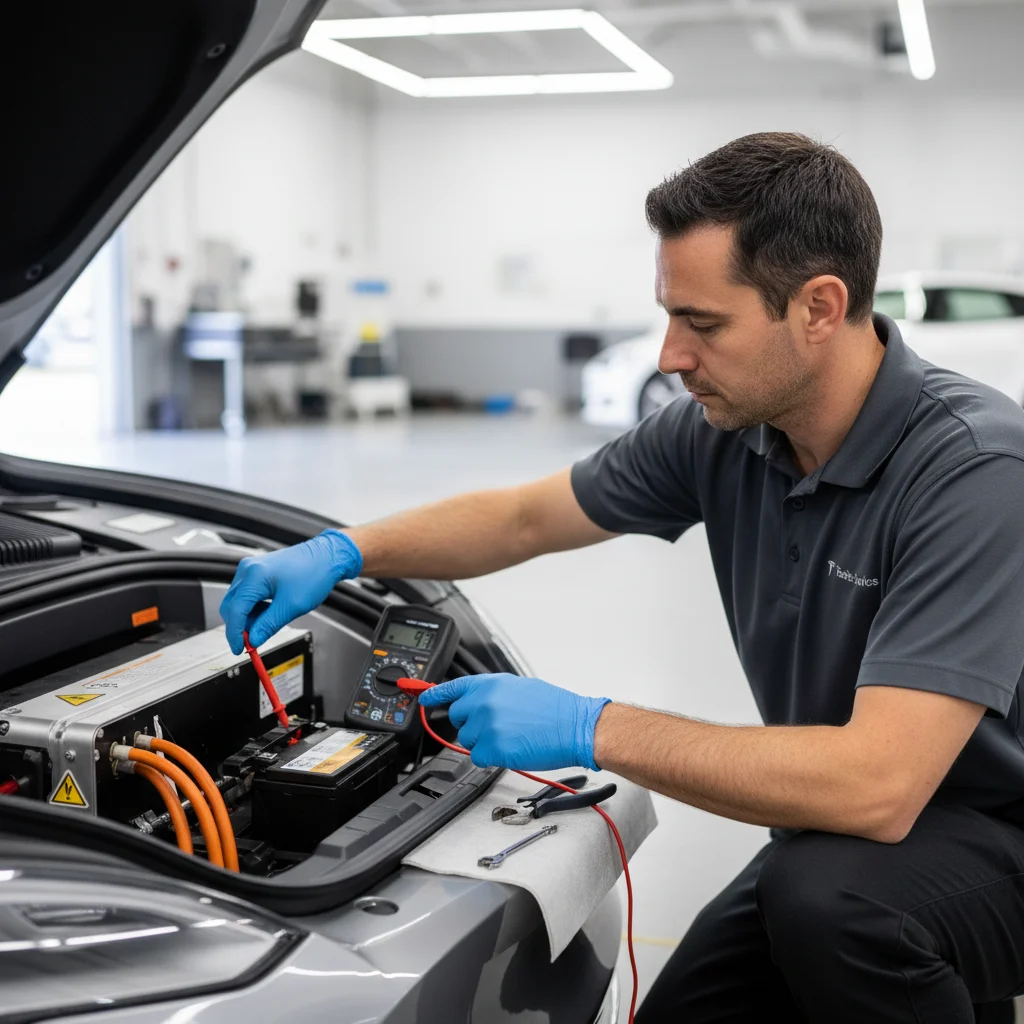
What the airport week actually looks like
Reagan National charges on Level 1 of Parking Garages 1 and 2. Those garages connect directly to the terminal. The MWAA pages are clear that charging is for parking customers, first-come, first-served, with limited spaces.
Dulles is different. MWAA publishes Level 2 charging in Garage 1 and Garage 2, no extra charge. No EV charging in the Economy Lot, the Terminal Lot, or Valet. The Economy Lot is the largest and cheapest on-airport option, reached by a 24/7 shuttle at Curb 2F.
Neither airport posts 12 volt maintenance for cars that sit a week. A week at Dulles Economy, or a long weekend at National Parking Garage 2, is how a 12 volt dies in this metro. The HV pack still reads high when you return. The 12 volt is what is dead.
Our mobile Tesla charging page for Dulles Economy walks through the same situation. The fix on arrival is a 12 volt jump, not a pack charge.
How to call the right service
Here is the quick decision rule. If your Tesla screen is on and the app shows low or zero charge, you need mobile charging. Call for out-of-charge EV recovery. If the screen is dark, the app cannot reach the car, and you had decent range when you parked, you need a Tesla 12 volt battery jump.
Still not sure? Call us. We will ask a few questions and know which truck to send before we hang up. We cover the District, Maryland, and Virginia, from Bethesda and Silver Spring to Alexandria and Arlington, with separate coverage for Arlington EV roadside assistance and Alexandria EV roadside assistance.
The fastest wrong decision is calling a standard jump-start service that arrives with a gas-car jump pack and no idea where Tesla’s 12 volt terminals are. That is the failure operators here see most. Operators in our network know the frunk pull-cord on a Model 3 and the jump points on a Model S.
Charge Pro DC covers the District, Maryland, and Virginia. We connect you with independent operators. For a quote before work starts, call (202) 629-0844.
Frequently asked questions
How can I tell if the 12 volt or the high-voltage pack is the problem?
If the touchscreen is dark, the app cannot reach the car, and you had range when you parked, the 12 volt is almost certainly the failure. If the touchscreen is on and shows a low state of charge, but the car will not drive, the high-voltage pack is the failure. The two failures look similar from the curb but require different fixes. A 12 volt jump will not charge the pack. A pack charge will not wake a dead 12 volt.
Why does airport parking kill the 12 volt?
Sentry Mode, cabin preconditioning, and the normal parasitic draw on a parked Tesla all run off the 12 volt. A week at Dulles Economy or several days at Reagan National draws the 12 volt down without any plug top-up. The traction pack still holds its charge. The 12 volt quietly drains until the car cannot wake up.
Can the Tesla app help me diagnose this?
Sometimes. If the app shows the car as asleep or unreachable, the 12 volt is the most likely failure. If the app shows a very low state of charge, the traction pack is the problem. If the app will not connect at all, that is consistent with a fully dead 12 volt, since the cellular modem runs off the 12 volt.
Will Tesla’s own roadside service handle this for me?
Tesla’s published options include their own roadside line and third-party providers listed in the Tesla app. Wait times and coverage rules vary. A local independent operator with Tesla-specific experience often moves faster and arrives with the right equipment on the first try. Our Tesla roadside rescue service connects you with that local operator. The operator quotes the work in writing before starting.