Your GMC Sierra EV has already stopped. You’re on I-95 or the Capital Beltway. The traction pack is empty, and the truck won’t roll. GMC Sierra EV emergency charging is a 240-volt top-up at the charge port. An independent operator brings Level 2 power to the truck. Charge Pro DC is the referral line that makes the match. We don’t own the rescue vehicle, set the price, or promise an arrival window. The operator quotes you before work starts, then bills you directly. You’re already stranded, and you’re not hunting a plaza from a dead stop. The job is enough range to leave the shoulder without a tow.
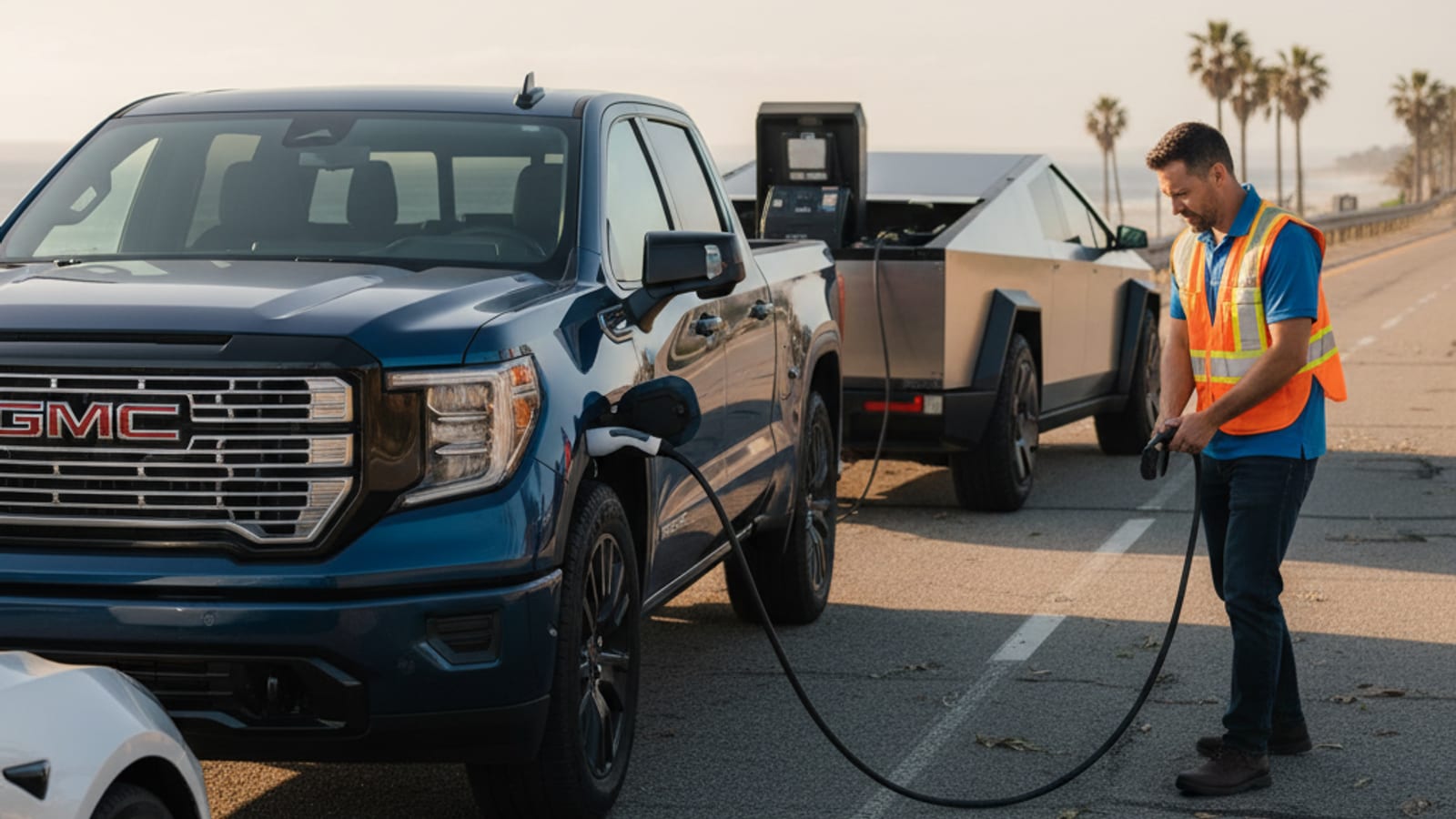
Get the truck off the travel lane first
Hazards go on as soon as the truck is slowing. Ease onto the shoulder if you still have a few yards of motion. Stay in the cab unless you’re stuck in a live lane.
The 495 Express Lanes sit in the median. Transurban’s published safety note is clear: pull to the left shoulder there. On the 95 and 395 Express Lanes, use the nearest shoulder. Stay in the vehicle until help arrives. Express Assist is the roadside patrol on those lanes. It helps with minor mechanical issues and will call a tow. It doesn’t tow the truck itself. Published FAQs don’t describe EV charging. Treat that patrol as traffic control, not a pack refill.
If you’re in the general lanes of I-495, those lanes are free. The Beltway still has tight shoulders and fast traffic. On the Woodrow Wilson Bridge, a stall sits where three jurisdictions meet. Alexandria, Oxon Hill, and the District share that span. The American Legion Bridge is the other high Beltway crossing. It’s wind-exposed, with a limited shoulder. It links McLean and Montgomery County. Don’t walk either span.
A longer Beltway checklist is in Out of charge on the Capital Beltway: what you should do next. If you’re already in the median lanes, read Dead EV in the 495 Express Lanes: pull left, then call.
Who to flag on a DC-area freeway
Virginia interstates have VDOT Safety Service Patrol. VDOT publishes about 1,079 interstate miles statewide, including I-95 and I-66. In Northern Virginia, the I-66 corridor is covered. The I-66 shoulder and express operation runs in weekday peak windows. Drivers reach that help through Virginia 511. Published material covers incidents, debris, and short-term traffic control. It doesn’t describe charging an EV.
Maryland’s MDOT SHA CHART Emergency Traffic Patrol covers the Baltimore/Washington metropolitan area. On a state primary roadway, you can dial #77. That includes I-495, I-270, US-50, and MD-295. CHART technicians publish tire changes and jump starts. They also publish about one gallon of gas, plus radiator water. Statewide, a motorist is assisted about every 14 minutes. That’s 37,400-plus assists a year, as published. They don’t publish a traction-pack charge.
The District is different. No DDOT motorist-assistance patrol turned up in the sources reviewed for this page. Inside DC, drivers rely on MPD and a private roadside plan. On the parkways, that’s US Park Police.
National Park Service roads need their own call. The Baltimore-Washington Parkway is one. So are the George Washington Memorial Parkway, Clara Barton, Rock Creek, and Suitland Parkway. These are limited-access scenic routes, and shoulders are narrow or missing. Commercial vehicles and trucks over 10,000 lb are banned. If you’re disabled on the Baltimore-Washington Parkway, report it to US Park Police. Use the contact published on the NPS parkway page.
None of the three codes reviewed has a special empty-pack rule. Disabled-vehicle rules apply the same way they would to any car. An empty Sierra EV is still a disabled vehicle.
Empty pack versus a truck that won’t wake
An empty traction pack and a dead 12-volt battery can look the same from the cab. They’re not the same job.
If the Sierra EV coasted to a stop after low-range warnings, the pack is empty. You need energy at the charge port. If the truck sat in a garage or airport deck, start with the 12-volt. A truck that won’t unlock or boot is often the small battery. Operators in this network can jump or replace a dead 12-volt on site. They also handle Tesla and every major EV brand, including GM’s electric trucks.
Don’t keep climate control roaring while you wait. Heat and AC on a stationary EV pull from the same pack. That’s the Beltway-in-gridlock problem, and the I-95 standstill problem. You’re not covering miles. You’re burning range in place.
The region’s hard reference for that is January 2022. On January 3 and 4, about 14 inches of snow fell. A multi-truck crash shut roughly 50 miles of I-95 near Fredericksburg. That’s just south of this service area. The road closed about 5:30 p.m. on January 3. It reopened about 7:40 p.m. on January 4. Hundreds of drivers sat overnight, with cabin heat on for more than 36 hours. A Sierra EV in that kind of stop gets no special exception. Cabin heat comes from the pack.
If you still have a few percent, kill extra loads. Keep hazards on, and keep yourself safe and warm enough.
What the operator actually brings to a Sierra EV
The match is for mobile EV charging, not a shop appointment. The independent operator arrives with a 240-volt Level 2 source. The native plug is NACS. CCS and J1772 adapters cover non-Tesla EVs, including a GMC Sierra EV. The operator can feed the charge port on the shoulder.
This is charging time, not a clock on when someone appears. Operators typically add 10 to 20 miles of range. That takes 15 to 30 minutes of charging. That’s usually enough to leave the shoulder and reach a longer session. It isn’t a full pack. It isn’t a dealer visit.
If the pack is simply empty, ask for out-of-charge recovery. GM and other non-Tesla trucks use the same non-Tesla EV rescue match.
The operator quotes before the cable goes in. If the quote doesn’t work for you, you can decline. Charge Pro DC doesn’t take that payment.
Stay with the truck while the cable is in. Move only if a responder says so. Keep hazards on. The operator is feeding Level 2 power, not a DC fast stall. You’re buying miles to roll. When they hit 10 to 20 miles, that’s the usual stop. You can take more if you and the operator agree on the quote.
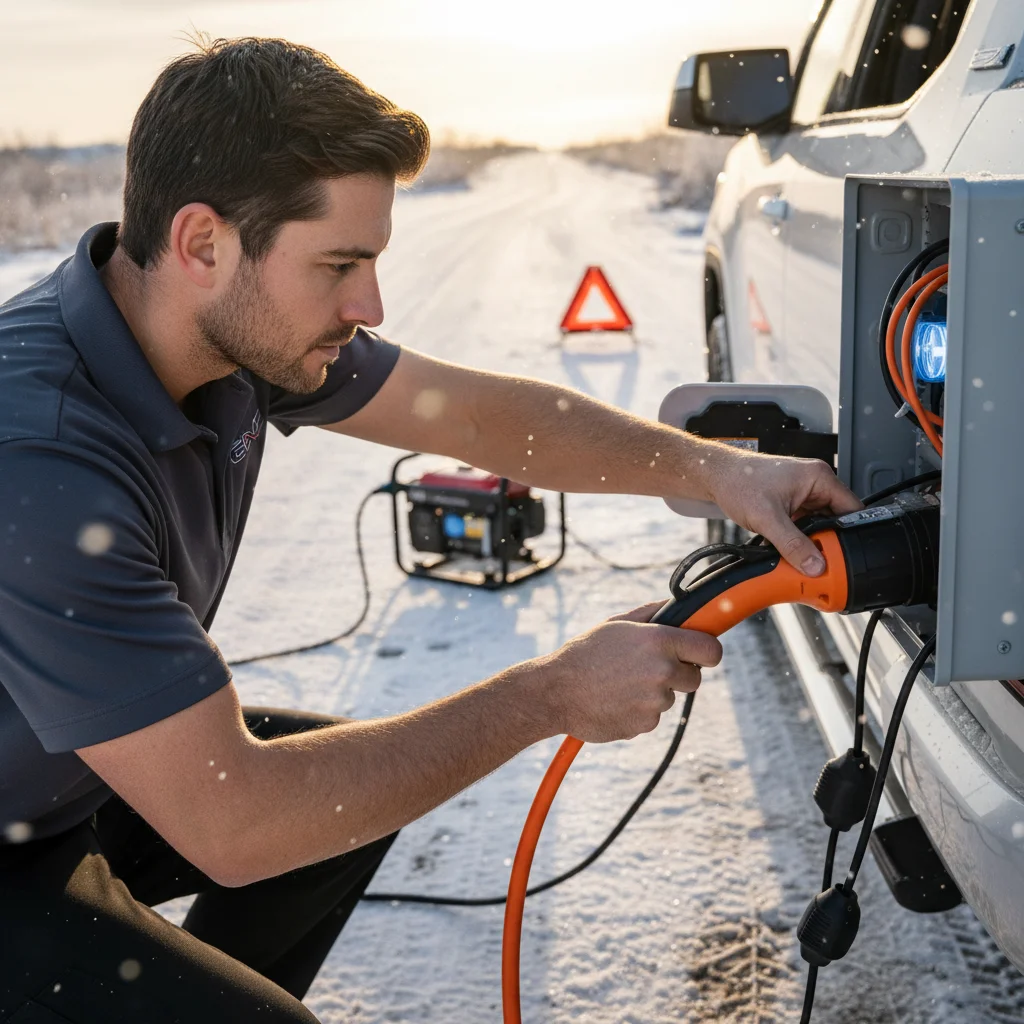
Why 95 and 495 empty a work truck faster than the nav guessed
A Sierra EV is a heavy electric pickup. Payload, a trailer, and a hard merge all cut range. None of that is unique to this metro. What is unique is how long the road holds you.
I-95 through Prince William is a long, stop-and-go commute. Woodbridge and Dale City sit on that crawl. You can sit between exits with the climate on. The estimate falls without a mile gained. More on that crawl is in Out of charge on I-95 through Woodbridge and Dale City.
Dale City isn’t an incorporated city. It’s an unincorporated Prince William community. Woodbridge is a census-designated place. Say the community name, the direction, and the last exit. Dispatch needs that, not a guess.
The Capital Beltway adds weaving and short ramps. The Express Lanes sit in the median on 495. I-66 inside the Beltway is dynamically tolled in peak hours. Outside the Beltway, I-66 has Express Lanes of its own. The Dulles Toll Road is VA-267, run by MWAA. The Dulles Greenway is a separate private toll road west of the airport. I-270 general lanes are free. So are the Beltway’s general lanes. Free doesn’t mean moving.
Springfield is where I-95, I-395, and the Beltway stack. A Sierra EV that dies in that mix is still a disabled truck. Lane choice matters more than a label on a map. Springfield is a census-designated place in Fairfax County. It isn’t the City of Fairfax. Those are separate jurisdictions. Tell the operator which one you’re actually in.
I-270 toward Germantown and Frederick is a climb-and-idle mix. Rockville is an incorporated city. Germantown is a census-designated place. Upper Montgomery often runs colder than the inner District. Plan the pack for that, especially on a winter morning.
The land rises from the tidal Potomac at the District toward the Piedmont. I-270 toward Frederick is a real climb. Westward in Loudoun and Prince William, the ground keeps rising. That’s toward the Bull Run Mountains and the Blue Ridge. No USGS pass elevation was pulled for this page, so we’re not publishing a number. Plan as if westbound and northbound grades cost you range. Regenerative braking gives some back on the way down. It doesn’t refund a trailer.
Heat, ice, and two airports that don’t share a climate
This metro sits on the fall line. Summers run hot and humid, with stretches above 90F. Winters swing from mild to sudden ice. Dulles runs colder and snowier than Reagan National. Loudoun feels that, and so do upper Montgomery and Prince William. The District and the inner Virginia core often don’t.
Recurrent Auto’s winter range study is the figure we can cite. It used more than 30,000 EVs. A typical EV keeps roughly 80% of range at 32F. At 20F, that’s about 70%. Most drivers lose 20 to 35% in real cold. Cars with a heat pump averaged about 83% retained. Cars without averaged about 75%. Cabin heating is the main draw. An EV makes that heat from the pack.
Preconditioning while plugged in at home helps the next morning. It doesn’t help on a shoulder. If the Sierra EV is already stranded, keep cabin demand down. Stay warm enough to be safe. Don’t heat empty seats.
Airport parking is a different failure. The common call isn’t an empty pack on the ramp. It’s a traveler who left the truck for a week. The 12-volt has gone to sleep.
At Reagan National, MWAA publishes EV charging on Level 1 of Parking Garages 1 and 2. Spaces are first-come, first-served, and limited. Those garages connect to the terminal. MWAA also notes 2026 electrical upgrades that expand capacity.
At Dulles, MWAA publishes Level 2 charging in Garage 1 and Garage 2. Published unit counts have been around 96 and 66. Confirm the live number on the airport page. MWAA also publishes no EV charging in the Economy Lot. The Terminal Lot and Valet are the same, per MWAA. The Economy Lot is the largest on-airport option. A shuttle runs from Curb 2F. Leave a Sierra EV there a week, and you return to the 12-volt that’s left.
Pepco, Dominion, and NOVEC won’t come charge the truck
Home charging is how a Sierra EV should start a workday. Emergency charging is what you call when that plan has already failed.
Pepco serves the District, Montgomery County, and Prince George’s County. Its EV program is Pepco EVsmart. Maryland addresses in those two counties have a published residential Level 2 smart-charger rebate. Confirm the current amount on Pepco’s application. Pepco also publishes a multifamily charging program. The District runs a separate alt-fuel infrastructure tax-credit framework. Verify that on the District’s pages.
Dominion Energy Virginia serves most of Northern Virginia. Named programs include residential EV rate Schedule 1EV. There’s also the voluntary Off-Peak Plan time-of-use rate. EV Charger Rewards is the demand-response incentive. The Off-Peak Plan needs a smart meter.
NOVEC serves parts of Loudoun and Prince William. That includes much of Sterling, Ashburn, and Gainesville. BGE touches parts of Laurel. SMECO serves the southern edge toward Clinton. The City of Manassas runs its own municipal electric utility. Confirm the serving utility by address. Don’t guess from a neighbor’s bill.
None of the utility EV pages reviewed for this article offer a stranded-car charge. Those programs help a wall unit at home. They don’t dispatch a truck to I-95.
Housing stock decides whether you even have a plug
Census ACS 2019-2023 figures show why some owners never plug in at home. Takoma Park’s housing is 90.0% pre-1980. Annandale is 79.8%. Wheaton is 73.1%. Washington is 70.3%. Pre-1980 stock is a proxy for no dedicated home charging. The no-home-plug pattern is strongest in apartment-heavy older areas. That’s Arlington, Alexandria, the District, Silver Spring, Wheaton, Hyattsville, and Annandale.
Newer ground tells the other story. Ashburn is 3.1% pre-1980. Gainesville is 3.8%. Centreville is 11.1%. Germantown is 14.1%. A Sierra EV on a new Loudoun street often wakes full. The same truck beside a Takoma Park porch may never see a 240-volt wall unit.
Takoma Park is a city. Ashburn is a census-designated place. Wheaton and Annandale aren’t cities. Tysons was renamed from Tysons Corner. The mall is still Tysons Corner Center. A Sierra EV that sits in a Tysons garage all day can lose the 12-volt. That can happen even if the pack still shows range. National Harbor is a development in Oxon Hill, not a town. Prince George’s County takes the apostrophe. A District address without its quadrant is ambiguous. NE, NW, SE, and SW repeat the same street names. Give the quadrant when you call.
Public plugs are a plan for later, not for a dead shoulder
If the Sierra EV still has a sliver of motion, open the truck’s nav. Open a charging app too, and filter for the connector your truck actually has. Operators still show up with NACS plus CCS and J1772 adapters. A roadside 240-volt visit doesn’t depend on you guessing a plaza’s hardware.
This page doesn’t publish a station inventory. Supercharger, Electrify America, and ChargePoint counts were not pulled into the research. NEVI-funded corridor work is under way in DC, Maryland, and Virginia. We’re not mapping that program here. We’re not estimating distance to a charger.
Maryland has reported more than 60,000 registered electric vehicles, as MDOT announced it. Treat that as a reported milestone, not a live head count. Virginia and District registration tables were not read into this research. They aren’t quoted.
A Level 1 household outlet is a trickle. On a full-size electric pickup, it isn’t a roadside recovery. A portable 240-volt unit only helps if you’re already next to the right receptacle. On I-95, you’re not. On a Beltway shoulder, you’re not.
Some Sierra EV trucks export AC power for tools and gear. That’s for jobsite loads. It isn’t a standard way to refill another EV’s traction pack. Don’t make another driver your charger.
Towing a Sierra EV across three sets of rules
A tow still has a place. If a control arm is bent, you need a bed. If the truck won’t accept a charge, you need a bed. For a pack that’s only empty, a tow adds loading, a second wait, and maybe another jurisdiction’s paperwork.
Confirm the Sierra EV owner’s manual for towing posture. Many EVs need a flatbed so drive wheels aren’t spinning. Don’t assume a sling pull is safe. Don’t assume four-down is safe.
Virginia private-property towing sits in Va. Code § 46.2-1231, plus § 46.2-1233 and § 46.2-1233.1. Localities may set fee limits by ordinance. Northern Virginia localities in Planning Districts 8 and 16 also set a floor by ordinance. Exact Arlington, Alexandria, and Fairfax City ordinance numbers were not re-pulled for this page. Confirm the locality before you argue a bill. This page isn’t publishing a tow figure.
Maryland stopping, standing, and disabled-vehicle rules are in Transportation Article Title 21. Private-property towing and county ordinances sit beside 21-10A. Montgomery County and Prince George’s County set their own. Cite the county ordinance before you treat any Maryland tow charge as fixed.
DC towing and impound sit under Title 50 and the DC Municipal Regulations. The DC DPW impound facility is Blue Plains, 5001 Shepherd Parkway SW. A second lot is at 2115 Bryant St NE. If the truck is hooked in the District, that’s where you start looking. Bring the quadrant.
Cable or a bed: see Mobile EV charging or a tow: which one you need when stranded.
What GMC’s own roadside plan may send
A new Sierra EV often includes a factory roadside plan for a limited term. This research didn’t pull GMC’s current booklet. We’re not stating years, miles, or a covered menu. Open the GMC app. Open the glove-box packet. See whether the plan sends a tow, a jump, or anything that refills a traction pack.
National motor clubs need the same check. Many still think in gas, flats, and hooks. A Level 2 visit to a CCS or NACS port is a different trade. The operators in this network quote before they start. They bill you. Charge Pro DC doesn’t take that payment.
Maryland is all-party recording consent. DC and Virginia are one-party. A metro line that can touch Maryland treats every call as all-party. You may hear a recording notice. That’s the legal baseline, not a delay tactic.
Keep the next commute from ending on the shoulder
Start work trips with more pack than the nav’s optimistic number. Towing cuts range. A cold Loudoun morning cuts range. A parked idle on I-95 cuts range without moving you. Recurrent’s winter figures are a planning floor. They’re not a worst case.
Charge at home on a 240-volt circuit when you have a wall to use. In Pepco territory, look at EVsmart before you buy hardware. In Dominion territory, look at Schedule 1EV, the Off-Peak Plan, and EV Charger Rewards. Confirm current rebate and rate language on the utility site. Programs change with budgets.
Watch the energy screen when you pull a trailer. A work-truck Sierra EV won’t match a commuter’s range. Leave a buffer at arrival. That’s a habit, not a law.
Keep software current. Follow GMC’s service schedule for the truck you own. We’re not publishing a degradation curve. We don’t have a Sierra-specific pack-health study in this research.
After the truck will roll again
Use the 10 to 20 miles for a real destination. That can be home or a workplace plug. It can be a public stall you’ve already confirmed in an app. Don’t spend the boost sitting with the cabin on.
If you recovered from I-95, get off at the next safe exit. Don’t hunt a stall from the travel lanes. If you recovered from 495, respect the Express Lanes shoulder rule you used. Transurban still wants you in the vehicle until the scene is stable.
Charge Pro DC serves the DC area. That’s the District of Columbia, Maryland, and Virginia. We connect stranded EV drivers with independent local mobile rescue operators. The pros we connect you with are licensed and insured. We hold no license. We employ no technicians. We own no equipment.
When you need GMC Sierra EV emergency charging, call (202) 629-0844. That number starts the match. It isn’t a promise of when someone arrives. Stay with the truck. Keep the hazards on. Have your location ready: route, direction, and the last exit you passed.
Frequently asked questions
What does GMC Sierra EV emergency charging cost in this metro?
Charge Pro DC doesn’t set prices. The independent operator quotes you before any charging starts. That quote is the number that matters. The operator then bills you directly. Utility rebates and state registration fees are a separate topic. Confirm those on Pepco, Dominion, NOVEC, or your DMV site. This page isn’t publishing a roadside figure.
How long does a mobile 240-volt charge take on a Sierra EV?
Charging time on site is typically 15 to 30 minutes. In that window, operators typically add 10 to 20 miles of range. That’s charging time only. It isn’t an arrival estimate. A full pack still belongs at a wall or a DC fast stall once you can roll.
Can another EV charge my stranded Sierra EV?
Don’t plan on it. A few EVs can export power. A GMC Sierra EV’s onboard outlets are for AC loads, tools, and gear. They’re not a roadside traction-pack refill. Connector standards and safety interlocks get in the way. Call for a 240-volt operator instead of hoping a passing pickup can clone a charger.