Electric vehicle battery maintenance in this metro is a climate problem and a traffic problem at once. Dulles runs colder and snowier than Reagan National. Cabin heat on a stopped Beltway pulls from the traction pack without adding a mile. Those two facts wear the battery more than a charge-limit chart. Your maker’s manual still comes first, and local weather decides how often you use it.
The pack pays for cabin heat and summer heat
This region sits at the fall line. Summers run hot and humid, with stretches above 90F. Winters swing from mild to sudden ice. Loudoun, upper Montgomery, and Prince William get more snow and harder freezes than the District and the inner Virginia core. A car that lives near Dulles isn’t living the same thermal year as a car near National.
Cabin heating is the expensive part in the cold. An EV makes that heat from the traction battery. A Recurrent Auto study covered more than 30,000 EVs. A typical car keeps about 80 percent of range at freezing, 32F. At 20F, retained range is about 70 percent. Most lose 20 to 35 percent in real cold. Heat-pump cars averaged about 83 percent retained. Cars without a heat pump averaged about 75 percent. That’s a fleet study, not a Tesla published spec. Don’t treat it as your model’s number.
Summer heat is a different load. A lot that cooks past 90F still soaks into the pack. Then you blast AC on the Beltway, and that comes from the same battery. We can’t confirm a single degradation rate for every EV in DC, Maryland, and Virginia. We also can’t confirm one charge-limit percent or one ideal charging window. No reputable source publishes a figure that covers every make and chemistry. A post that assigns a life-cost to heat, ice, or idling is guessing.
Start with the owner’s manual and the maker’s app. Tesla, Rivian, Ford, Hyundai, Chevrolet, and Kia each set their own charge caps, update cadence, and service intervals. Those figures change when the maker updates them. If the app says to precondition before a DC fast session in the cold, follow it. Preconditioning uses energy, and it’s still the maker’s way to protect the pack. If you want the non-battery calendar, our EV maintenance schedule for owners covers tire rotations, cabin filters, and brake fluid. This post stays on the traction pack, the 12-volt, and the local conditions that drain both.
IAD weather isn’t DCA weather
Reagan National sits on the Potomac, in the milder core. Dulles sits west in Loudoun County, and IAD runs colder and snowier. A January commute out of Ashburn, Sterling, or Leesburg is a harder battery morning than a short District hop.
The land rises as you leave the tidal Potomac, and I-270 climbs toward Frederick. Westbound miles in Loudoun and Prince William lean toward the Bull Run Mountains and the Blue Ridge. We don’t have a verified elevation figure, so we won’t publish one. A loaded EV on a sustained grade in cold air still works the pack harder than a flat loop inside the Beltway.
Housing stock changes how empty the pack is when weather hits. About 3.1 percent of Ashburn homes predate 1980, a fair proxy for driveway charging being common. Takoma Park sits at about 90.0 percent pre-1980 housing. Older blocks in Arlington, Alexandria, Silver Spring, Wheaton, and Hyattsville often mean the car charged at work or at a public stall. You start a cold morning closer to empty.
Pepco serves the District, Montgomery County, and Prince George’s County under Pepco EVsmart. Dominion Energy Virginia serves most of Northern Virginia. NOVEC covers parts of Loudoun and Prince William, including much of Sterling, Ashburn, and Gainesville. Confirm the serving utility by address. None of the utility EV pages we reviewed offer a service that charges a stranded car. A home program isn’t a roadside top-up. For Tesla pack life in this climate, see how long Tesla batteries last by 2026. Warranty questions still belong with the manufacturer.
Idling on the Beltway eats range you didn’t drive
Sitting still with heat or AC on drains charge without covering distance. That’s the Beltway crawl, the I-95 standstill, and the I-66 peak-hour stop. It isn’t a mileage problem.
On January 3 and 4, 2022, about 14 inches of snow hit the Fredericksburg area, just south of this metro. A multi-truck crash shut roughly 50 miles of I-95. The road closed about 5:30 pm on January 3 and reopened about 7:40 pm on January 4. Hundreds of drivers sat overnight for more than 36 hours. It’s the region’s reference for being stuck in the cold with the heat running. An EV in that mess heats the cabin from the traction pack the whole time.
You don’t need a shutdown to feel a smaller version. A crawl on I-495 will pull the same way. So will a jam on I-66 inside the Beltway, or a stop on I-270 between Rockville and Germantown. Turn the cabin down if you can stand it. Use a lower climate setting if your maker offers one. Don’t run every seat heater and the defroster on high unless you need them to see.
If the range number is falling while you’re barely moving, what to do on the Capital Beltway is the next-step guide. Keep the car out of a live lane. Get to a legal, safe spot, then save what charge you still have.
On the 495 Express Lanes, pull to the left shoulder. Those lanes sit in the median. On the 95 and 395 Express Lanes, pull to the nearest shoulder and stay in the car. Transurban’s Express Assist is a free roadside patrol on those lanes. It handles minor mechanical issues and will call a tow, but it doesn’t charge an EV. VDOT Safety Service Patrol covers Virginia interstates, including I-66. Published VDOT material describes incident and debris clearance, not EV charging. In Maryland, MDOT SHA CHART Emergency Traffic Patrol can change a tire and jump a 12-volt. Dial #77 on state primary roadways, including I-495, I-270, US-50, and MD-295. CHART doesn’t publish a traction-pack charge. The District has no DDOT motorist-assistance patrol that we found. DC drivers rely on MPD, private roadside plans, and US Park Police on the parkways.
The Woodrow Wilson Bridge carries the Beltway between Alexandria, Oxon Hill, and DC. The American Legion Bridge carries it between McLean and Montgomery County. Both are high, wind-exposed spans with limited shoulder. A stall there sits in weather you feel, even when downtown is milder.
Tell the two batteries apart before you pick a fix
The traction battery is the large pack that powers the motors and shows your range. When it runs low, the car keeps working until it doesn’t. You get a countdown, then warnings, then it won’t move under its own power.
The 12-volt auxiliary battery is much smaller. It runs locks, the screen, and the computer that wakes the high-voltage system. When that 12-volt dies, the car can look fully dead with a full traction pack. Locks ignore you, and the screen stays dark. Nothing starts, because the low-voltage side has nothing to run on.
A depleted traction pack on I-270 or the Beltway is a charging problem. A dead 12-volt in a garage or airport lot is a jump or replacement. You often never touch the main pack. If the car won’t wake and range looked fine last time you parked, start with the 12-volt. The EV 12-volt replacement guide walks through the signs.
Airport lots make this mix-up common. The usual pattern is a traveler returning after a week to a car that won’t wake. That’s the 12-volt, not an empty pack. At Dulles, MWAA has Level 2 charging in Garage 1 and Garage 2, with no extra charge. At Reagan National, EV charging is on Level 1 of Parking Garages 1 and 2. It’s complimentary for parking customers, first-come, with limited spaces. If the stall is a Tesla in Dulles long-term parking, see mobile Tesla charging at the Dulles Economy Lot.
Match the help to the battery that’s actually down
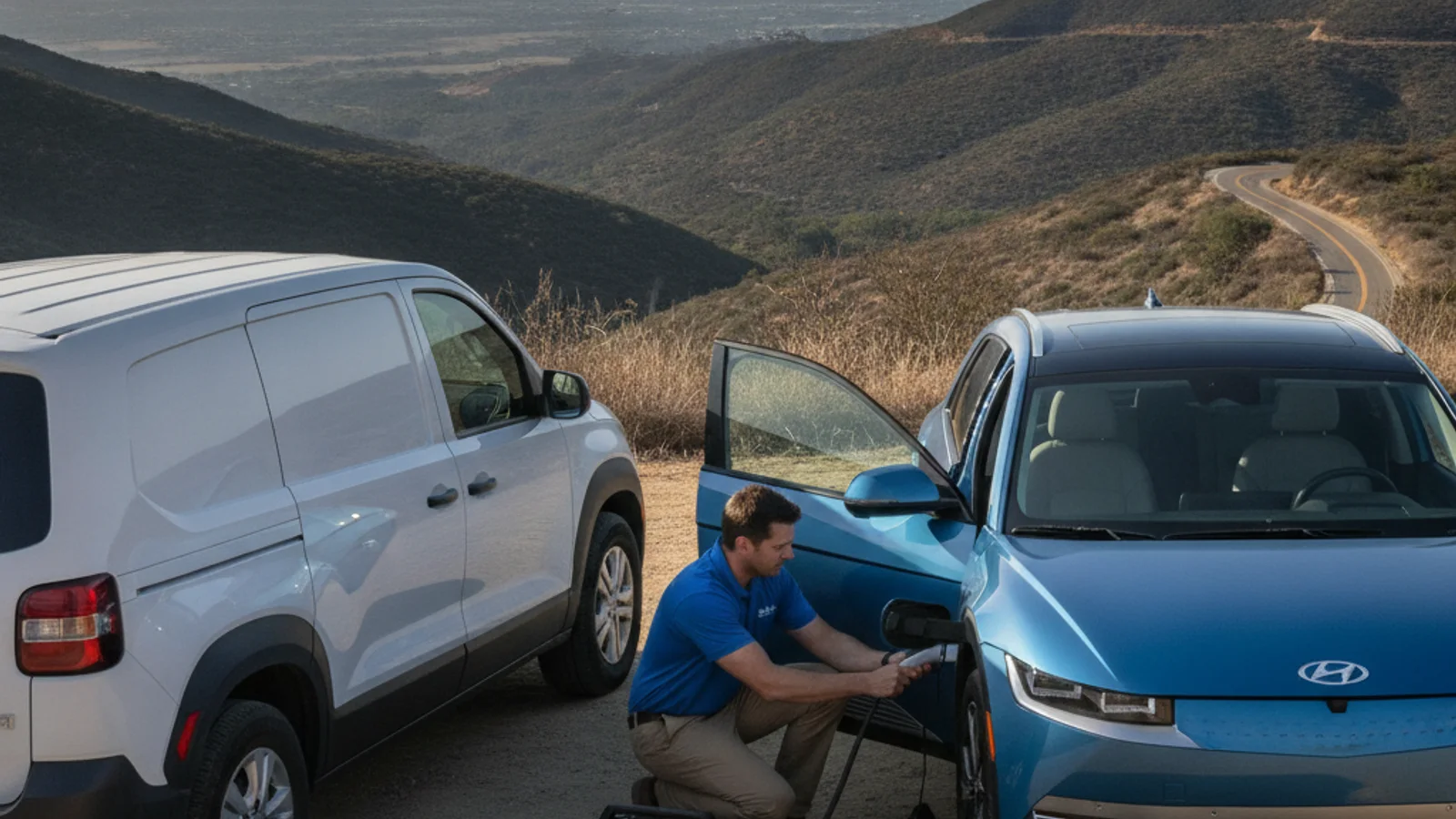
If the traction pack is depleted and you’re somewhere an operator can reach, a mobile 240-volt top-up is the roadside option. The independent operators we connect you with bring a 240V Level 2 source to the car. They use a native NACS plug, or a CCS or J1772 adapter for non-Tesla EVs. They typically add 10 to 20 miles of range in 15 to 30 minutes of charging. That’s charging time, never an arrival time. The operator quotes before starting and bills you directly.
Request out-of-charge recovery when the pack is the issue. The operator on scene decides whether a top-up will get you to a compatible charger, or whether the car needs a tow. If the symptoms point to the 12-volt, a jump is usually enough. Tesla 12-volt jump help covers Tesla owners. The same 12-volt failure shows up on every major EV brand.
If the car charges, drives, and wakes normally, that’s a service-center question, not a roadside one. Diagnostics and warranty work belong with the manufacturer or an authorized shop. Charge Pro DC is a referral line. It doesn’t hold a trade license, own trucks, or perform the work. The pros we connect you with are licensed and insured.
Call when you’re already short, not after the pack hits zero
If the traction pack is emptying on a shoulder, or the car won’t respond and you suspect a dead 12-volt, waiting doesn’t restore either battery. Save what charge you still have, then ask for a local operator.
Call (202) 629-0844 and we’ll connect you with an independent mobile rescue operator in the DC area.