Rush hour on I-270 can empty an EV without moving you a mile. You sit north of the Beltway with the cabin still on. The pack ticks down. The odometer barely moves. Charge Pro DC connects you with a local operator. That operator brings 240-volt charging to the car. The operator quotes you before any work starts.
The I-270 problem is idle drain, not a long trip
Most range math assumes you’re covering miles. This corridor often does the opposite. Cars stack from the Capital Beltway through North Bethesda and Rockville. Heat or AC keeps running. The traction pack feeds the cabin. You gain almost no distance.
That’s the dominant call along this spine. It’s not a weekend trip that overran the plan. It’s a freeway that turned into a parking lot on the way home.
Pepco serves Montgomery County along I-270. A Level 2 plug in a Germantown or Gaithersburg garage resets the pack overnight. It does nothing for you on the shoulder. The backup already spent the last buffer.
Cold makes the same stall cost more. Recurrent Auto studied more than 30,000 EVs in winter. A typical car keeps about 80 percent of range at freezing. It keeps about 70 percent at 20F. Cabin heat is the reason. Sitting still with the heat on is the drain. The January 2022 I-95 shutdown farther south is this region’s reference. That’s the heat-on, sitting-still pattern. About 14 inches of snow and a multi-truck crash closed a long stretch overnight. Hundreds of drivers sat with the heat on for more than 36 hours. I-270 is a shorter road. The physics are the same.
The land also rises as you head toward Frederick. Traffic finally rolls, then the grade asks for more energy. A flat Beltway crawl doesn’t prepare the pack for that. Drivers who left Rockville with a thin buffer often meet the climb already short.
I-270’s general lanes are free. There’s no left-shoulder rule on I-270. That left-shoulder rule belongs to Transurban’s 495 Express Lanes, which sit in the median. On I-270, pull as far right as you safely can. Stay with the car. Call from inside.
What the operator actually brings to the car
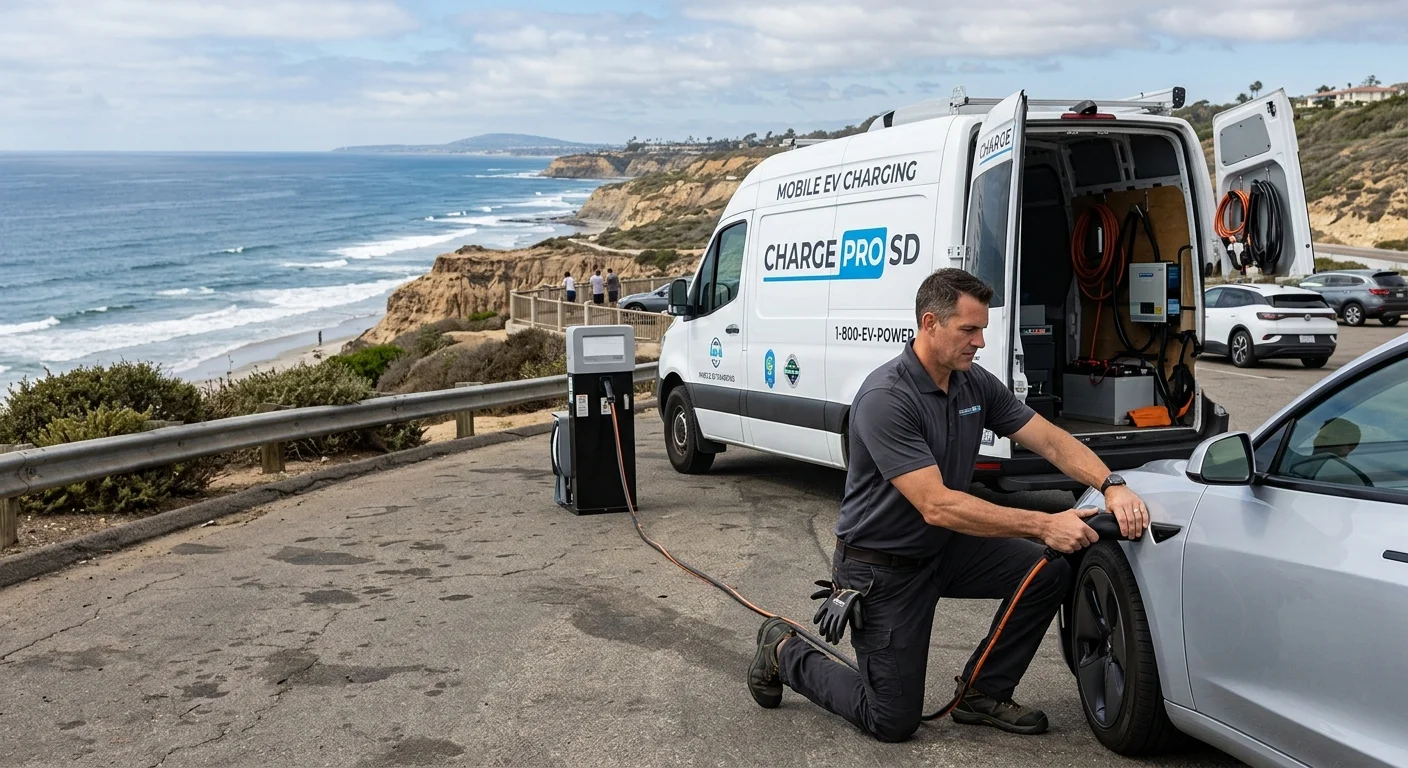
The pros we connect you with roll up with a 240-volt Level 2 source. Tesla owners get a native NACS plug. Other EVs use a CCS or J1772 adapter. Typical charging adds about 10 to 20 miles of range. That takes 15 to 30 minutes of charging time. That clock starts when the cable is on. It isn’t a promise of when someone shows up.
They can also jump or replace a dead 12-volt battery on site. A car that won’t wake in a Rockville or Gaithersburg garage is often the 12-volt. It isn’t always an empty pack. Tesla and every major EV brand are in scope.
Charge Pro DC is a referral line. We don’t own trucks. We don’t employ technicians. We don’t set prices. The operator quotes you before starting. The operator bills you directly.
For the gear, read what’s an EV charging truck, and who actually owns it. When the pack is already empty on this freeway, start here. Out of charge on I-270 covers the idle-drain stretch between Rockville and Germantown.
Rockville through Germantown sits on one commute
I-270 is the biotech-and-commuter spine north from the Beltway. Rockville and Gaithersburg are incorporated cities. Germantown and Olney aren’t. North Bethesda isn’t a city either. The backup doesn’t care. Your dispatch notes still need the right place name.
Rockville is where the crawl usually becomes real after the Beltway. Office garages and long-stay lots produce two failure modes. A pack that sat in traffic with climate on. A 12-volt that sat too long in a garage. The Rockville charging hub is the local page if you live or park there.
Gaithersburg sits farther up the same lanes. A low-charge commute often stops being a commute here. Mobile EV rescue in Gaithersburg is the matching local write-up.
Germantown housing is newer than the inner Montgomery ring. Only about 14 percent of homes predate 1980. More driveways already have a plug. That helps the overnight reset. It doesn’t help the afternoon backup. That backup can eat the buffer before you reach your street. Germantown EV roadside assistance is the local guide for that drained commute.
Olney sits off the freeway on the north-county commute. A stall there is often the last stretch home. It isn’t always a highway shoulder. Tell the operator you’re off I-270, not on it.
Newer housing as you go north is the housing story. More home charging up the corridor is real. The call we still get is the car that never made it home.
CHART can clear the lane. It can’t fill the pack.
If you’re disabled on I-270, call CHART. MDOT SHA’s Emergency Traffic Patrol is the state motorist-assist unit. Dial #77 on a Maryland primary roadway. That list includes I-270, I-495, and US-50.
CHART Emergency Response Technicians change tires. They jump-start 12-volt batteries. They add about a gallon of gas. They top radiator water. Published CHART material doesn’t describe charging an EV traction pack. A jump can wake a 12-volt. It won’t put miles into an empty battery.
There’s no out-of-charge rule in DC, Maryland, or Virginia code. Disabled-vehicle rules apply to an EV the same way they apply to any car. Maryland stopping and standing rules live in Transportation Article Title 21.
Stay in the vehicle unless you’re in immediate danger. Put the hazards on. If you can reach a shoulder, use it. Don’t walk the travel lanes looking for a plug.
Pepco EVsmart is a home and multifamily equipment program. It isn’t a stranded-car service. Pepco doesn’t publish a stranded-car charging service on the freeway. Neither does Dominion Energy Virginia. Neither does NOVEC. Don’t treat the utility as a rescue option.
What moves the quote, and who bills you
There’s no published menu price on this site. We won’t invent one. The operator who comes to you sets the number. The operator bills you directly. You hear that quote before work starts.
Three things actually move it. How far the operator has to travel to reach you. How much range you need to get home. Or how much you need to reach a charger you already planned to use. Time of day matters too. A peak I-270 crawl can stretch the on-site charging visit.
Plug type is usually simple. NACS on Tesla. CCS or J1772 on most others. A 12-volt jump is a different job from a 240-volt top-up. Say which problem you have.
A tow is a different product. Montgomery County sets its own private-property tow rules. Confirm any tow figure with the county or the towing company before you agree. We won’t publish a dollar amount here. Mobile charging leaves the car where it is. It puts enough energy in the pack to drive it.
What you pay for mobile EV charging, and who bills you is the quote walkthrough. Compare that with a tow only after you know one thing. That’s whether the car can still accept a charge.
What to do in the backup before you call
If you still have a sliver of range, and you can exit safely, exit. Sitting through another cycle of the backup burns charge. A 12 percent display becomes a 4 percent display. You gain no miles. You still spend charge.
Kill climate control if you can stand it. Drop accessory loads. Seat heat costs less than cabin heat. It still costs something. If the car is still in a live lane, get it to the shoulder first. Then stay put.
Tell dispatch the mile marker and the direction. Name the nearest place you know: Rockville, Gaithersburg, Germantown, or Olney. If you’re already off the freeway in a lot, say so. Give the garage name or the cross streets.
If the car won’t wake at all, say so. That points the operator at the 12-volt first. If the display still shows a percent near zero, they bring the 240-volt source. Mobile EV charging is the service page for that visit.
Don’t leave the car in a live lane to hunt a public stall. You can’t walk I-270 for a plug. A mobile visit comes to the vehicle.
If you made it home and the wall unit failed, that’s a driveway visit. It isn’t a shoulder visit. Same 240-volt idea. Different setting. Farther north, newer houses mean that wall unit is more likely to exist. It still doesn’t help while you’re on the freeway.
If you didn’t make it home, don’t limp the last exits on hope. The Frederick-bound climb is where that bet fails.
Call Charge Pro DC at (202) 629-0844. We match you with an independent local operator. They quote you before they start. They bill you. We don’t.