EV roadside assistance in Gaithersburg starts on I-270, not in the driveway. You left with enough for home. Then the crawl began, and the cabin stayed on. The pack kept falling while the car sat still.
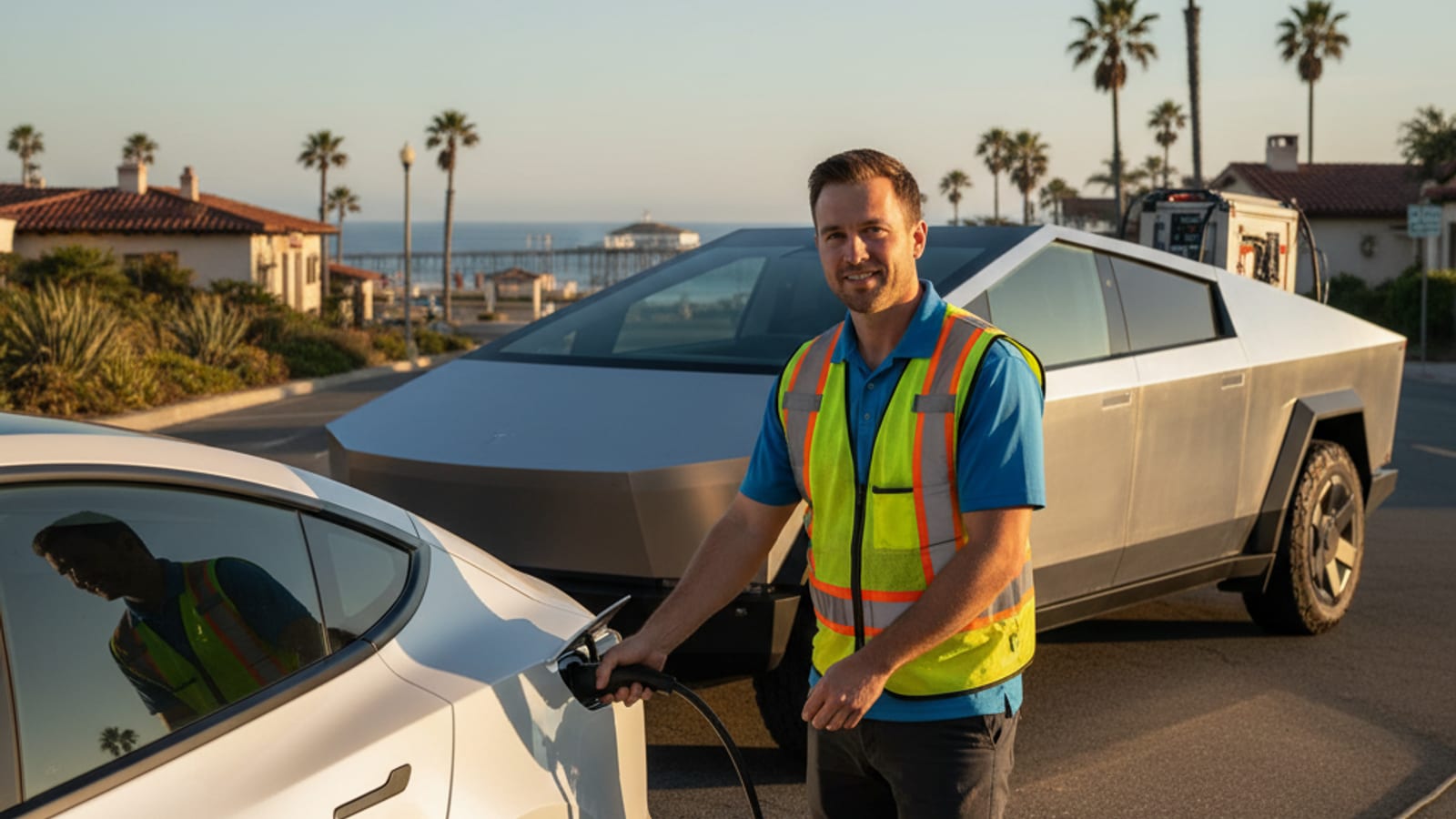
That’s the local pattern on this stretch of Montgomery County. Charge Pro DC is a referral line. We match you with an independent operator who brings 240-volt charging to the car. The operator quotes you before any work starts. They bill you directly.
Why I-270 through Gaithersburg spends the pack
Gaithersburg is an incorporated city on the I-270 corridor. Census ACS figures put the population at 69,225. The land area is a little over ten square miles. Nearly a third of residents are Hispanic or Latino. Housing is newer than the inner suburbs. About 31 percent of homes were built before 1980. A lot of owners plug in at night. Cars still die on the commute.
I-270 is the spine from the Beltway up through Rockville. Then Gaithersburg. Then Germantown. Then the run toward Frederick. The general lanes are free. They’re also stop-and-go for long parts of the afternoon. An EV that isn’t covering miles is still spending energy. Heat in January. Air in July. Fans, screens, computers. All of it comes off the pack.
MD-355, Frederick Road, runs parallel through town. Drivers duck onto it when 270 locks. That only helps if 355 is actually moving. Often it isn’t. Sam Eig Highway cuts across to Rio and the Washingtonian Center. MD-124, Montgomery Village Avenue, feeds neighborhoods back onto 270. You can empty a pack on any of those roads without leaving the city.
The land here begins to roll toward the Frederick Valley. Northbound 270 is a real grade. You spend range going up. You don’t get it all back on the same trip, and not in traffic. Weekend drivers feel the hill. Weekday drivers feel the idle. Both are Gaithersburg problems.
Recurrent Auto studied winter range across more than 30,000 EVs. A typical car keeps about 80 percent of range at 32F. At 20F it’s about 70 percent. Cabin heat is the cause. An EV makes that heat from the battery. Cars with a heat pump averaged about 83 percent retained. Cars without averaged about 75 percent. Gaithersburg runs cooler and snowier than Bethesda or the District. Upper Montgomery sees harder freezes than the inner core. A thin buffer on a cold night doesn’t survive a 270 sit.
What Maryland’s CHART patrol will do on I-270
If you’re disabled on I-270, MDOT SHA’s CHART patrol is the state option. Dial #77 from a state primary roadway. That includes I-270 and I-495. CHART technicians change tires. They jump 12-volt batteries. They can add about a gallon of gas. They can add radiator water. They handle incident clearance and short-term traffic control. Published CHART pages don’t describe charging an EV.
Call them when you need the lane made safer. Call them for a tire or a 12-volt jump in the ordinary sense. Don’t wait on that truck to fill a traction pack. That’s not what they carry.
Maryland’s disabled-vehicle rules sit in the Transportation Article. They treat an empty EV like any other stalled car. The codes reviewed for this page have no separate out-of-charge statute. You still leave the travel lane. You still use hazards. You still stay with the car on a high-speed road.
A gas can doesn’t help. A jump helps only if the 12-volt failed. A 240-volt visit helps if the pack is empty. Sort those two before you pick a call.
Empty pack or dead 12-volt
From the seat, both feel like a dead car. They aren’t the same job.
The traction pack hit empty
The car may still unlock. The screen may still talk. Range is zero, or so close you shouldn’t roll. This is the I-270 Gaithersburg stall. You budgeted for the drive home. You didn’t budget for a long sit with climate control on.
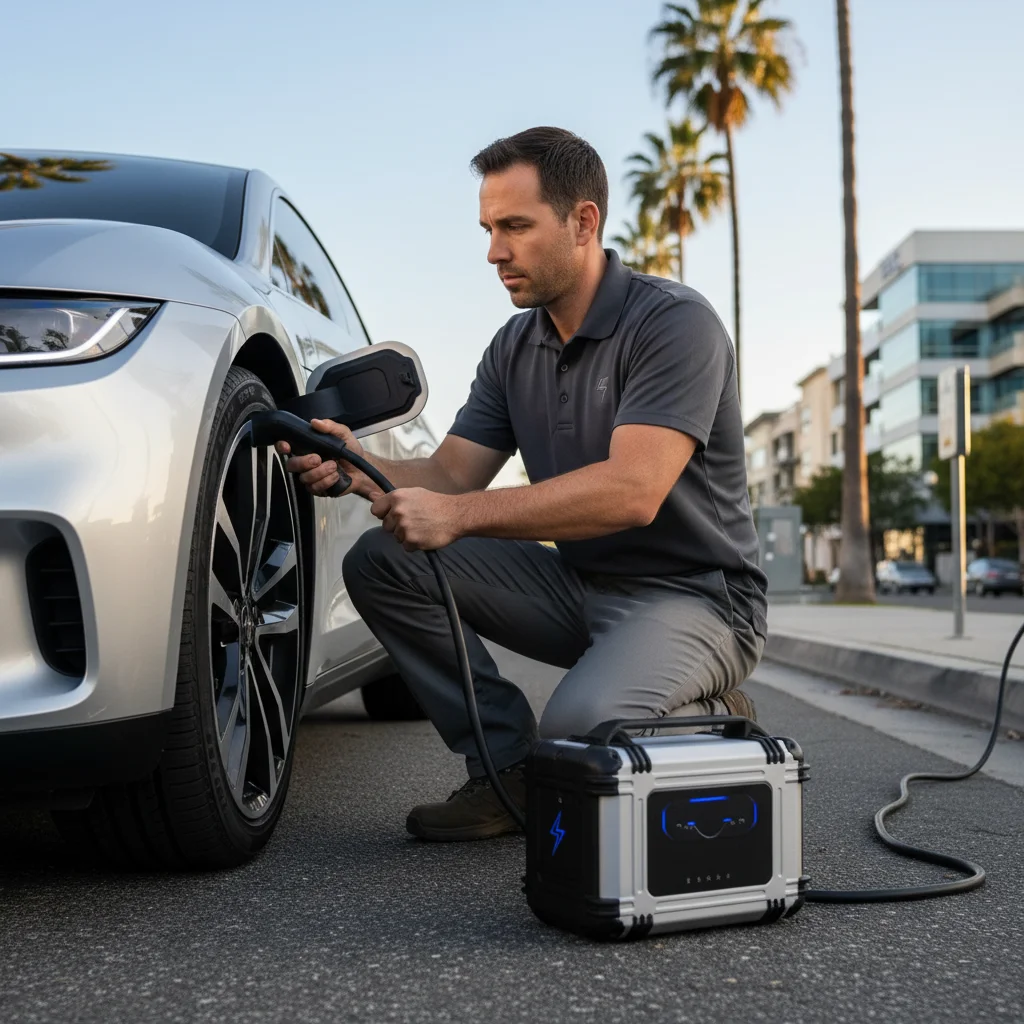
Mobile EV charging is the on-site fix. An operator brings a 240-volt Level 2 source to the port. Tesla takes a native NACS plug. Other EVs take a CCS or J1772 adapter. Typical roadside charging adds about 10 to 20 miles of range. That usually takes 15 to 30 minutes of charging time. That window is cable time, not a promise of when a person arrives. You need enough to reach home or a plug you already planned. The next exit you can use also works.
If you’re still on the freeway deciding, read out of charge on I-270. Mobile EV charging along I-270 covers the same corridor from the truck side.
The 12-volt gave up after a sit
Plenty of Gaithersburg stalls aren’t an empty pack. They’re a 12-volt that died after a long park. Rio and the Washingtonian Center. A Kentlands garage. A shift at Adventist HealthCare Shady Grove. A day on the NIST campus. The high-voltage battery can be fine. The 12-volt runs locks, computers, and the contactors. When it dies, the car won’t wake. Ready mode never comes. Doors may not behave.
Operators in the network jump or replace a 12-volt on site. They handle Tesla and the other major EV brands. A CHART jump may wake a 12-volt too. If the car still won’t go after that, you’re past a simple jump.
Don’t order a flatbed just because the car is silent. Find out which battery failed. A tow still delivers a dead 12-volt to a shop. It also makes the load more complicated.
Where the cars sit in this city
Gaithersburg is offices, housing, a hospital, a federal campus, and retail that holds cars for hours.
Rio and the Washingtonian Center are the long errand and dinner sits. Kentlands mixes neighborhoods with retail. Garages there hide a 12-volt problem until you try to leave. Adventist HealthCare Shady Grove is a true long-dwell lot. Staff and visitors leave cars for a shift or an appointment. The National Institute of Standards and Technology campus is the other all-day park. A car that sat from morning to evening can lose the 12-volt. That happens even with plenty of pack left.
Pepco serves Montgomery County, including Gaithersburg. Pepco EVsmart is the utility’s published EV program. It covers home and multifamily charging equipment. It isn’t a stranded-car service. No utility EV page reviewed for this metro offers a stranded-car charge. If you skipped the home plug, that’s a roadside problem.
Newer housing is why this isn’t an apartment-plug story first. Takoma Park and Wheaton have much older stock. Gaithersburg doesn’t. The local failure is I-270, the Frederick run, and the workplace sit. Plan for those.
Rockville is the next incorporated city south on the same freeway. EV roadside assistance in Rockville is the 270 rush one stretch earlier. Germantown is the next community north. Germantown EV roadside assistance is the drained commute a few miles up. Olney sits east. North Bethesda sits farther in toward the Beltway. A trip that starts in Gaithersburg often aimed at one of those places. The operator only needs the pin where the car actually stopped.
What a mobile rescue is here
Charge Pro DC doesn’t own trucks. We don’t employ technicians. We don’t set prices. We don’t publish hours. We hold no trade license for the work. We connect stranded drivers with independent local operators. The pros we connect you with are licensed and insured. They own the equipment. They do the job.
A mobile visit means the charger comes to you. The operator confirms the connector. They plug in. They add enough range to move the car. You stay with the vehicle. They bill you.
What moves the quote is ordinary. How far the operator must travel. Time of day on I-270. How much range you need. Whether this is a pack top-up, a 12-volt jump, or both. Whether the car is on a shoulder or in a garage. Height limits and lot access matter too. Weather. The operator quotes before any cable goes in. If the quote isn’t a fit, you stop there.
That’s the whole relationship. We match. They quote. You decide.
If the percent is already on the floor
Get out of the travel lane. Hazards on. On I-270, use a shoulder and stay inside the car. Don’t stand in a live lane to watch the display. The car is better cover than you are.
If you can still roll a short way, a lot beats a freeway shoulder. Rio parking, the hospital lots, and streets off MD-355 or Montgomery Village Avenue are calmer pins. Only do that if the car will actually get there. Don’t spend the last of the pack hunting a prettier spot.
Call #77 if you’re on I-270 and you need CHART. Ask for traffic control, a tire, or a 12-volt jump. Tell them you’re in an EV so they aren’t planning a gas fill.
Then call for a mobile operator if the pack needs energy. Have the make and model. Have a pin a person can find. Mile marker, exit, Adventist HealthCare Shady Grove, NIST, Kentlands, Rio, a Frederick Road cross street. Say whether the car is awake. Say whether you think this is charge or 12-volt.
Stay with the vehicle. An empty EV is a disabled car. Maryland doesn’t give you a special walk-away rule because it’s electric.
When a tow is the right call
Tow when the car can’t take a charge. Tow when the port won’t release. Tow when 12-volt work doesn’t wake it. Tow when you won’t sit on I-270. A shop or a plugged driveway should be waiting.
A flatbed is often required so the drivetrain isn’t damaged. That’s a load and a destination. It isn’t a fill. The pack is still empty on arrival unless someone charges it there.
Maryland private-property towing sits with county ordinance. Montgomery County sets its own. Virginia’s statewide hookup rules don’t apply in Gaithersburg. Don’t bring a Virginia figure to a Maryland lot. Confirm the current Montgomery rule if a private lot is already calling a wrecker.
Rescue and repair are different jobs. A 240-volt visit is rescue. A failed pack or a broken port is shop work. So is a car that won’t wake after a good 12-volt.
Cold, humidity, and the weekend run north
Upper Montgomery isn’t a mild in-town winter. It runs colder than the inner suburbs. Snow shows up here more than it does in the District. If the forecast is near freezing, use Recurrent’s retained-range figures. Leave more buffer than the map suggests.
The January 2022 I-95 shutdown sat south of this service area, around Fredericksburg. It’s still the regional memory of a highway that didn’t move. Drivers spent a night with the heat on. Gaithersburg isn’t that stretch of I-95. The physics match. A parked car still spends charge to keep you warm. Cut what you can. Call while the phone still has battery.
July mirrors it. Humidity plus a 270 crawl means air conditioning for the whole sit. Miles don’t add up. The percent still drops. Treat standing still as a charging event, not as rest.
Northbound toward Frederick is the grade. Start that weekend trip with more pack than a southbound Rockville run needs. This metro isn’t mountainous. The hill is still real.
Home charging doesn’t cover the freeway
If you can plug in at home in Gaithersburg, do it. Pepco is the utility. EVsmart is the program name for home and multifamily equipment. Confirm rebate details on Pepco’s own pages. Those programs change. This page won’t invent an amount.
A driveway plug doesn’t help you on Sam Eig at rush hour. It doesn’t help a visitor who planned to charge overnight and is still on 270. It doesn’t help the car in a Rio garage that never made it home.
Older inner-ring places have a no-home-plug problem first. Gaithersburg’s housing is newer, so a home plug is more common. I-270 is still I-270. Leave with a buffer that survives a crawl.
For the city overview, see EV charging in Gaithersburg.
What this page won’t invent
Charger maps go stale. Station counts for this city weren’t pulled into the research behind this article. This page won’t invent a station count or a distance to a plug. If you already know a charger you can reach, go there. If you can’t reach one, a mobile 240-volt visit is the on-site option.
This page won’t publish a price. The operator quotes you. Distance, time of day, and range needed move that quote.
This page won’t promise an arrival window. You’re sitting in the same traffic they have to drive.
This page won’t say Charge Pro DC owns a fleet or holds the trade license. The operators we connect you with do the work.
Habits that cut the odds
Plug in at home when you have a plug. Don’t leave at a few percent because home is only a few exits. Look at the northbound grade before a Frederick run. If the car sits all day at NIST, Shady Grove, or Rio, watch the 12-volt. Don’t watch only the pack. Long sits kill 12-volts. A full shift is the everyday version of that.
Save #77. Save a pin-drop habit. If the percent is falling and you can still roll, pick a lot and wait there. A calm pin is easier for an operator than a live I-270 lane.
Frequently asked questions
Can an operator charge both Teslas and other EVs here?
Yes. They bring a native NACS plug for Tesla. They carry a CCS or J1772 adapter for everyone else. Ford, Hyundai, Rivian, Chevrolet, and the other common brands on this corridor are in that group. Say the model when you call so the right lead comes with the truck.
How much range do I get from a roadside charge?
Enough to move is the goal, not a full pack. Typical Level 2 roadside charging adds about 10 to 20 miles in 15 to 30 minutes of charging. Your car, the pack’s state, and the outdoor temperature change that. Name the destination: home, a planned public plug, or the next city on I-270. The operator runs the session against that.
What do I need to say when I call?
Where the car is, down to an exit, lot, or campus. Make and model. Whether it’s awake. Whether you think this is an empty pack or a 12-volt. If you’re on I-270, say so. If CHART is already on scene, say that too.
When I-270 leaves you short in Gaithersburg
Stay with the car. Get a quote. Charge Pro DC matches you with a local operator for EV roadside assistance on this corridor. Call (202) 629-0844. The operator quotes before any work starts. You decide if it runs.