Ice on Loudoun and inner Fairfax County mornings is when this cable freezes. A Mach-E charge port stuck closed is usually ice on the latch. A weak 12-volt can fail to fire the release too. Don’t yank the CCS handle. End the session on the car and at the stall first.
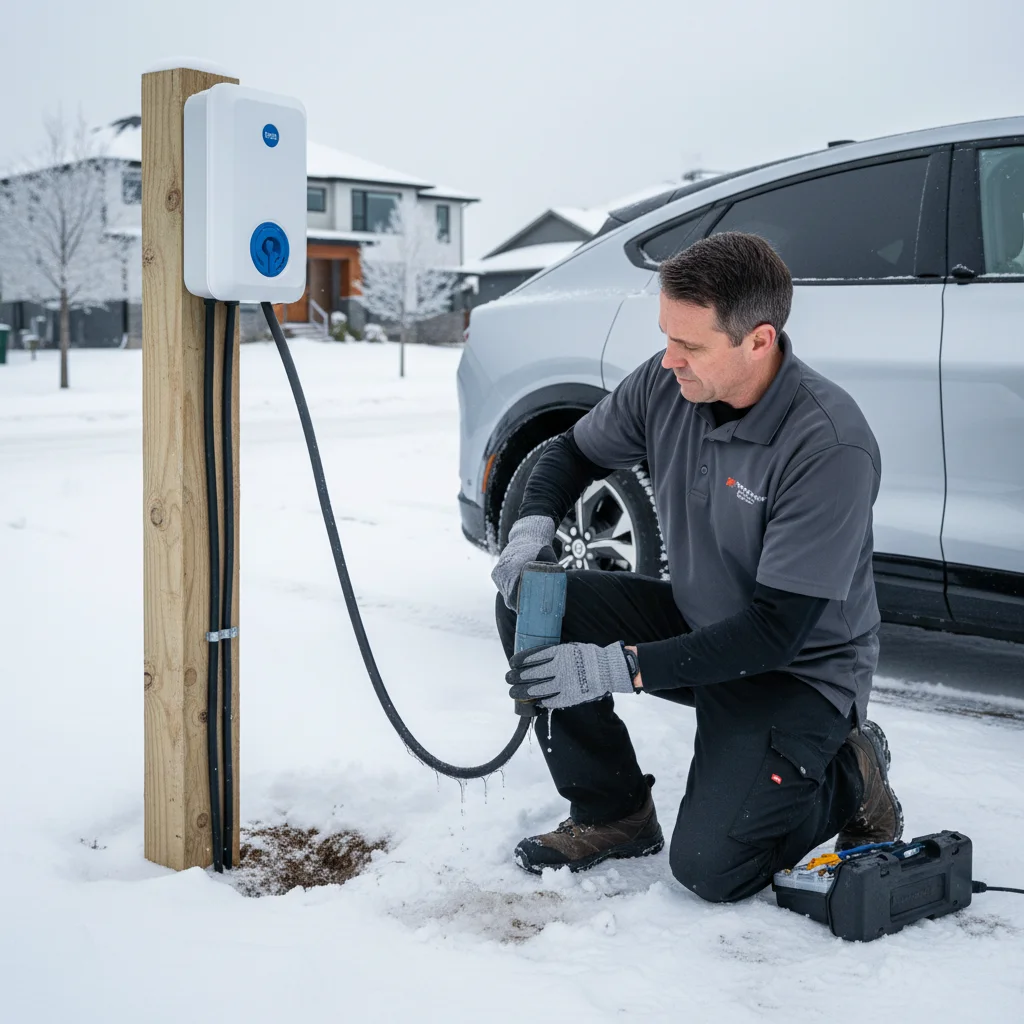
Ice here is not one metro freeze
This metro sits on the fall line. Summers run hot and humid. Winters swing from mild to a sudden ice event. Dulles runs colder and snowier than Reagan National. Loudoun sits in that colder band, along the Dulles Toll Road and the Dulles Greenway.
Inner Fairfax County still ices overnight. McLean driveways, Tysons garages, and Vienna streets see that morning lock. The District often thaws earlier. The City of Fairfax is its own jurisdiction, not Fairfax County. A garage there can still ice a port left plugged in all night.
A typical EV keeps about 80 percent of range at 32F. At 20F it keeps about 70 percent. Recurrent Auto published that from a study of more than 30,000 EVs. Cabin heat is the main draw. Sitting still with heat on burns charge without covering miles. In January 2022, drivers sat more than 36 hours on I-95 near Fredericksburg with heat on. Ice on a charge port follows that same cold-sit physics.
Don’t chip ice with a key or a screwdriver. You’ll scar the pins. If the cabin still wakes, use the car’s heat. Wipe the port dry, then try the handle again. Standing water in a humid-metro port is a separate failure. See water in your EV charge port before you plug back in.
Annandale’s housing stock is mostly pre-1980, so more plugs sit outside and ice. Ashburn’s stock is mostly new, but an open garage door still ices a latch. Heat, ice, and Beltway idling also cut range. How heat, ice and Beltway idling wear an EV battery covers that drain.
Two locks can hold the same handle
The Mach-E uses a motorized charge door and an electronic latch in the port. Both draw electric power. When they work, the CCS connector stays locked while current flows. When they don’t, you’re not looking at a piece you can brute-force.
Rule the stall out before you fight the car. End charging on the Mach-E screen. Wait until it shows the session is done. Then end it on the cabinet and in the network app. Some stalls keep the connector until you close their session. FordPass can already say complete.
Read the station ID on the unit. Call the number printed on the cabinet and ask them to release that stall. Stay with the car while you wait. Hold times aren’t something this page can confirm.
Don’t force the handle. A yanked CCS connector can crack the housing or bend pins. If they say the stall is clear and the handle still won’t move, the lock is on the car. The same checks across brands live in what to do when your EV won’t release the charge cable.
The 12-volt fires the latch, not the pack
The door motor and the latch solenoid draw from the 12-volt system, not the traction pack. The dash can show a full pack while the small battery is too weak to release. FordPass may show a charging error. The port light may blink with no motion. That’s an electrical miss, not a bent hook you can muscle.
A Mach-E that sat a week at Dulles can look charged and still refuse the latch. MWAA publishes Level 2 charging in Garage 1 and Garage 2. It publishes none in the Economy Lot, the Terminal Lot, or Valet. A car that sat in the Economy Lot returns on whatever the 12-volt has left. Reagan National puts complimentary EV charging on Level 1 of Parking Garages 1 and 2. A stuck cable there blocks a limited stall.
If the car is dark, start with the 12-volt. Ford’s Mach-E how-to says a charge may be needed to open the door and hood before you attach cables. It points to the Owner’s Manual Crash and Breakdown Information section. This page won’t freeze a clamp map. If the car won’t wake, use Ford Mustang Mach-E won’t start: start with the 12 volt. You can’t reach Ford’s override until the hood opens.
Follow Ford’s override for this VIN
Ford documents a mechanical coupler release that bypasses the solenoid. The exact path changes by model year. Charge Pro DC doesn’t publish a year-by-year strap diagram. Open the Crash and Breakdown section in the owner’s manual that matches this car. Follow that page. Confirm the color, the side, and the path on Ford’s diagram. Don’t guess from a photo on a blog.
Open the frunk from FordPass or the in-cabin hood release. If nothing answers, restore 12-volt power first, then follow Ford’s pull. Use one steady motion and don’t snap the cable. Go back to the CCS handle, press its release button, and draw the connector straight out.
The override is a workaround. It doesn’t fix a weak 12-volt, and it doesn’t clear a messy session. If power or software caused the lock, it can happen on the next plug-in.
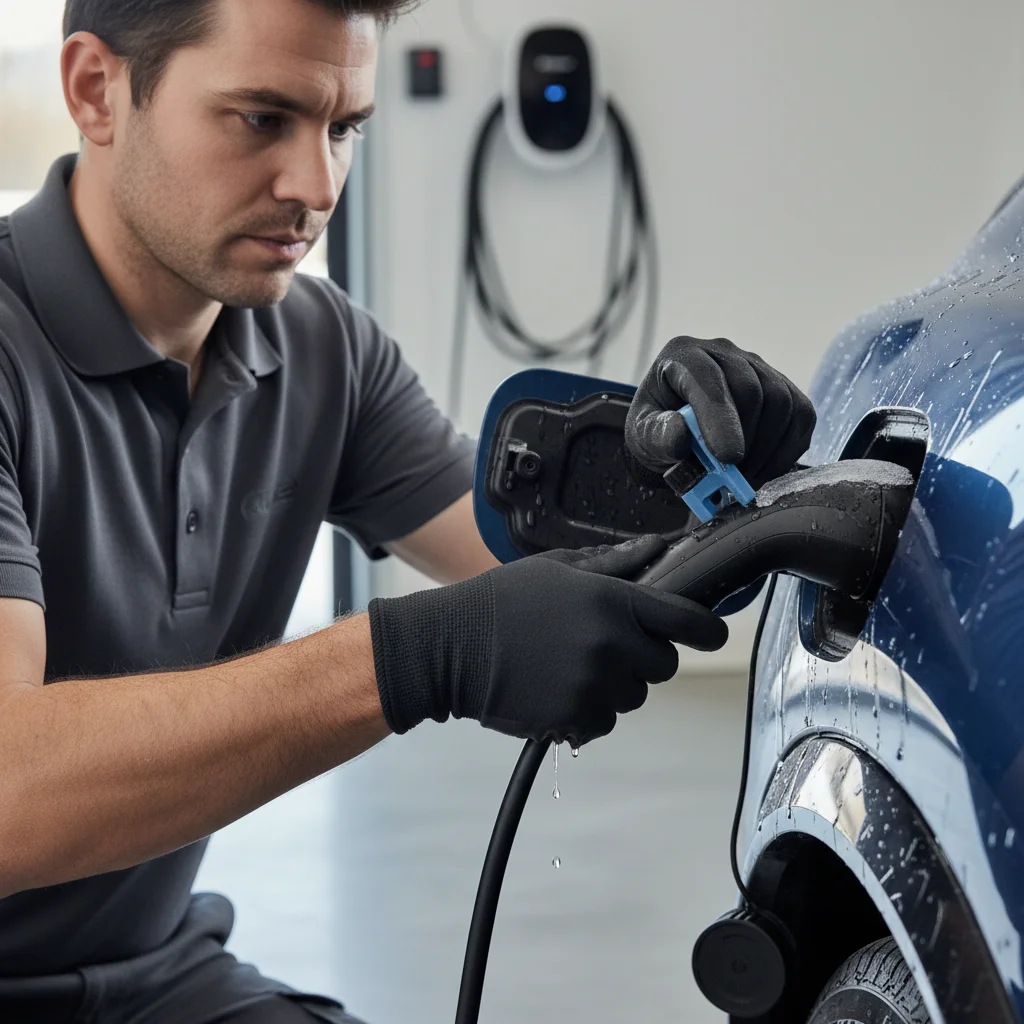
A slack pull means stop
If Ford’s override has firm resistance and you heard a click, but the handle stays put, go back to the network. Ask them to release the stall again. If the pull feels slack, with almost no resistance, stop. The cable to the hook may be off, or the hook itself may be jammed. That’s a port assembly problem you won’t solve in a lot. Don’t pry on the pins. A Ford shop has to inspect it.
A firm pull with a click, then a free handle, means you bypassed an electrical latch. Address the 12-volt and the messy session next, or you’ll repeat this.
If the car is still on the road
A disabled Mach-E follows the same rules as any disabled car in Virginia, Maryland, and the District. None of the three codes add a special stuck-cable exception. Confirm current rules with the agency that owns the road.
On Virginia interstates, VDOT Safety Service Patrol covers corridors including I-66. Drivers reach help through Virginia 511. VDOT describes incident and debris clearance and short-term traffic control. It doesn’t describe EV charging or a charge-port release. If you stall on I-66, get out of the travel lane first, then work the cable.
On the 495 Express Lanes, pull to the left shoulder. Those lanes sit in the median. On the 95 and 395 Express Lanes, pull to the nearest shoulder. Stay in the car until help arrives. Express Assist helps with minor mechanical issues and will call a tow. It doesn’t tow, and it doesn’t publish EV charging. The American Legion Bridge carries the Beltway between McLean and Montgomery County. It’s a high, wind-exposed span with limited shoulder. If you’re in a travel lane, call 911.
Maryland drivers on state primary roads can dial #77 for CHART. CHART lists tire changes, jump starts, about one gallon of gas, and radiator water. It doesn’t publish EV charging or a port release. On National Park Service parkways, a disabled vehicle is reported to the US Park Police at 202-610-7500. Shoulders can be narrow or absent.
No DDOT motorist-assistance patrol turned up for the District. Drivers there rely on MPD, private plans, and Park Police on the parkways. Pepco, Dominion Energy Virginia, and NOVEC don’t publish a service that charges a stranded car. NOVEC serves parts of Loudoun, including much of Sterling and Ashburn. Dominion serves most of Northern Virginia. Confirm the serving utility by address. None of those pages unstick a CCS handle.
After the handle slides, read the dash
Freeing the cable doesn’t invent range. Ice already cut what the pack can give. A crawl on I-66 does the rest. So does a sit on the Beltway with heat on. Read the dash. If you’re still too low to reach the next stop you trust, you need energy in the pack. Another tug on the override won’t help.
The operators Charge Pro DC connects you with bring a 240-volt Level 2 source to the car. On a CCS Mach-E they use an adapter. A typical roadside hookup adds about 10 to 20 miles of range in 15 to 30 minutes of charging time. That’s charging time, not an arrival time. They also jump or replace a dead 12-volt on site. That’s what frees most locked ports. They handle Tesla and every major EV brand. They quote you before starting and bill you directly.
Charge Pro DC is a referral line. It matches stranded EV drivers with independent local operators. It performs no work, owns no trucks, and sets no prices. Non-Tesla EV rescue is the path for a CCS Mach-E. Mobile EV charging is the path once the connector is free and the pack is still short. For a western-suburb ice commute, see Leesburg EV roadside assistance when cold weather cuts your range.
When to call the referral line
Call when the 12-volt is dead and the frunk won’t open. Call when Ford’s override is missing, slack, or broken. Call when the handle is free and the pack is still too low to roll.
We serve the DC area, the District of Columbia, Maryland, and Virginia. We don’t publish arrival times or hours. The operator quotes you before work starts. The pros we connect you with are licensed and insured.
Call (202) 629-0844 when the stall, the 12-volt, and Ford’s override still leave you locked. We’ll connect you with a local operator.