A Jaguar I-Pace that won’t start here usually has a dead 12-volt. The traction pack is often still sitting full. The usual setup is a long sit in a garage. It isn’t a pack that hit zero on the Beltway. You walk up and the car does nothing at all.
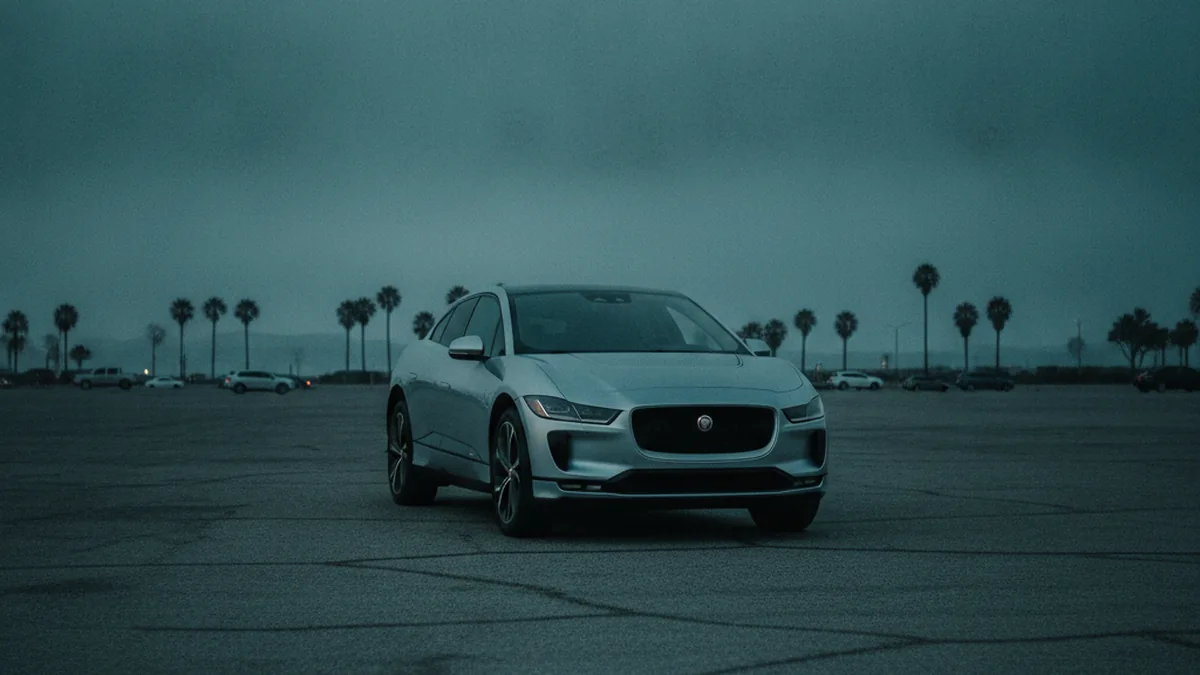
A silent I-Pace is usually the small battery
The I-Pace runs two electrical systems at once. The high-voltage pack is what moves the wheels. A regular 12-volt battery runs computers, locks, and screens. Those computers have to wake before the pack can engage. If the 12-volt is dead, the pack stays locked out. Range left from the last drive doesn’t matter.
Owners often assume the big battery died overnight. That’s almost never the real fault on this car. The small battery just can’t boot the car. These signs point straight at the 12-volt:
- Flush door handles stay retracted when you walk up
- The key fob won’t unlock the car at all
- The dash, the screens, and the cabin lights stay dark
- There’s no welcome chime and no lock clunk
If the dash lights, throws a warning, then dies, stop. That’s a different fault from a silent car. It needs a dealer scan, not another jump. For the version where nothing happens, start with the 12-volt. See when an EV 12 volt dies on a trip for the wider pattern.
Garage sits are what kill an I-Pace 12-volt here
This metro parks cars in dark structures for hours or days. That’s hard on a 12-volt that still feeds standby loads. Leave an I-Pace long enough and the small battery drops. It falls below the voltage the computers need to wake.
Airport parking is the most common version of this stall. Travelers leave an I-Pace at Dulles for a week. They come back to a car that won’t wake. MWAA has Level 2 charging in Garage 1 and Garage 2. Reagan National puts EV charging on Level 1 of Parking Garages 1 and 2. You return to whatever that small battery has left after a long Economy Lot sit.
The same sit happens in WMATA park-and-ride decks. The Union Station garage in the District is a long-dwell lot too. Office garages in Tysons go dark after a full workday. Tysons Corner Center is a mall garage with the same pattern. Luxury I-Pace cars in McLean and Potomac sit in quiet driveways. Apartment lots in Arlington, Alexandria, and Silver Spring often mean the car lives unplugged.
Pepco, Dominion Energy Virginia, and NOVEC publish home EV programs. None of the utility pages we reviewed will charge a stranded car. A home rebate or a time-of-use rate won’t wake a dark I-Pace. You still need the 12-volt brought back on site.
Early I-Pace cars wear the 12-volt out while parked
The I-Pace has been on these roads long enough to age. The 2018 to 2020 cars are old enough for the original 12-volt to be tired. Jaguar changed the low-voltage setup for the 2021 model year. Pre-2021 cars are the ones that go dark while parked.
Those earlier cars also use two 12-volt batteries under the frunk panel. A weak unit can drag the whole low-voltage system down. A jump has to reach the right post. Confirm the layout in your own model-year manual first. Don’t clip a post until you’ve checked that page.
Heat and cold both hurry that 12-volt decline. Summers run hot and humid, with stretches above 90F. A lead battery left low starts to sulfate, which is permanent. Winters swing from mild days to sudden ice. Dulles runs colder and snowier than Reagan National. Loudoun, upper Montgomery, and Prince William see harder freezes. A parked I-Pace still keeps modules alive in that cold. The 12-volt is what pays for it.
If yours is a 2018 to 2020 car, watch a slow wake. Treat a glitchy startup as a warning, not a fluke. A load test tells you if the 12-volt is done. The EV 12-volt replacement guide covers what to do after the jump.
Get into the cabin before you open the frunk
A dead 12-volt leaves the flush handles retracted. You can’t grab a door the usual way. The mechanical key lives inside the key fob. Slide the release and pull the metal blade out.
The hidden lock is on the driver’s door. Push the front of the handle inward so the back edge pivots out. Pull the handle out as far as it comes. That move exposes the lock cylinder behind the handle. Insert the key blade and turn it clockwise. The door unlocks even with zero power in the car.
Don’t pry a flush handle to force it. You can break the mechanism and still be locked out. Once you’re in the cabin, you can reach the frunk release. Other luxury EVs use this same lockout trap. The Taycan version is covered in Porsche Taycan won’t start.
Open the frunk, then jump the right post
The I-Pace 12-volt lives in the frunk under a removable center panel. A dead 12-volt is also what keeps that lid latched. After you’re in the cabin, look in the right-side footwell. There’s a black plug in the right-side footwell. Behind it is the manual frunk release cable. Pull that cable and the frunk should pop.
Lift the center panel to see the batteries. On pre-2021 cars you’ll see two batteries. The positive posts are the ones with red caps. Jump it in this order:
- Clip the red clamp to the exposed positive post with the red cap
- Clip the black clamp to bare, unpainted metal on the chassis
- Don’t clip the black clamp to the battery’s negative terminal
- Let the donor source feed the battery for two to three minutes
- Then try to power the car up and bring it to READY
Grounding to the body keeps any spark away from the battery. Pre-MY21 and MY21 layouts aren’t the same. Match the post and panel to your own manual. For the full EV sequence, see how to jump start an EV.
If the car wakes, then dies again in a day or two, stop. That 12-volt is likely at the end of its life. Another jump won’t fix a battery that’s already failing. See EV battery dies again after a jump for the next step.
What the no-start is telling you
| What you see | Most likely cause | What to do |
|---|---|---|
| Handles stay in, dash dark, no chime | Dead 12-volt | Manual key, then jump the frunk posts |
| Car wakes, warns, then shuts off | High-voltage or DC-DC fault | Stop jumping and get a dealer scan |
| Starts, then the 12-volt dies in days | Failing 12-volt near end of life | Load test and replace the 12-volt |
| Stays dark after a clean jump | Deeper electrical fault | Road diagnosis or a tow |
| Dead in a garage with no donor car | No 12-volt source on hand | Call for a mobile jump on site |
Read the table as a filter, not a diagnosis. The dark, silent car is the 12-volt path. The car that wakes and then quits isn’t. Don’t keep jumping a car that shuts down after a warning. You can hide a high-voltage fault that way.
When the pack is empty, the dash still talks
An empty traction pack can feel like a no-start, because the car won’t go. The difference is what the dash is doing. A pack at zero still usually shows a range figure or a charge warning. A dead 12-volt gives you a black interior.
If you’re really at zero on a freeway, the next steps change. On the 495 Express Lanes, pull over to the left shoulder. Those lanes sit in the median, not on the right. On the 95 and 395 Express Lanes, pull to the nearest shoulder. Stay in the car until help arrives. The Woodrow Wilson Bridge crosses the Potomac between Alexandria, Oxon Hill, and the District. The American Legion Bridge crosses between McLean and Montgomery County. Don’t stand in a travel lane to wait for a jump.
VDOT Safety Service Patrol covers Virginia interstates, including the I-66 corridor. Published material covers incident clearance, not EV charging. In Maryland, MDOT SHA CHART Emergency Traffic Patrol publishes jump starts. CHART hasn’t published an EV charging service. In the District, we found no DDOT motorist-assistance patrol. District drivers use MPD, a private plan, or US Park Police on the parkways. National Park Service parkways such as the Baltimore-Washington ban commercial trucks over 10,000 lb.
When to stop and call a local operator
Stop if the mechanical key won’t turn. Stop if the frunk cable won’t pop the hood. Stop if the car stays dark after a clean jump. Forcing a handle or the wrong post can do more damage than a quoted visit.
A tight garage stall is the other reason to stop. So is a shoulder on I-270, I-66, or the Capital Beltway. Jumping a luxury EV in live traffic isn’t a driveway job.
Charge Pro DC is a referral line. We match stranded EV drivers with independent local mobile rescue operators. We don’t own trucks, and we don’t send our own technicians. The operator quotes you before starting and bills you directly. The pros we connect you with are licensed and insured.
What they bring is a 12-volt jump. They can bring a 240-volt Level 2 source if the pack is low. For a Jaguar they use a CCS or J1772 adapter on that source. A typical top-up adds 10 to 20 miles of range. That takes 15 to 30 minutes of charging. That’s charging time, and it isn’t an arrival time. For the non-Tesla call path, use non-Tesla EV rescue. See dead EV in a Tysons garage after a long sit for that stall.
Frequently asked questions
Why won’t my Jaguar I-Pace start?
The usual cause here is a dead 12-volt after a garage sit. The I-Pace needs the 12-volt to wake its computers. Without that, handles stay in, the fob stays quiet, and the dash stays black. Jump the 12-volt first, before you assume the pack is empty. If a clean jump still leaves it dark, it likely needs a dealer scan.
How do I get into an I-Pace when the handles won’t present?
Use the mechanical key inside the fob. Slide the release and pull out the metal blade. Push the front of the driver’s handle in so the rear edge pivots out. Pull the handle out to expose the lock cylinder. Turn the key clockwise to unlock the door. That works with no power in the car.
When should I call instead of jumping it myself?
Call if you can’t get the door or the frunk open. Call if a clean jump leaves the car dark. Call if you’re on a shoulder or a bridge with no room to work. A local operator can jump the correct post on site. They confirm the quote with you before they start.
If your I-Pace is dark in a Dulles garage, a Metro deck, or a driveway in Rockville, call Charge Pro DC at (202) 629-0844. We’ll match you with a local operator. The operator sets the price and the timing with you directly.