Your EV came back after a jump, then went dark again. That second death is almost always the 12-volt, not the traction pack. A battery dying after jump start means the 12-volt can’t hold a charge. Copy the warning. Stay with the car. Ask for a quoted local operator, not another guess jump.
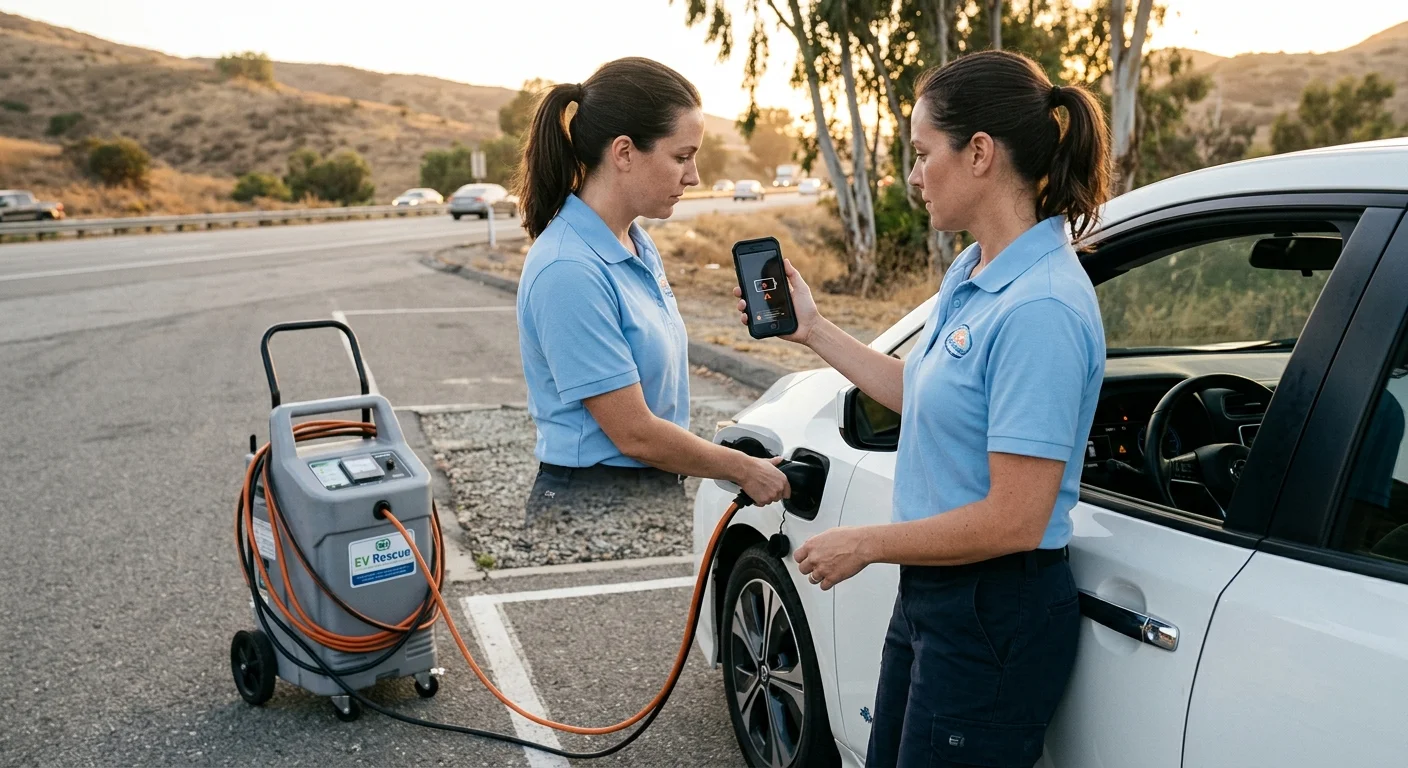
The 12-volt failed, not the pack
Every EV in the District, Maryland, and Virginia still uses a small 12-volt battery. It wakes the computers, unlocks the doors, and closes the contactors so the pack can drive. The pack moves the car. The 12-volt turns the car on.
A jump can supply a burst of current. Computers come back, then the 12-volt sags again. Screens go dark and the app drops. From the seat the car looks fully dead. The pack can still hold miles the whole time.
That’s the mix-up after a battery dying after jump start. People hear “dead battery” and think they burned the last mile. After a repeat collapse, treat it as a 12-volt failure. Let a pro test this car before you name a cause. Don’t rewrite the dash in your own words. Copy 12V, low voltage, propulsion, or charging text exactly as shown.
Note whether the doors, lights, charge screen, shifter, and app still work. Those notes describe the failure without naming a cause. Use the owner’s manual for your model year, the official app, or the maker’s support page. Don’t follow steps written for a different brand.
If the display mentioned low voltage, start with our guide to a dead 12-volt versus the pack. That page sorts the two systems.
Why the second death happens here
The usual call in this metro isn’t a pack that hit zero on a highway. It’s a car that sat. Office decks around Tysons Corner Center do it. WMATA park-and-ride garages do it. Long-stay airport parking does it. The 12-volt keeps modules alive while you’re gone, then can’t wake the car.
At Dulles, MWAA lists Level 2 charging in Garage 1 and Garage 2. Many travelers still use the Economy Lot and the shuttle at Curb 2F. After a week away, the car often won’t wake. The pack may still show a number, but the 12-volt doesn’t.
Reagan National is usually a shorter sit. Complimentary EV charging is on Level 1 of Parking Garages 1 and 2. A weak 12-volt can still die there after a long weekend.
Winter isn’t even across the metro. Dulles runs colder and snowier than Reagan National. Recurrent Auto studied more than 30,000 EVs. A typical car keeps about 80% of range at 32F and about 70% at 20F. A 12-volt on the edge often fails on a cold start in Ashburn, Leesburg, or Germantown.
Beltway gridlock and an I-95 crawl drain charge without covering distance. Heat on in a standstill can drop a weak 12-volt even when the pack isn’t empty.
Older housing adds another pattern. Takoma Park’s housing stock is about 90% pre-1980. Arlington, Alexandria, Silver Spring, and Hyattsville add apartment density. Cars sit in unheated garages and open lots.
Pepco, Dominion Energy, and NOVEC EV pages reviewed don’t offer a stranded-car charge.
Write it down before anyone tries again
A second blackout is new information. Capture a timeline while the details are still sharp.
- What the car was doing before the first loss of power
- The exact warning text, in the order it appeared
- Who performed the first jump, and with what gear
- Which functions returned afterward
- What happened in the minutes before it died again
Don’t fill gaps with a theory. A tired 12-volt, a weak converter, and a charging fault can look the same from the seat. None of those labels is confirmed until someone tests this vehicle.
Photograph the full dash and center screen if you can do it safely. Don’t crop to one banner. If messages cycle, catch each one.
Location has to be specific. “Maryland” isn’t enough. Give the street, garage level, gate instructions, Beltway direction, and nearest exit. Left-shoulder access on the 495 Express Lanes is its own problem. A locked Model Y on a Rockville driveway is another.
On the 495 Express Lanes, Transurban and VDOT tell you to pull to the LEFT shoulder. Those lanes sit in the median. On the 95 and 395 Express Lanes, pull to the nearest shoulder. Stay in the car until help arrives. Express Assist handles minor mechanical issues and will call a tow. It doesn’t tow. Published material doesn’t describe EV charging.
If you’re on an NPS parkway, call the US Park Police at 202-610-7500. That covers the Baltimore-Washington Parkway, the George Washington Memorial Parkway, Clara Barton, Rock Creek, and Suitland. Commercial vehicles and trucks over 10,000 lb are banned.
Maryland drivers on I-495, I-270, US-50, or MD-295 can dial #77 for CHART. CHART technicians change tires, jump-start cars, and handle similar roadside help. A CHART jump that dies again is still a 12-volt signal. VDOT’s Safety Service Patrol covers Virginia interstates. Published VDOT pages describe incident clearance and short-term traffic control.
No DDOT motorist-assistance patrol turned up in the District materials reviewed. DC drivers lean on MPD, a private roadside plan, or Park Police on the parkways. Give the quadrant with any District address, because NE, NW, SE, and SW repeat street names. Disabled-vehicle rules in DC, Maryland, and Virginia treat an EV like any other car. None of the three codes reviewed has a special out-of-charge section.
On the Woodrow Wilson Bridge you’re at Alexandria, Oxon Hill, and the District. On the American Legion Bridge you’re between McLean and Montgomery County. Say which side and which direction.
Don’t make a second jump the default
Power coming back once isn’t a repair. It only shows the car answered a burst of current. If it dies again, stop treating this like a loose clamp.
This page doesn’t publish repeat-jump steps. Connection points, access panels, and allowed equipment change by model year. Gas-car clips can miss the 12-volt post on a Tesla, Rivian, or Hyundai.
Read the official procedure for your exact make, model, and year. If the book says don’t try again, don’t. If you can’t confirm the procedure, don’t improvise on a shoulder. Tell the next person that power already returned once and failed again.
See how to jump start an EV for 12-volt background. When an EV 12-volt dies on a trip covers the long-sit pattern in garages and airport lots.
If someone else did the first jump, ask what they used and write it down. Don’t restage it. The next pro needs a clean account, not a second experiment.
Replacement may be the real talk. EV 12-volt replacement covers what to ask before anyone pulls the battery. Charge Pro DC doesn’t diagnose cars. The independent operator you’re matched with quotes before they start, then bills you directly. Some operators jump or replace a dead 12-volt on site. Ask what they can do for this model before they open a panel.
If you see smoke, a burning smell, or visible damage, stop. Call emergency services. Don’t let a bystander invent a workaround around a high-voltage vehicle.
Roadside help or a service center
Choose based on what you need right now. Roadside help fits when the car won’t unlock, won’t shift, or can’t leave this spot. Ask whether the operator supports your brand and a 12-volt job. A pack boost is the wrong request if the computers won’t wake.
Operators in this network can bring a 240-volt Level 2 source to the car. That’s a native NACS plug, with a CCS or J1772 adapter for non-Tesla EVs. They typically add 10 to 20 miles of range in 15 to 30 minutes of charging. That’s charging time, never an arrival time. It only helps once the car will accept a plug. A dark 12-volt often blocks that step.
A service center fits when you need testing, a programmed replacement, or follow-up after a repeat failure. Send the same timeline and photos. Say the car died again after a jump.
Sometimes you need both. An operator may get the car to move, or get it onto a wrecker. If towing comes up, follow the maker’s current tow steps for your model. Confirm the plan with the operator before any work starts.
For a Tesla 12-volt job at the bumper, see Tesla 12-volt battery jump. For a general match across the District, Maryland, and Virginia, see EV roadside assistance. Non-Tesla drivers can start with non-Tesla EV rescue. Charge Pro DC is a referral line. We match stranded drivers with independent local mobile rescue operators. We don’t own trucks. We don’t employ technicians. We don’t set prices. The pros we connect you with are licensed and insured. They handle Tesla and every major EV brand.
If the car still won’t wake
Keep the notes in your phone. When you want a match with a local operator, call Charge Pro DC at (202) 629-0844. Give the model, the year, the exact warnings, the location, and what followed the first jump. The operator quotes before any work starts.