You come back to a Burke garage after a long Inner Fairfax workday. The EV won’t wake. The traction pack is often still sitting on a usable percentage. The 12-volt spent the day keeping computers and locks alive, then it quit.
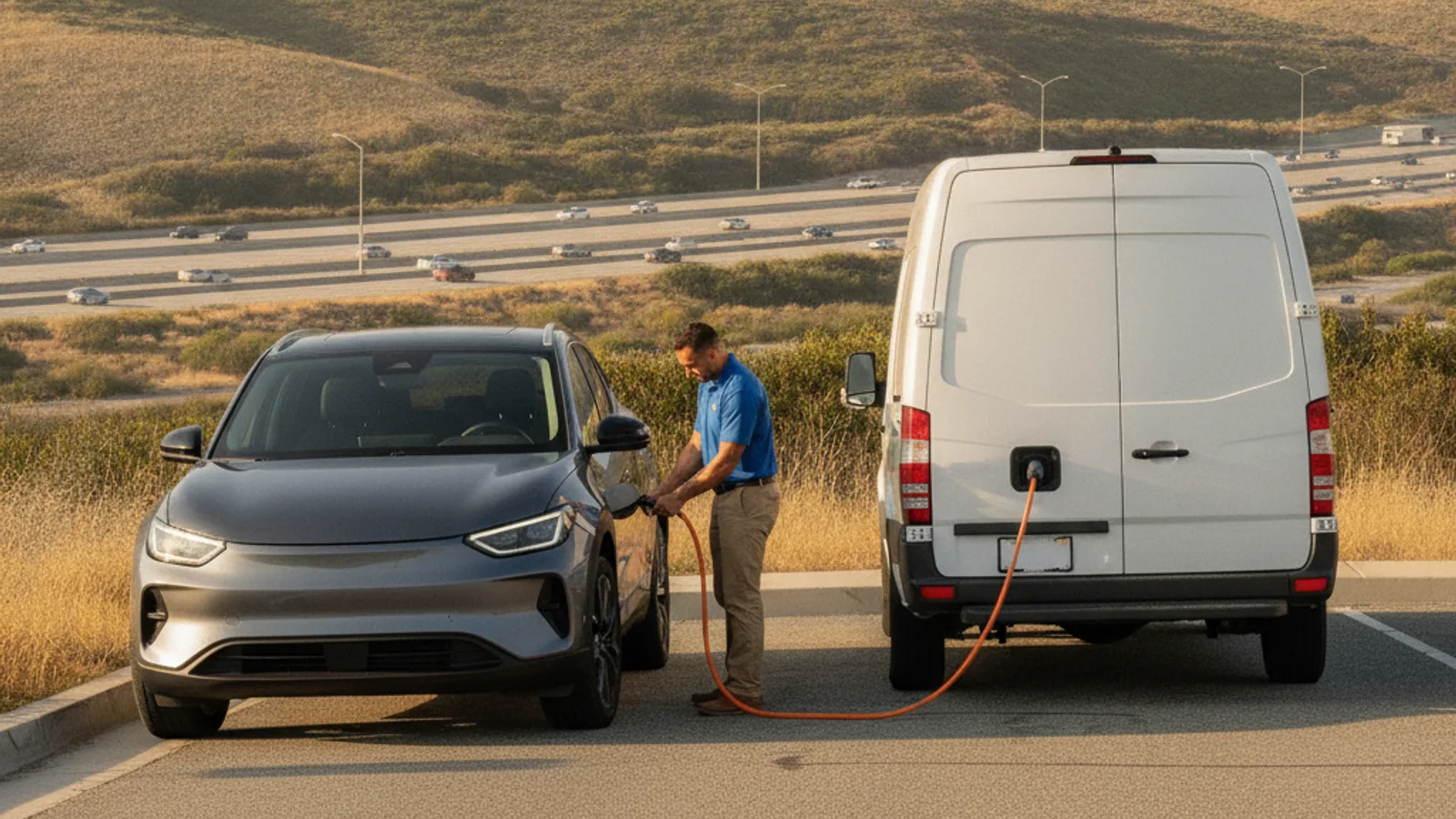
Why Burke cars die in the garage, not on the pack
Burke is a wooded Inner Fairfax community south of the Beltway. It isn’t an incorporated city. Fairfax County and the City of Fairfax are separate places. Name the county when you call. That keeps the operator out of the wrong place.
You get here on the Fairfax County Parkway, also signed VA-286. Braddock Road, Ox Road, and Burke Lake Road feed the same grid. Ox Road is VA-123. Most homes have a driveway. Dominion Energy serves the addresses, and home charging is common. The weekday stall is usually not a house with no plug.
It’s the car you left at the Burke Centre VRE station at dawn. Commuter lots hold vehicles all day while you take the VRE. Office garages around Inner Fairfax do the same. A 12-volt battery runs the wake circuit even when the big pack is full. A full workday is enough for a weak one to drop.
Weekend lots follow the same pattern. Burke Lake Park, South Run Recreation Center, and Lake Braddock hold cars for hours. You return to a silent dash and a pack that isn’t empty.
Census figures put 43,336 people in Burke. More than half the housing was built before 1980. Some driveways never got a Level 2 circuit. Even then, the common stall is the all-day lot. It’s not the renter with nowhere to plug in.
Winter ice on the curving parkway wears a tired 12-volt. Humid summer heat does the same. Cabin climate control while you sit still draws from that small battery. A car that was fine at 7 a.m. can be dark at 6 p.m.
Our Burke EV charging page covers the local picture if you’re planning. Skip it if you’re already stuck.
Dark dash or empty pack: say what you see
“My EV died in Burke” covers two different failures. A car that showed a zero-range warning before it stopped is a traction-pack problem. A car that’s dark after sitting all day is usually the 12-volt.
The 12-volt is a small accessory battery. It isn’t the battery that moves the car. It powers computers, locks, and the circuit that wakes the high-voltage pack. When it’s too low, the big pack can be half full. The car can still do nothing. The dash stays dark. The doors may not release. The app may drop offline.
Read the screen if anything is still lit. Repeat the words as they appear. “Battery empty, pull over” isn’t the same as a blank display. The second pattern points at low voltage. Only your maker’s manual confirms what a given message means on that model.
Don’t invent a jump procedure from a forum post. Access panels and approved 12-volt steps change by brand and year. Use the owner’s manual or the maker’s app. That’s the right reference, not a general article.
Tell the operator what still works. Note interior lights, door handles, the phone app, and the charge-port latch. A car that unlocks and shows range but won’t ready is one case. A car that’s fully dark is another.
If the 12-volt is the failure, an on-site jump is often the first move. See our Tesla 12-volt jump service and the guide on when an EV 12-volt dies on a trip.
Getting an operator into a Burke garage
The operator has to reach the bumper, not just the street. A VRE garage, an office structure, and a private driveway are three different jobs.
Give the level, the row, and a nearby landmark inside the garage. “Burke Centre VRE, upper deck, near the stairs” is usable. “In the garage” isn’t. If the structure has a height bar, read it and say the number. A mobile rescue vehicle is a van or a small truck, not a sedan. Low clearance can block the truck.
Gated lots and after-hours office decks add a step. If you have a code, share it. If you don’t, plan to meet the operator at the gate. A locked garage they can’t enter is the same as no access. Don’t assume they can follow another car in.
Slope matters too. Streets off Braddock and Ox Road grade more than they look. A car nosed into a curb on a hill may not sit well. Charging cables and jumper leads need a safe run. Say whether the ground is flat.
If you already left the lot, the car may quit on the Parkway. Treat that as a safety stop first. Get as far right as the pavement allows. Turn the hazards on. If you’re in a travel lane with no room, call 911 first.
The Parkway is fast, curved, and short on shoulder. VDOT’s Safety Service Patrol works Virginia interstates. It handles debris and short-term traffic control. It doesn’t charge an EV. You reach that patrol through Virginia 511 on an interstate. Burke’s local roads are county roads. Don’t wait on a patrol that isn’t assigned to them.
A side street off Ox Road is a better work site. Burke Lake Road works too. A parkway shoulder isn’t. If you can still roll a short distance, do that. If you can’t move, stay with the car and say so.
Springfield, Fairfax City, Centreville, and Lake Ridge sit on the same commute. Give the road and the nearest cross street. “Somewhere in Burke” doesn’t help an operator find you. If you made it toward Springfield before the car quit, name that road too.
What they need before they take the call
Charge Pro DC is a referral line. We match you with an independent local operator. The operator quotes you before work starts and bills you directly. They won’t accept a Burke call on a vague report.
They need the vehicle. Make, model, year, and the plug type. Tesla uses NACS. Most other EVs use CCS or J1772. The truck has to match the car.
They need the site. VRE garage, office structure, driveway, or parkway shoulder. They need the symptom, not your diagnosis. “I don’t know. The dash is dark. The app still sees the car. Range showed forty percent this morning.” That’s usable. A confident guess that’s wrong wastes the trip.
Share whether anyone is with the car. Share whether it’s blocking a travel lane. Share whether the charge port still opens. Those three details change what the operator loads before they roll.
Mobile EV charging is the conversation for a depleted pack. EV roadside assistance is the first call when you’re not sure.
Jump, a 240-volt top-up, or a tow
A dead 12-volt often wakes with an on-site jump. The operator checks that against your model’s procedure. If it takes a jump and then dies again, it needs a replacement. Another boost isn’t the fix. That’s a shop job once you can move.
If the traction pack is actually empty, a jump won’t drive you home. Maybe you left Burke a little low. Maybe you sat in traffic on the way to Springfield. Maybe cabin heat ate the last miles while you waited in a lot. The operator brings a 240-volt Level 2 source to the car. Native NACS for Tesla. A CCS or J1772 adapter for other brands. Typical add is 10 to 20 miles in 15 to 30 minutes of charging. That’s charging time. It’s never an arrival time.
Some scenes aren’t a roadside charging job. That includes a car that won’t accept current. It includes a garage level the truck can’t enter. It includes an active parkway lane with no safe shoulder. In those cases the operator may say transport is the tool that fits. Out-of-charge recovery covers that path.
Don’t force a mobile charge onto a car that won’t take current. Charging faults belong to the maker’s docs and the person on scene.
Dominion Energy doesn’t send a truck to charge a stranded car. None of the utilities in this metro publish that service. A patrol won’t do it either. The independent operator is who actually brings 240 volts or a 12-volt jump.
Virginia disabled-vehicle rules treat an EV the same as any other car. There’s no separate out-of-charge statute. If you’re on a public road, the same pull-over and hazard rules apply.
When to call
Call when you’re in Burke with a dark dash after a long sit. Call if you stopped on the Parkway and can’t sort it out. We’ll connect you with a local EV rescue operator. Call (202) 629-0844. The operator sets the terms, confirms the plug, and quotes the work with you.