Roadside assistance for EV drivers here follows three sets of patrol rules, not one. The District, Maryland, and Virginia each handle a disabled car differently. None of those patrols publish an EV charge as part of the stop. Independent operators quote you first, then bill you directly.
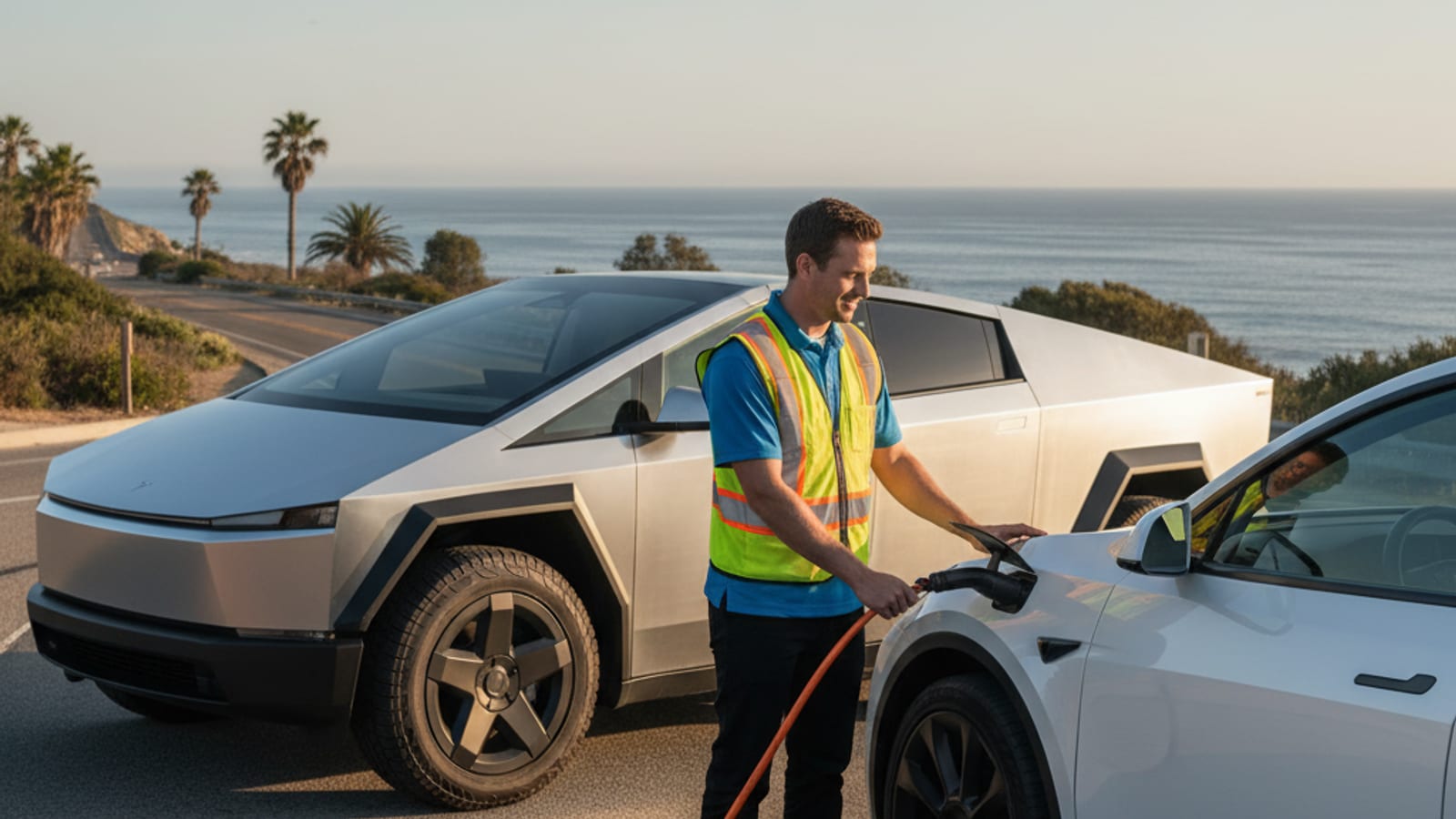
If you’re stuck right now, start with the pavement under the tires. Then decide whether the car is empty or just asleep. Those two failures need different kinds of help. The EV roadside assistance we refer covers Tesla and every major EV brand. Charge Pro DC doesn’t do the work itself. We match you with an independent local operator.
This metro is three roadside systems
Cross a river and the agency on the shoulder changes. The Woodrow Wilson Bridge is the clearest local example. It carries the Beltway over the Potomac River. Alexandria, Oxon Hill, and the District meet on that span. A stall there isn’t one state’s problem. The American Legion Bridge does the same job between McLean and Montgomery County. Both decks are high, wind-exposed, and short on shoulder. Say the jurisdiction out loud when you call.
Virginia’s interstate patrol
VDOT’s Safety Service Patrol covers Virginia interstates that run through this metro. I-95 and I-66 are the ones most drivers hit. Drivers reach that patrol through Virginia 511. VDOT’s published pages describe incident clearance, debris, and short-term traffic control. They don’t describe charging an electric vehicle. Treat that silence as an absence.
Northern Virginia’s I-66 corridor has a shoulder and express operation. That operation runs in weekday peak windows. Confirm the current window on 511 if you’re stopped there. A patrol can make the scene safer. It won’t deliver 240 volts to your pack.
Maryland’s CHART trucks
MDOT SHA’s CHART Emergency Traffic Patrol covers the Baltimore/Washington metropolitan area. Western Region hours run from 5 am to 9 pm. CHART technicians change tires and jump 12-volt batteries. They also carry about a gallon of gas and radiator water. That’s the published list, and a traction pack isn’t on it.
On a Maryland state primary, you can dial #77. That covers I-495, I-270, US-50, and MD-295. Use it for a live-lane stall. Don’t treat that number as a charger.
The District has no motorist patrol on file
No DDOT motorist-assistance patrol turned up in the sources we checked. That’s an observed absence, not a rumor. District drivers rely on MPD, a private plan, or Park Police on the parkways. If you’re on a numbered street, say the quadrant. NE, NW, SE, and SW reuse the same names. A dispatcher can’t guess SW from NE.
Park Service pavement
The National Park Service runs several limited-access parkways through this area. The Baltimore-Washington Parkway and the George Washington Memorial Parkway are the ones drivers hit most. Clara Barton, Rock Creek, and Suitland sit in the same family. These are scenic, limited-access roads with narrow or missing shoulders.
Commercial vehicles and trucks over 10,000 lb are banned there. Don’t assume a heavy truck can legally enter. A disabled vehicle on the Baltimore-Washington Parkway is reported to US Park Police at 202-610-7500. Make that call first, then work the rest from a legal place.
Express lanes are their own world
Transurban operates the 495, 95, and 395 Express Lanes with VDOT. Tolls move with traffic, and E-ZPass and E-ZPass Flex are the published tags. Flex set to HOV-3 rides free, per Transurban.
Express Assist is the published patrol on those lanes. It helps with minor mechanical issues and will call a tow. It doesn’t tow, and it doesn’t charge an EV.
On the 495 Express Lanes, pull over to the left shoulder. Those lanes sit in the median. On the 95 and 395 Express Lanes, pull to the nearest shoulder. Stay in the car until help arrives. That’s Transurban’s published safety rule.
I-66 inside the Beltway is tolled in peak hours. Outside the Beltway it has Express Lanes of its own. The Dulles Toll Road is VA-267, run by MWAA. The Dulles Greenway is a separate private road west of the airport. I-270 and the Beltway’s general lanes carry no toll. Know which ribbon you’re standing on. For Beltway stalls, keep out of charge on the Capital Beltway open. For the Wilson span, use dead EV on the Woodrow Wilson Bridge.
Two kinds of dead, and they aren’t the same
A silent EV fools people on the shoulder. Neighbors will tell you the pack is empty. Often it isn’t empty at all.
An empty traction pack
You burned the last miles in traffic. Heat or AC kept running while the wheels sat still. The Beltway does that on a normal Tuesday. I-95 through Prince William does it in a backup. Sitting still spends charge without covering any distance.
Cold cuts range further than most dashboards admit. Recurrent Auto studied more than 30,000 EVs in winter. A typical car keeps about 80% of range at 32F. At 20F that retained range is about 70%. Most lose 20 to 35% in real cold. Heat-pump cars averaged about 83% retained. Cars without a heat pump averaged about 75%. Cabin heat comes straight from the pack. Those figures aren’t Tesla’s, so don’t quote them as Tesla’s.
Dulles runs colder and snowier than Reagan National. That’s a real local split. Loudoun, upper Montgomery, and Prince William feel it first. The District and the inner Virginia core stay milder. Winter in Ashburn or Leesburg hits harder than a night in the District.
January 2022 is still the story people tell. Snow and a multi-truck crash shut about 50 miles of I-95 near Fredericksburg. The dates were January 3 and 4, just south of this metro. The road closed at 5:30 in the evening on January 3. It reopened at 7:40 in the evening on January 4. Hundreds of drivers sat overnight with the heat on. They were stuck more than 36 hours. An EV in that mess dies from idle drain, not from miles on the odometer.
If the pack is truly at zero, a tow isn’t your only option. Operators we connect you with bring a 240-volt Level 2 source to the car. Tesla takes a native NACS plug. Other EVs use a CCS or J1772 adapter. A typical stop adds 10 to 20 miles. Charging time is 15 to 30 minutes. That window is charging time, never an arrival time. Mobile EV charging is that visit.
A dead 12-volt battery
Most EVs still carry a small 12-volt battery. It wakes the computers and closes the high-voltage contactors. When that battery dies, the car looks finished. Screens stay black and doors may not answer. The start command does nothing. The pack can still hold a week’s commute.
This is the airport-lot pattern. You left the car for a week, then came back and it won’t wake. Reagan National publishes complimentary EV charging on Level 1 of Parking Garages 1 and 2. Spaces are first-come and first-served. Those garages connect directly to the terminal. Dulles publishes Level 2 charging in Garage 1 and Garage 2. Confirm stall counts with MWAA, and don’t memorize a number from a blog. Union Station’s garage is a long-dwell lot too. WMATA park-and-ride garages produce the same week-long sit. Confirm a specific WMATA garage’s plugs on WMATA’s page before you count on them.
Tysons Corner Center and Silver Line lots create the same sat-all-day failure. So do office garages in Arlington, Reston, and North Bethesda. The car didn’t drive down to empty. The 12-volt quit from sitting.
A jump often wakes it. An on-site replacement is next if the battery is done. Technique matters on an EV, because wrong clamps can wreck a module. How to jump start an EV without frying the 12 volt system covers the checks.
Operators quote you. Utilities don’t roll.
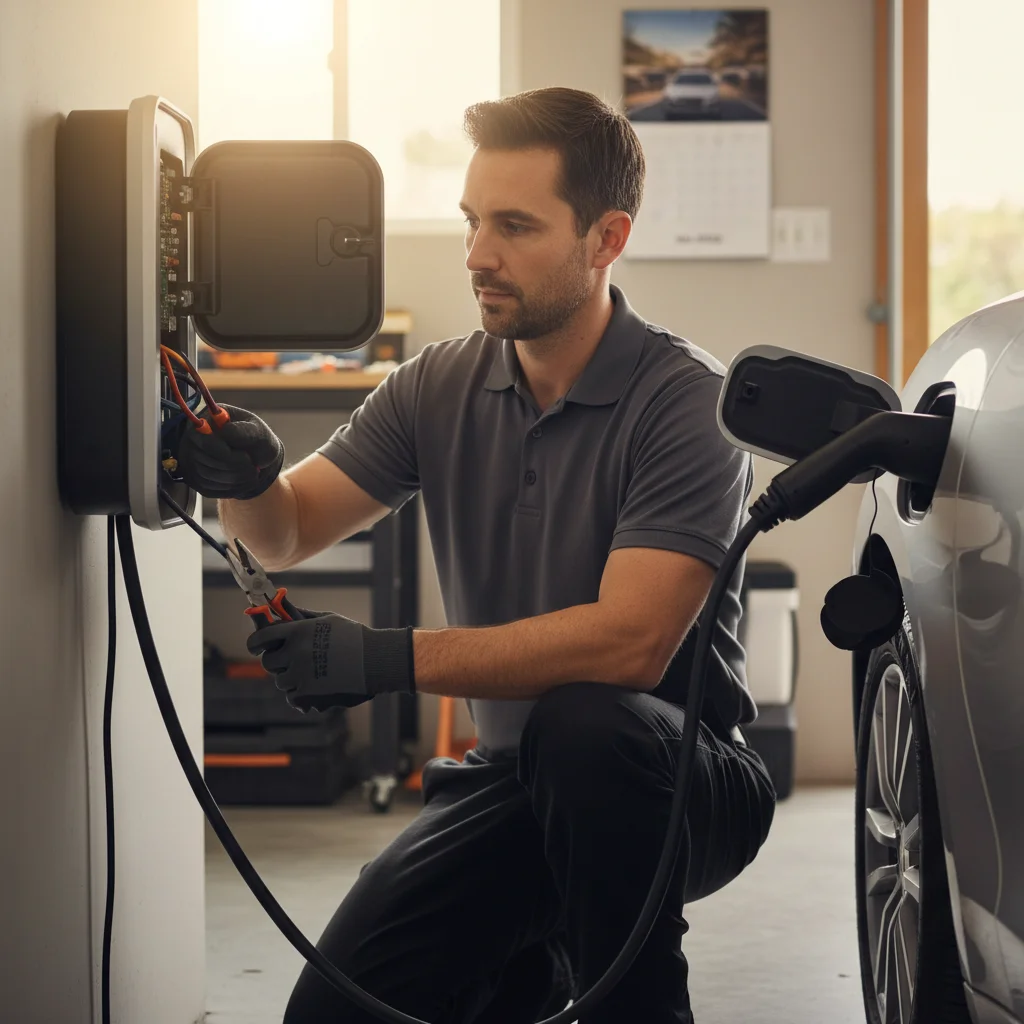
Pepco serves the District, Montgomery County, and Prince George’s County. Dominion Energy Virginia serves most of Northern Virginia. NOVEC covers parts of Loudoun and Prince William, including much of Sterling, Ashburn, and Gainesville. BGE touches parts of Laurel. SMECO reaches the southern edge toward Clinton. The City of Manassas runs its own municipal electric utility. Confirm the serving utility by address. Don’t guess from the nearest town name.
Pepco’s published EV program is EVsmart. Maryland’s version includes a residential Level 2 smart-charger rebate for Montgomery and Prince George’s addresses. Confirm the current amount on Pepco’s own EVsmart page. The District’s program runs separately under its alt-fuel infrastructure tax-credit rules. Dominion publishes Schedule 1EV, a voluntary Off-Peak Plan, and EV Charger Rewards. The Off-Peak Plan needs a smart meter. Those programs are about home charging. No utility EV page we reviewed offers to charge a stranded car.
Charge Pro DC is a referral line. We don’t hold a trade license for this work. We don’t own trucks, employ technicians, set prices, or publish hours. We match stranded drivers with independent local operators. The operator quotes you before starting, then bills you directly. What you pay for mobile EV charging, and who bills you is the billing walkthrough.
Manufacturer roadside is a different stack. Tesla and other brands publish plans, and coverage changes by VIN and year. Read the brand’s own support page. A brand plan can still send a contractor. That contractor still may not bring 240 volts. Insurance add-ons vary the same way. Get EV charging in writing. A jump-start clause isn’t a pack charge.
Tow law splits the same three ways
None of the three codes we reviewed singles out an empty EV. Disabled-vehicle rules apply to an EV like any other car. State that as an absence. There’s no special out-of-charge statute in this metro.
Towing is where the split gets messy in practice. Details live in why towing a dead EV in this metro gets expensive fast. Charge Pro DC doesn’t tow. When a flatbed is the honest call, that’s another operator.
Virginia private-property towing sits in Virginia Code sections 46.2-1231, 46.2-1233, and 46.2-1233.1. Localities may set fee limits by ordinance. Statewide, Virginia publishes a first-day storage rule. There’s no storage charge for the first 24 hours. Northern Virginia localities in Planning Districts 8 and 16 set hookup floors by ordinance. Confirm Arlington County, Alexandria, or Fairfax County text before you pay a yard. Fairfax County and the City of Fairfax aren’t the same place, so say which one.
Maryland stopping and disabled-vehicle rules live in Transportation Article Title 21. Private-property towing sits with 21-10A and county ordinances. Montgomery County and Prince George’s County each write their own. Prince George’s County takes an apostrophe-s. We aren’t printing a Maryland tow fee here. The county ordinance has to be the source.
The District uses Title 50 and the DC Municipal Regulations. DPW’s impound lot is Blue Plains, 5001 Shepherd Parkway SW. A second lot sits at 2115 Bryant St NE. DPW’s published number is (202) 541-6083.
If the car can’t take a charge, it needs a flatbed. Drive wheels on the pavement can hurt motors. That’s true on I-66, I-270, and a District alley.
Where cars sit, and why the 12-volt quits
Apartment and condo drivers without a driveway plug show up in older, denser housing. Arlington, Alexandria, the District, Silver Spring, Wheaton, Hyattsville, and Annandale fit that pattern. Census ACS 2019-2023 figures put Takoma Park’s pre-1980 housing share at 90.0%. Annandale sits at 79.8%, Wheaton at 73.1%, and Washington at 70.3%. Those numbers describe housing age. They don’t map public plugs.
Names on the Beltway fool visitors. Bethesda, Silver Spring, Wheaton, Tysons, McLean, and Reston are unincorporated. They aren’t incorporated cities. Arlington is a county with no towns. Alexandria, Fairfax, Falls Church, Manassas, and Manassas Park are independent cities. National Harbor is a development in Oxon Hill, not a town. Use the right label when you describe the stop.
The land isn’t mountainous, but it isn’t flat either. It rises from the tidal Potomac toward the Piedmont. I-270 climbs toward Frederick. Loudoun and Prince William rise toward the Bull Run Mountains and the Blue Ridge. We didn’t pull a USGS pass elevation, and we aren’t inventing one.
First minutes on the shoulder
Get out of live lanes if you can, with hazards on and the seatbelt on. On an interstate, stay in the car. Don’t walk the Beltway or I-95.
Tell the helper the road, the direction, and the nearest exit. Add the jurisdiction if you know it. On a District street, add the quadrant. On 495 Express Lanes, say you’re on the left shoulder. On 95 or 395 Express Lanes, say which shoulder you used.
Then name the failure. Black screens and dead handles usually mean 12-volt. A live dash that already showed zero is an empty pack.
If the pack is low but not gone, kill climate and extra screens. Save what’s left for hazards and locks. You’re not finishing the trip on hope.
On a parkway, call Park Police first. On a Maryland primary, dial #77. On a Virginia interstate, use 511. Those calls protect the scene. They don’t replace a Level 2 visit.
Maryland is all-party recording consent under Maryland Courts and Judicial Proceedings section 10-402. DC is one-party under DC Code section 23-542. Virginia is one-party under Virginia Code section 19.2-62. Metro calls cross Maryland, so treat a recorded line as needing everyone’s OK. You’ll hear a notice, and that’s why.
What not to wait on
Don’t wait for Pepco or Dominion to send a charger, because they don’t. Don’t wait for CHART or VDOT to fill the pack. They don’t publish that work. Don’t wait for Express Assist to tow you. They call a tow, and they don’t perform one.
Do wait for a quoted operator if the car can take Level 2. That’s the clean way off a shoulder without a yard. The pros we send jump or replace a dead 12-volt battery when that’s the fault. They bring NACS, CCS, or J1772 for the pack when that’s the fault.
Keep Charge Pro DC in the phone for that match at (202) 629-0844. You’ll get an operator quote before work starts. This page doesn’t publish an arrival window. We don’t have one we can stand behind.
Frequently asked questions
Who rolls if my EV dies on a DC-area interstate?
It depends who owns the asphalt. VDOT’s Safety Service Patrol covers Virginia interstates, reached through 511. Maryland CHART covers state primaries in this metro at #77. The District has no DDOT motorist patrol on file. Parkways go to US Park Police. None of those agencies publish an EV charge. For 240 volts or a 12-volt jump, you still call a private operator.
Can CHART, VDOT, or Express Assist charge my pack?
Not in anything those agencies publish. CHART lists tire changes, 12-volt jumps, a little gas, and radiator water. VDOT describes debris, incidents, and short-term traffic control. Express Assist handles minor mechanical issues and will call a tow. It doesn’t tow. Utilities here publish home-charging programs, not shoulder charging. An empty pack needs a mobile Level 2 source.
Who bills me for mobile EV roadside help?
The independent operator bills you. Charge Pro DC is a referral line. We don’t set the price and we don’t run the truck. The operator quotes you before starting. Manufacturer roadside and insurance add-ons are separate files. Confirm those in their own documents. Don’t assume they buy a 240-volt visit.