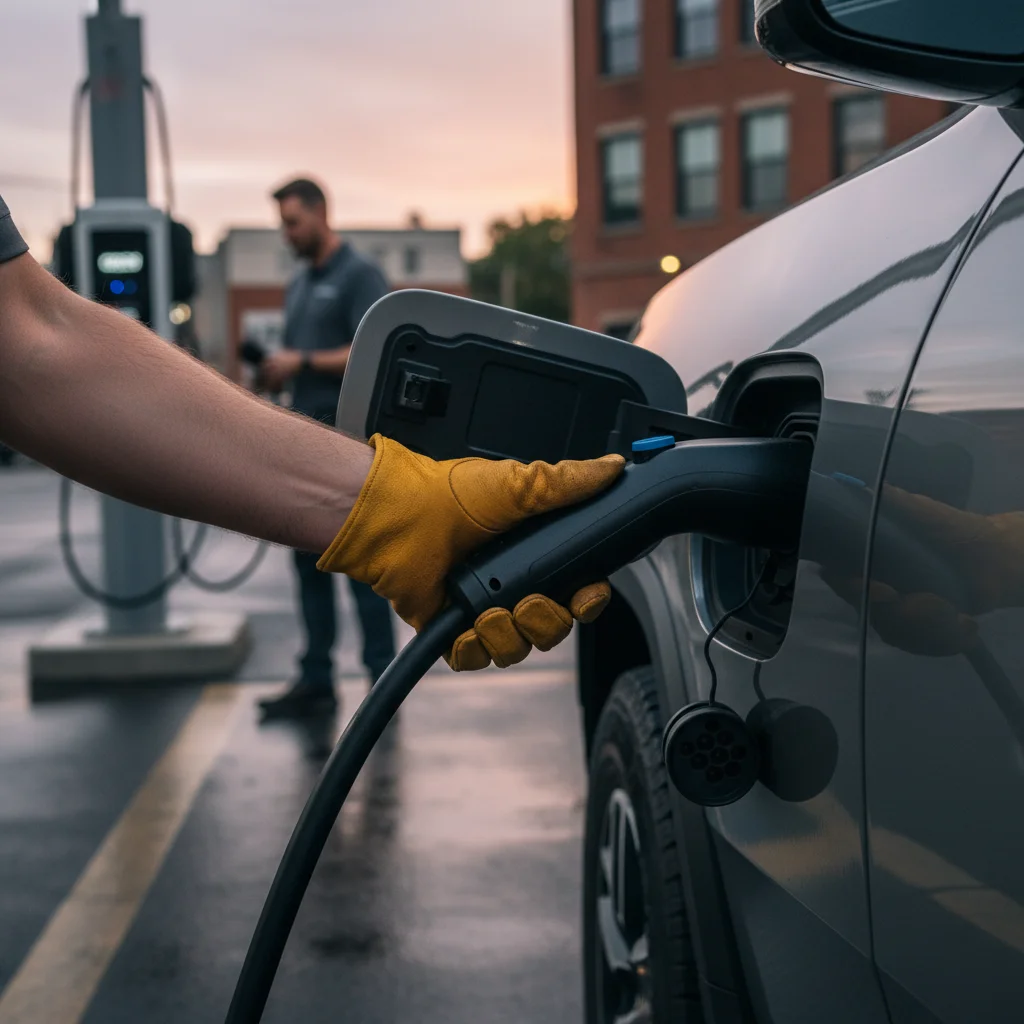
The charging session is already over. You tap the button on the handle. The pin doesn’t retract. A Rivian charge port stuck like this is usually ice or moisture. Sometimes the truck never sent the unlock command. Ice west of Dulles will freeze that latch after a hard night. Humid District summers do the same when water sits in the port. Your pack can be full. You still can’t leave the stall.
Two climates, one Rivian latch
Dulles International runs colder and snowier than Reagan National. That split is real in this metro. Loudoun, upper Montgomery, and Prince William take the harder freezes. Ashburn, Sterling, Herndon, and Leesburg sit on that western side. A wet pin on a January night can ice shut by morning.
The District and the inner Virginia core stay milder in winter. They pay for it in summer. This metro sees stretches above 90F with heavy humidity. Moisture creeps past the port seal. The lock then binds even though the charge finished hours ago.
Range loss in the cold is a separate issue. Recurrent Auto studied more than 30,000 EVs in winter. A typical pack keeps about 80% of range at 32F. It keeps about 70% at 20F. Cabin heat is the usual drain. A frozen latch isn’t a range problem. The truck has energy. The handle is the part that failed.
Many EVs lock the handle the same way. Our broader note on an EV charge port that won’t release covers the shared steps.
Why the pin stays seated
The port uses a small actuator and a locking pin. The pin keeps the handle from walking off while current is flowing. When the session ends, that pin should pull back. When it doesn’t, you’re tied to the stall.
Software confusion is the cleanest cause. The truck still thinks a charge is active. Or it thinks the vehicle is locked. The center screen and the Rivian app may still show charging. The port light may stay blue or solid green after you’ve already stopped.
Mechanical trouble is messier. The actuator can sit off-center. It can wear. You hear a click or a whir, and the pin never moves. The door can sit a hair out of line. Then it binds on the latch.
Weather is the third path, and it’s the one this metro actually has. Ice west of the airport. Condensation and summer humidity in the District. Grit on a parkway after a storm. None of that needs a failed part. The pin is simply blocked.
You can usually tell which path you’re on. A software mix-up shows on the displays. A mechanical bind makes noise at the port. Ice is quiet. The handle just refuses to move. Don’t yank it. Force can crack the port or the station cable.
Reset the truck before you open the frunk
Stay with the vehicle. Cycle the locks with the fob, the phone key, or the card. Lock, then unlock, a few times. That often forces the computer to re-check the pin.
On a public stall, end the session from the charger screen or the network’s app. A Rivian and a third-party station don’t always close the handshake cleanly. Stopping it from the station side can drop their lock and yours.
If you’re already in a safe, parked spot, try a soft reset. Press and hold the far-left and far-right steering-wheel buttons. Hold them about 15 seconds, until the screens go black. When they reboot, try the handle again.
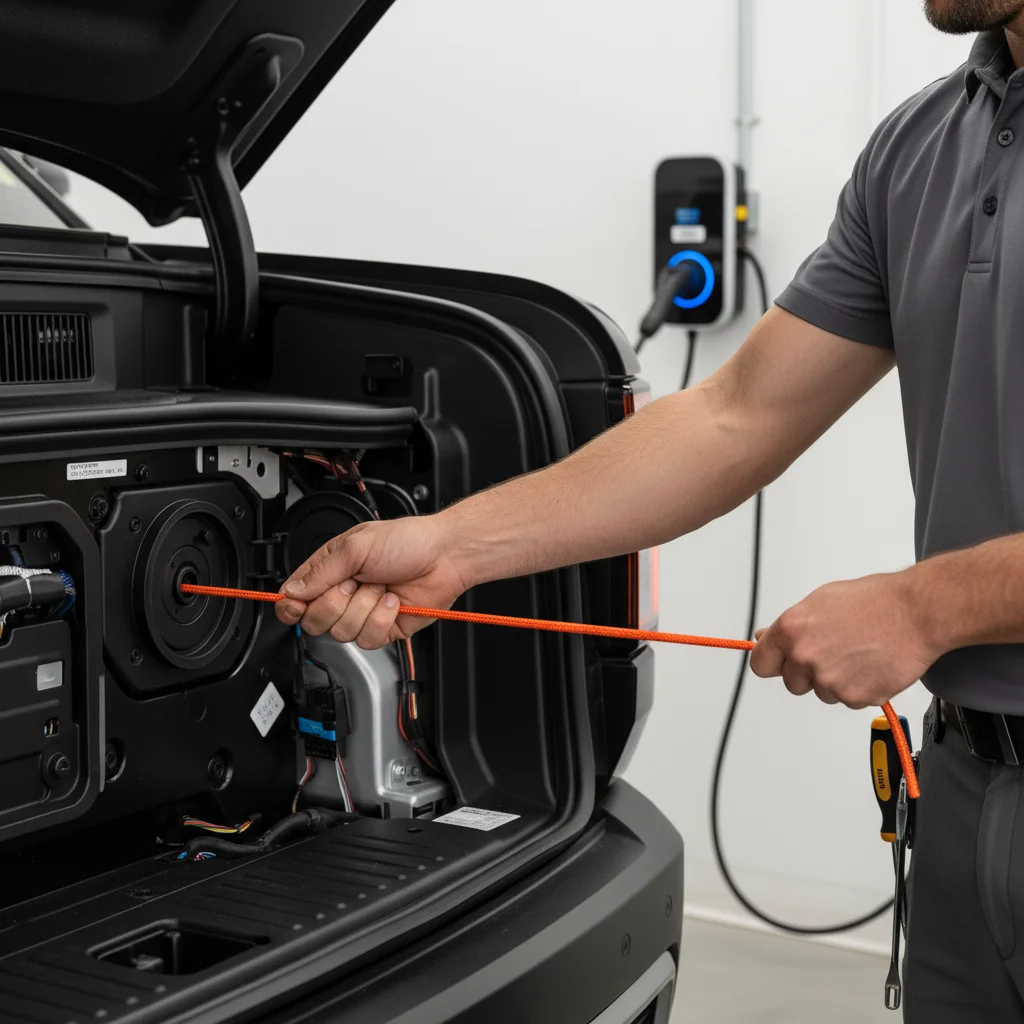
If the light still lies, skip more resets. Grinding at the port is the same signal. Rivian put a manual release in the frunk for this jam. Use it.
Manual release on the R1T
Open the front trunk and get some light on the driver’s side. Near the hinge, close to the cabin wall, you’ll find a small rectangular plastic panel.
Pry that panel off with your fingers. If it’s stubborn, a plastic trim tool is kinder than metal. A cloth-wrapped flat screwdriver will do. Don’t gouge the finish.
Inside the opening is a short cable with a loop. It’s often tagged green or yellow so you can see it. Pull the loop firmly toward the front of the truck. Steady pressure, not a jerk. You want a distinct clunk from the charge port. After that clunk, the handle should come free.
Manual release on the R1S
The R1S SUV uses the same loop. The panel is still on the driver’s side wall of the frunk. It usually sits a bit higher than on the truck. It’s also farther back.
Pop the panel. Find the tagged loop. Pull toward the front of the vehicle until you hear the pin release. Unplug, then press the panel back in. You don’t want it rattling on I-270 or the Beltway.
If the loop travels and you hear nothing, stop. The pin may be iced in place, or the actuator may have failed. More pulling on the release won’t help. It can stretch the cable.
Stuck at a public stall, not in your driveway
A jammed handle at home is a delay. A jammed handle in a shared garage blocks the stall and your exit. Drivers in Arlington, Alexandria, Silver Spring, Wheaton, and the District hit this more often. Pre-1980 housing is common there. Those houses often predate a home plug, so more sessions happen at public stalls.
Tysons Corner Center parking is a long-dwell pattern for this metro. So are airport garages. At Dulles, MWAA puts Level 2 charging in Garage 1 and Garage 2. Parking customers can use those stalls. The Economy Lot is the largest on-airport option. You reach it by shuttle from Curb 2F. Cars sit there for a week.
A traveler coming back to a Rivian often meets a dead 12-volt. That’s not an empty pack. A frozen latch is the other greeting, especially after a Loudoun freeze.
Work the software steps first, then the frunk loop. If both fail, the station may be the seized side. Networks print a support number on the cabinet. Call it. Tell them the session is over and the connector won’t release. They can often reboot the stall or drop their lock remotely.
Never force the handle while you wait. You’re standing next to live equipment. If you’re in a travel lane, get the truck out of traffic first.
On the 495 Express Lanes, pull over to the LEFT shoulder. Those lanes sit in the median. On the 95 and 395 Express Lanes, pull to the nearest shoulder. Stay in the car until help arrives. Transurban’s Express Assist patrol handles minor issues and will call a tow. It doesn’t free a Rivian pin. It doesn’t charge an EV.
Parkways are stricter. The Baltimore-Washington, George Washington Memorial, Clara Barton, Rock Creek, and Suitland parkways are National Park Service roads. Commercial vehicles and trucks over 10,000 lb are banned. Shoulders are narrow or missing. Report a disabled vehicle on the Baltimore-Washington Parkway to the US Park Police. The number is 202-610-7500.
Maryland state primary roads, including I-495, I-270, and US-50, reach CHART through #77. CHART can change a tire and jump a 12-volt. It doesn’t publish charge-port release. In Virginia, VDOT Safety Service Patrol is reached through 511. Published material covers incidents, debris, and short-term traffic control, not EV charging. We found no DDOT motorist-assistance patrol for the District. Private roadside is the backup inside the city.
Hyundai households see a cousin of this jam. The Ioniq 5 steps aren’t the Rivian steps. Compare notes in Hyundai Ioniq 5 charge port stuck.
Ice, humidity, and a weak 12-volt
West of Dulles, start with ice after a freeze. You can aim cabin heat toward the port if you’re parked. The truck has to wake first. Waiting for a thaw is safer than tools. Don’t pour boiling water on the electronics. Don’t chip at the pin with a key.
In the District, humidity is the quieter version. Clear standing water before you plug in again. Our guide on water in an EV charging port covers that check.
Sometimes the latch isn’t the root. A weak 12-volt battery starves the actuator, the screens, and the locks. The R1T and R1S still depend on that small battery. If the truck feels half-awake, check the 12-volt first. A slow frunk is the same hint. The walkthrough is in Rivian R1T or R1S won’t start.
The January 2022 I-95 shutdown is this region’s cold-sit reference. About 14 inches of snow hit I-95 near Fredericksburg. A multi-truck crash closed it on January 3-4, 2022. Drivers sat overnight with heat on and nowhere to go. A latch that ices in a long sit isn’t a mystery. Keep the cabin reasonable. Don’t burn pack on a handle that needs the frunk loop instead.
When the loop doesn’t free the cable
A slack loop with no clunk means you’re past the DIY steps. The actuator may have failed. The release cable may have stretched. The station connector may be seized on its side.
Rivian Highway Assist and in-app roadside send help on Rivian’s terms. We don’t set those waits, and we don’t do the work. Charge Pro DC is a referral line. It matches stranded EV drivers with independent local mobile rescue operators. The operator quotes you before starting and bills you directly.
The operators we connect you with bring a 240V Level 2 source to the car. They use a native NACS plug when that’s the inlet. A CCS or J1772 adapter covers the other Rivian ports. They typically add 10 to 20 miles of range in 15 to 30 minutes of charging. That’s charging time, never an arrival time. They can also jump or replace a dead 12-volt on site. For plug type, see what charger a Rivian uses when a mobile rescue rolls up.
If this happened after a Dulles trip, start with the Loudoun page. That’s Ashburn EV roadside assistance. For a non-Tesla EV that needs a person at the bumper, use non-Tesla EV rescue.
Stay out of the live lane. Don’t force the handle. If the frunk release didn’t free the cable, call (202) 629-0844. The operator you’re matched with quotes the work before anything starts.