An EV maintenance schedule here is short, but it’s not blank. Cabin heat, Beltway idle, and long garage dwell decide what actually wears. You still skip oil, plugs, and fuel filters. You still check tires, coolant, brake fluid, and the 12-volt on a calendar. The owner’s manual is the authority, not this page. This is how those intervals feel on I-495, I-270, and I-66.
Electric cars cut a lot of shop time. They don’t cut care to zero. A pack, motors, and a small 12-volt still age. In this metro they age in three local ways. Summer AC and winter cabin heat both come from the battery. Stop-and-go on the Capital Beltway burns charge without adding miles. A week in Metro or airport parking sleeps the 12-volt. The car may not wake. Maryland has reported more than 60,000 registered electric vehicles. That’s MDOT’s published milestone, not a live tally.
Charge Pro DC is a referral line. We match stranded EV drivers with independent local operators. We don’t hold a trade license. We don’t own trucks, a yard, or a service bay. We don’t set prices or arrival times. The operators quote you before they start and bill you directly.
What drops off the list, and what never should
A gasoline service lane is built around combustion. An EV lane is built around electricity and rubber.
You can stop planning for:
- Engine oil and oil filters
- Spark plugs and plug wires
- Fuel filters
- Timing belts
- Frequent transmission flushes
Many EVs use a single-speed reduction gear. Some books never call for fluid there. Don’t copy a neighbor’s interval. Open your own manual.
What you can’t skip is smaller, and it’s pickier here. Regenerative braking saves pads. It doesn’t keep brake fluid dry. Instant torque and pack weight still wear tires. Thermal systems still pump coolant on a 90F afternoon. The 12-volt still boots the high-voltage system. Skip those, and a Reston Silver Line lot is where the car goes silent.
For brand-by-brand notes, use EV maintenance by brand. Tesla also posts model guidance on its support pages.
Cabin heat is pack work in this climate
The metro sits on the fall line. Summers are hot and humid, with stretches above 90F. Winters swing from mild to sudden ice. Dulles runs colder and snowier than Reagan National. Loudoun, upper Montgomery County, and Prince William get more snow and harder freezes. The District and the inner Virginia core stay milder. Your maintenance feel follows that split.
An EV has no engine block to steal heat from. Cabin heat is a battery job. So is AC on a stacked August commute. Recurrent Auto studied more than 30,000 EVs. That’s the winter-range source we can cite. A typical EV keeps about 80 percent of range at 32F. It keeps about 70 percent at 20F. Most lose 20 to 35 percent in real cold. Heat-pump cars averaged about 83 percent retained. Cars without a heat pump averaged about 75 percent. Don’t treat those as Tesla numbers. They weren’t pulled from tesla.com.
That loss is mostly cabin heating, plus a colder pack. You feel it on an early I-270 run toward Germantown. You feel it on a Leesburg morning after a freeze. Preconditioning while plugged in saves pack energy, if you have a plug.
Housing often decides that plug. Census ACS 2019-2023 figures show Takoma Park at about 90 percent pre-1980 housing. Annandale is about 80 percent. Washington is about 70 percent. Ashburn is about 3 percent pre-1980. Germantown is about 14 percent. Older close-in streets often predate a wall connector. Newer Loudoun and western Fairfax County houses more often have one. That’s housing age. It isn’t a public-charger claim.
If you park in the sun at Tysons Corner Center, the cabin soaks heat. Pre-cool on plug power when you can. If you can’t, the pack does that work on the first miles. That’s wear on the thermal loop. For the climate physics, read how heat, ice, and Beltway idling wear an EV battery.
Apartment and condo life stacks the same load. The no-home-plug pattern is strongest where old housing and apartment density overlap. That’s Arlington, Alexandria, the District, Silver Spring, Wheaton, Hyattsville, and Annandale. Arlington is a county. Alexandria is an independent city. Fairfax County and the City of Fairfax are not the same place. Name the right jurisdiction when you book a shop.
Beltway idle is miles you never bank
I-495’s general lanes are free. They’re also a rolling pause. I-66 inside the Beltway is dynamically tolled in the peak. I-95 through Woodbridge and Dale City crawls. I-270 toward Frederick climbs the Piedmont. Watch the car’s predicted range as you climb.
Sitting still with heat or AC running drains charge without covering distance. That’s the Beltway-in-gridlock problem. It’s also the I-95 standstill problem. The odometer barely moves. The pack still works.
The region’s reference for this is January 3 and 4, 2022. About 14 inches of snow and a multi-truck crash shut I-95 in the Fredericksburg area, just south of this service map. The road closed about 5:30 p.m. on January 3. It reopened about 7:40 p.m. on January 4. Hundreds of drivers sat overnight for more than 36 hours. Cabin heat ran from whatever they had. Climate control on, wheels not turning: that’s the idle load to plan against.
A disabled EV is still a disabled car here. VDOT’s Safety Service Patrol covers Virginia interstates, including I-66. Reach them through Virginia 511. They publish incident help, not a pack charge. Maryland’s CHART patrol takes I-495, I-270, US-50, and MD-295 at #77. They publish jumps and tire changes, not EV charging. No DDOT motorist-assistance patrol turned up for the District. On the Baltimore-Washington Parkway, call US Park Police at 202-610-7500. NPS parkways can have narrow or missing shoulders. None of the three codes we reviewed has a special out-of-charge rule.
If that stop is in the 495 Express Lanes, Transurban says to pull to the left shoulder. Those lanes sit in the median. On the 95 and 395 Express Lanes, pull to the nearest shoulder. Stay in the car until help arrives. Express Assist will call a tow. It doesn’t charge an EV. The Woodrow Wilson Bridge and the American Legion Bridge are high, wind-exposed spans with limited shoulder.
Garage dwell is a 12-volt job
Long sits don’t empty most traction packs. They flatten the little battery. That 12-volt runs locks, lights, the screen, and the wake computer. If it’s dead, a full pack still won’t wake the car.
The common local pattern is a traveler coming back from a week away. Reagan National publishes complimentary EV charging on Level 1 of Parking Garages 1 and 2. It’s first-come, first-served for parking customers. Dulles publishes Level 2 charging in Garage 1 and Garage 2. Confirm stall counts with MWAA. Union Station’s garage is another long dwell. So are WMATA park-and-ride decks. A workday in a Tysons Corner Center garage is the short version of the same sleep. See a dead EV in a Tysons garage after a long sit. The trip version is what happens when an EV 12-volt dies on a trip.
Test the 12-volt on a yearly shop visit. Replace it when the test says so, not when the doors freeze. It’s often outside the traction-pack warranty. Heat in a closed garage and weeks of sleep both age it. Warning signs are slow electronics, a sticky fob, and a car that won’t wake. The full checklist is in EV 12-volt replacement. If you’re already silent, the operators we connect you with can jump or replace a Tesla 12-volt on site. They handle Tesla and other major EV brands.
Tires, brakes, and fluids still have dates
Tires
EV torque is instant. The pack is heavy. Factory tires are often low-rolling-resistance designs. That mix can wear inner edges faster than a light gas sedan. Rotation is the cheap item. Alignment is the one you notice as a wander. Use the book’s mile interval. Use the door-jamb pressure sticker, cold. Loudoun mornings drop pressure. A Prince George’s County afternoon lot raises it. Don’t guess.
Brakes
Regen does most of the slowing on a Rockville to Bethesda run. Pads last. Calipers still sit in slush on I-270. They can seize. Brake fluid still absorbs water, even if the pads look thick. Many makers put fluid on a two-to-three-year clock. Ask for a moisture test. Don’t wait for a long pedal in Springfield traffic.
Coolant
The pack and power electronics usually have their own loops. Some are labeled long-life. Some have a replace date. Summer heat above 90F runs those pumps hard. So does winter preconditioning at Dulles-like temps. Check reservoirs when you rotate tires. Don’t mix chemistries. Don’t add tap water. If the book calls for a service, do that service.
Cabin filter, wipers, washer, and the port
Pollen and haze load the cabin filter. Change it when the book says, or when the fan smells. Wipers take ice and storms. Washer fluid still matters on parkway spray. Look at the charge port after humid weather. Clear debris. Dry moisture before you plug in. Keep software current. Battery management is maintenance, even when nobody lifts the car.
Motors
Motors are usually sealed. Some models want drive-unit fluid at high miles. Some never do. That’s a VIN question. It isn’t a Beltway question.
Charging habits that belong on the same calendar
Many makers want daily charge in a mid band. They don’t want a life at 100 percent or at empty. Confirm the target in your car’s app. We’re not printing a percentage as a rule.
Who sells your power changes how you time that charge. Pepco serves the District, Montgomery County, and Prince George’s County. Its EV program is Pepco EVsmart. In Maryland, Pepco publishes a residential Level 2 smart-charger rebate and a multifamily charging program. Those published amounts change. Confirm the current figure with Pepco before you budget. The District’s charger incentive sits under the city’s alt-fuel infrastructure tax-credit rules. Dominion Energy Virginia serves most of Northern Virginia. Named programs are Schedule 1EV, the Off-Peak Plan, which needs a smart meter, and EV Charger Rewards. NOVEC serves parts of Loudoun and Prince William, including much of Sterling, Ashburn, and Gainesville. BGE, SMECO, and the City of Manassas utility cover smaller slices. Confirm yours by address. None of the utility EV pages we reviewed offers a charge for a stranded car. That’s an absence on their EV pages, not a claim about public stations.
Off-peak home charging is the gentle habit when you have a plug. A DC fast charge is a tool on a trip. It isn’t a daily substitute if you can avoid that. Virginia has a Highway Use Fee for EVs at registration. Maryland has EV credits and an MVA surcharge that move with the budget. The District offers a reduced registration fee for new EVs for the first two years. The prior full excise-tax exemption was repealed effective February 2025. EVs now pay a weight-based excise tax. Confirm current rules with Virginia DMV, Maryland MVA, or DC DMV.
A calendar you can keep without guessing
Use this to open the manual. Don’t use it as the manual.
Every few thousand miles, or about twice a year
Rotate tires and set pressures. Look at pads, rotors, and calipers. Check coolant, brake fluid, and washer. Cabin filter if the book is due. Wipers if they smear.
Every year or two
Test the 12-volt. Service brake fluid if you’re on a time interval. Inspect suspension bushings and tie rods on a heavy EV. Replace the key-fob battery. Confirm software is current.
Only at high miles, and only if the book says so
Drive-unit fluid. A pack coolant service. A dealer health report on the high-voltage pack. Most makers publish a long pack warranty. Read the card in your glove box. Don’t assume a year or mile figure we didn’t pull from your brand this week.
When a skipped item becomes a stop
A skipped 12-volt test is a silent car in a garage. A pack run down on the commute is a stop on I-270, I-66, or the Beltway. Those are different calls.
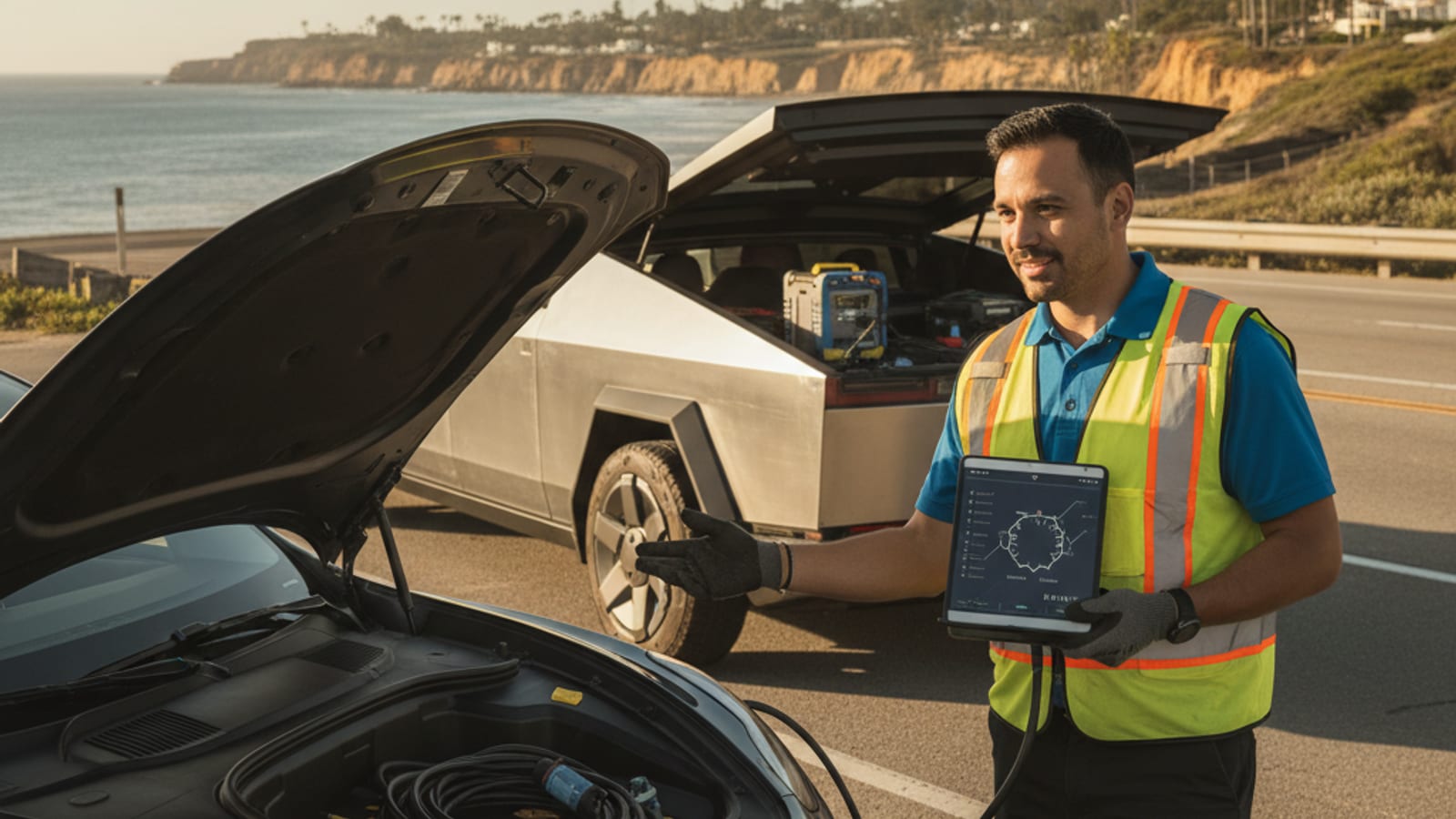
Independent operators we refer bring a 240-volt Level 2 source to the car. They use a native NACS plug, or a CCS or J1772 adapter for non-Tesla EVs. They typically add 10 to 20 miles of range in 15 to 30 minutes of charging. That’s charging time, never an arrival time. They can jump or replace a dead 12-volt on site. They quote before they start. They bill you directly. For that visit, start with mobile EV charging.
If you’re already stopped, stay with the car where it’s legal and safe. On the 495 Express Lanes, use the left shoulder. On an NPS parkway, use the Park Police number above. Then call for a quoted rescue if you need a charge or a 12-volt jump.
We serve drivers in the District, Maryland, and Virginia. The pros we connect you with are licensed and insured. To start a referral, call (202) 629-0844. That number starts a match. It doesn’t promise a clock.