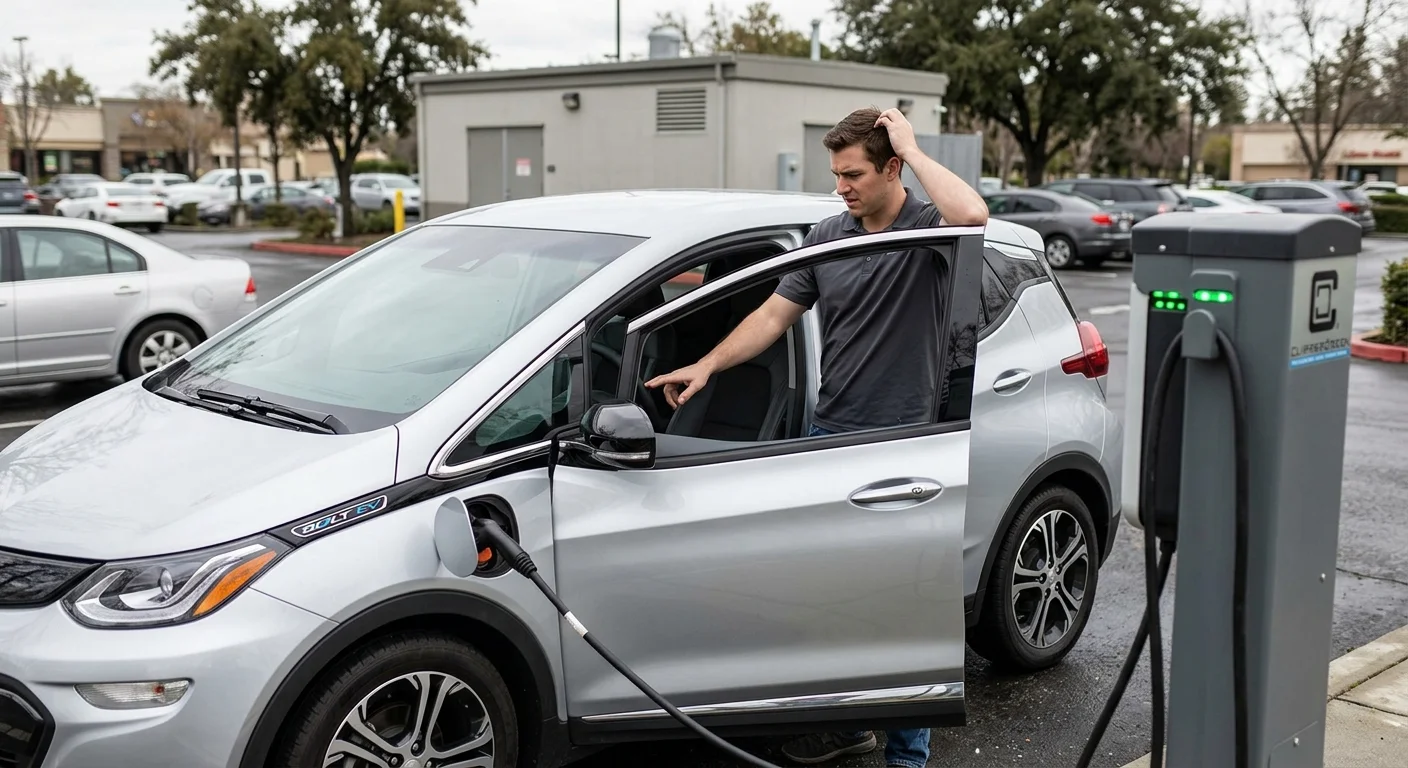
A Chevy Bolt that won’t charge still has a next step. Isolate the stall, the power, and the 12-volt first. An empty traction pack can still take a mobile 240-volt top-up. Charge Pro DC connects you with independent local operators. The operator quotes you before any work starts.
Overnight housing and lots change what failed
A Bolt in Takoma Park isn’t living the same night as a Bolt in Ashburn. Census ACS 2019-2023 figures put pre-1980 housing at 90.0% in Takoma Park. Washington sits at 70.3%, Wheaton at 73.1%, and Annandale at 79.8%. Those older homes often predate a dedicated Level 2 circuit. Ashburn is 3.1% pre-1980, Germantown is 14.1%, and Centreville is 11.1%. Newer stock still doesn’t move energy onto I-66 once you leave the driveway.
Apartment and condo density stacks the same miss. Arlington, Alexandria, and the District show that squeeze. So do Silver Spring, Wheaton, Hyattsville, and Annandale. If you never had a plug at home, last night wasn’t a charger failure. It was a public stall, a garage session, or nothing at all. A refused session the next morning is then a car-and-stall problem.
Airport parking adds a third overnight pattern. Reagan National lists EV charging on Level 1 of Parking Garages 1 and 2. Those stalls are complimentary for parking customers, first-come, and limited. Dulles lists Level 2 charging in Garage 1 and Garage 2. MWAA publishes no EV charging in the Economy Lot, the Terminal Lot, or valet. A week in the Economy Lot is often a 12-volt story, not an empty pack. Union Station’s garage and WMATA park-and-ride lots run the same long sit. Confirm which WMATA garage publishes EV charging before you plan on a plug.
An Equinox that won’t take a charge can fail the same GM handshake. The dash refusal looks familiar on a Bolt.
Start with whose power you actually used
The wall unit at home isn’t the Beltway. Pepco serves the District, Montgomery County, and Prince George’s County under Pepco EVsmart. Maryland Pepco lists a residential Level 2 smart-charger rebate for Montgomery and Prince George’s addresses. Confirm the current amount on Pepco’s EVsmart pages before you budget it.
Dominion Energy Virginia serves most of Northern Virginia. Named programs include residential EV rate Schedule 1EV. The voluntary Off-Peak Plan needs a smart meter. Dominion also publishes EV Charger Rewards. None of those programs roll a charger to a stalled Bolt.
NOVEC serves parts of Loudoun and Prince William. That includes much of Sterling, Ashburn, and Gainesville. BGE touches the Maryland ring in parts of Laurel. SMECO serves the southern edge toward Clinton. The City of Manassas runs its own municipal electric utility. Confirm the serving utility by address, not a neighborhood name. Fairfax County and the City of Fairfax are separate jurisdictions. We reviewed those utility EV pages, and none offer a charge for a stranded car.
If last night’s Level 2 died, check the right outage map first. A tripped breaker in Takoma Park is a house-power story. A dark Dominion feed in Reston is too. Once you leave the driveway, the Bolt can still strand you with thin range. A car that sat plugged in overnight and never charged has usual causes. Those causes are the breaker, the handshake, or the utility.
Weather makes a missed fill worse here. This metro sits on the fall line. Summers run hot and humid, with stretches above 90F. Winters swing from mild weather to sudden ice. Dulles runs colder and snowier than Reagan National. Loudoun, upper Montgomery, and Prince William see harder freezes. A Recurrent Auto study of more than 30,000 EVs tracked winter range. Typical cars keep about 80% of range at 32F. They keep about 70% at 20F. Most lose 20 to 35% in real cold. Cabin heat is the cause, because an EV makes that heat from the pack. Sitting still with heat or AC on burns charge without covering miles. That’s the Beltway crawl and the I-95 standstill.
A refused handshake isn’t a dealer ticket yet
Chevy’s “Unable to Charge” line is a blanket stop. The car and the equipment talk about power and safety. If that talk fails, the Bolt refuses the session. The stall can be the weak side. The port latch can be the weak side. The onboard charger can be the weak side. Unstable supply can trip the same message. The Bolt will protect the pack if the feed looks unsafe.
You won’t get a shop diagnosis from that one line. Don’t invent a code from memory. If the Driver Information Center shows a number, write it down. Share it with a Chevy dealer or the operator who quotes you on site. This page can’t map each code, because Chevrolet’s manuals set that mapping. Those bulletins weren’t in the research behind this piece.
A failed DC stall doesn’t prove Level 2 is dead. A failed home Level 2 doesn’t prove every public stall will refuse you. Test one other method if you still have enough range to move. A 120-volt crawl won’t save a Bolt already sitting on I-270.
Reseat the cable before you blame the car
At a public stall, try the next dispenser if it looks live. Then try another site if you can still roll. A connected cable that never starts is a known mess. If the screen says linked, treat the stall as failed when kWh never moves.
At home, reseat the connector until it clicks. Reseat the wall end too. A loose J1772 latch will kill a Level 2 session with no drama. Look at the cable for heat marks, a crushed jacket, or a bent pin. Swap to a known-good cable if you have one. Water in the port is another quiet stop. Dry it before you plug. Don’t pry ice or grit with a metal tool.
Open the breaker panel only if it’s dry and you can reach it safely. Look for a tripped EV circuit and reset once. If it trips again, stop and call an electrician. Charge Pro DC doesn’t inspect panels or install stations. For a wall unit that died, read what to do if the home charger fails.
Level 1, Level 2, and DC fast charge are different talks. Don’t treat one failed protocol as a dead car.
The 12-volt can brick charging while the pack still has miles
The drive battery moves the car. The 12-volt runs the computers that let charging start. Relays, screens, locks, and charge-port logic sit on that small battery. If it’s weak, the Bolt can look bricked. “Unable to Charge” can show while the pack still holds range.
Clues stack when the 12-volt is weak. The dash stays dark, and accessories blink out. Locks act odd, and the port never wakes. Those clues overlap a dead pack, so don’t guess from one symptom. Airport long-term lots make this pattern common. A week in Dulles Economy parking is often a 12-volt return.
Find the 12-volt in the owner’s manual for your year. This page won’t invent an under-hood map. Look for corrosion on the terminals if you can see them safely. We won’t quote a roadside voltage number Chevrolet hasn’t published.
Don’t hold jumper clamps on while you guess. Don’t open high-voltage orange gear. The pack isn’t a DIY jump point. A 12-volt jump or replacement is work for someone who knows EV low-voltage systems. The operators we connect you with can jump that 12-volt on site. They can replace it on site too. The pros we connect you with are licensed and insured.
If the dash still wakes, a short restart is cheap
Software glitches stall the handshake, and a restart often clears them. It’s a safe pause in a driveway or a lot.
Unplug the cable and wait until the session fully ends. Power the Bolt off, then open and close the driver’s door. Wait a few minutes so modules can go quiet. Power the car back on and plug in again. Watch for a real start, not just a click.
If nothing changes, you didn’t waste the try. Next is outside help, not a tenth reseat.
Once you’re stopped, the road decides who can even reach you
If the car is in a travel lane, call 911. Do the same from any other dangerous place. Turn the hazards on and stay out of live lanes.
On the 495 Express Lanes, pull to the left shoulder. Those lanes sit in the median, not the right edge. Pull to the nearest shoulder on the 95 and 395 Express Lanes. Stay in the car until help arrives. Transurban’s Express Assist handles minor mechanical issues and can call a tow. It doesn’t tow, and published pages don’t describe EV charging.
VDOT’s Safety Service Patrol covers Virginia interstates, including the I-66 corridor. Drivers reach that help through Virginia 511. VDOT describes incident clearance and traffic control, not EV charging. On Maryland primary roads, dial #77 for MDOT SHA CHART. That includes I-495, I-270, US-50, and MD-295. CHART publishes tire changes, jump starts, gas, and water, not an EV charge. In the District, we didn’t find a DDOT motorist-assistance patrol. District drivers rely on MPD, private roadside plans, and US Park Police on the parkways.
National Park Service parkways here include the Baltimore-Washington and George Washington Memorial parkways. Commercial vehicles and trucks over 10,000 lb are banned. Shoulders on those roads are narrow or missing. A disabled vehicle on the Baltimore-Washington Parkway goes to US Park Police at 202-610-7500.
The Woodrow Wilson Bridge carries the Beltway across the Potomac. A stall there sits at Virginia, Maryland, and the District at once. The American Legion Bridge does the same between McLean and Montgomery County. Both are high, wind-exposed spans with limited shoulder.
None of the three local codes we reviewed has a special out-of-charge rule. Disabled-vehicle rules apply to an EV the same way they apply to any car.
Idle drain is the local trap. Sitting still burns range even when you planned a stop. The January 2022 I-95 shutdown is the region’s reference point. Snow and a multi-truck crash closed a long stretch near Fredericksburg overnight. The road stayed shut for more than 36 hours. Heat on with the car sitting still emptied tanks and packs overnight. A Bolt in Beltway gridlock can burn the same way without covering miles.
A mobile 240-volt add and a hook are different jobs
If you can still roll, a working public stall may finish the job. If the Bolt refuses every stall, towing to another dispenser may refuse you again. That’s when on-site help matters.
Mobile EV charging brings a 240-volt Level 2 source to the car. For a Bolt, that visit is non-Tesla EV rescue with a CCS or J1772 adapter. Teslas take a native NACS plug. Operators typically add 10 to 20 miles in 15 to 30 minutes of charging. That clock is charge time only, never an arrival time. The goal is enough movement to reach the place you choose, not a full pack.
A hook is right after a crash or a seized drivetrain. It’s also right if you can’t wake the car after the 12-volt is handled. A hook is a weak first call for a refused charge. You can spend the tow and still meet a stall that won’t handshake. Compare that choice in mobile EV charging or a tow.
Confirm the current tow cap with the locality before you pay a yard. We couldn’t confirm one metro-wide rescue price. The operator and the stop set the terms.
Tell the operator what you already tried. Name the home utility if you know it. Say whether the dash is dark. Say whether “Unable to Charge” is the only line. That briefing is how they bring the right adapter for a Bolt.
Charge Pro DC is a referral line, and we don’t own trucks. We don’t employ technicians or set prices. We don’t hold a trade license. The operator bills you directly.
When the easy checks are done, call
If the breaker is on and the cable is seated, you’ve done the easy checks. If the restart is done and the Bolt still refuses, stop repeating the same plug. You need a person at the bumper.
Call (202) 629-0844 and we’ll connect you with a local operator who quotes before starting.