A BMW i5 won’t start after a week in a Metro or airport garage. Check the 12-volt first. The drive pack is usually still fine. iDrive stays black, the handles feel dead, and you can’t shift. The computers never got the low-voltage they need to boot.
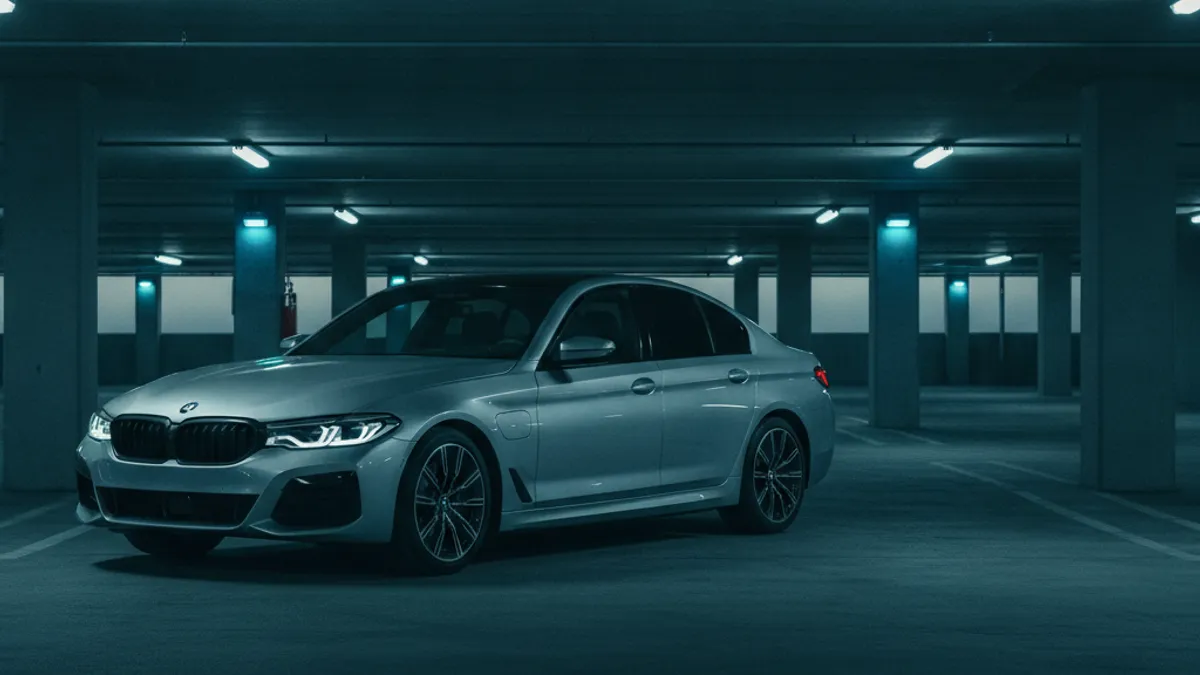
The i5 (G60) and i7 (G70) share this 12-volt layout. They share the failure pattern too. A dark cabin in a Tysons garage or at Dulles follows the same steps.
A week in a garage is the usual no-start
These cars never fully sleep. Power-operated doors, the alarm, and the cellular modem keep drawing current. The i7 also keeps a theater screen and rear executive seats in that mix. A fresh 12-volt AGM battery can cover a few days of that drain. An older one often can’t.
Long-stay parking is normal in this metro. WMATA park-and-ride garages hold cars for a full work week. The Union Station garage in the District does the same for train trips. Tysons Corner Center decks swallow these BMWs all day. Office garages in McLean and Bethesda do too. Then they sit overnight.
Airports are the other half of the pattern. At Dulles (IAD), MWAA publishes Level 2 charging in Garage 1 and Garage 2. The Economy Lot is the largest on-airport option, with a shuttle at Curb 2F. MWAA’s parking guides don’t list charging in the Economy Lot, the Terminal Lot, or Valet. You park for a week, fly, and return to whatever the 12-volt has left. That’s the classic i5 or i7 no-start here.
Reagan National (DCA) is a shorter hop for a lot of owners. Complimentary EV charging sits on Level 1 of Parking Garages 1 and 2. Spaces are first-come and limited. If you parked on another level, the 12-volt still sat the whole trip. A dark i5 there is still a 12-volt story until you prove otherwise.
Owners in Potomac, McLean, and Bethesda leave these cars in private garages while they travel. Same drain, quieter setting. The battery doesn’t care if the stall is a Metro lot. A home bay does the same thing.
Apartment parking is a third version of the same sit. In Arlington, Alexandria, and the District, many i5s live in lots with no home Level 2. Silver Spring, Wheaton, Hyattsville, and Annandale see the same pattern. Pre-1980 housing is common in Takoma Park, Annandale, Wheaton, and Washington. The car sits all week, then fails to wake on Friday. For what a long sit does to any EV 12-volt, read what happens when an EV 12-volt dies on a trip.
The pack can still have range while the car stays dark
The 12-volt auxiliary battery wakes every computer in the car. It also closes the contactors that connect the high-voltage pack. If that small battery can’t hold voltage, the car refuses to boot. A full drive battery doesn’t override that.
You get a cabin with no iDrive, no chimes, and no gear selection. Power-operated doors stop finishing their cycle. Exterior handles may not present. The fob can still unlock the latches and still fail to power the car. People assume the traction pack is empty. It usually isn’t.
Two paths get you here. The car sat long enough that standby current emptied a marginal 12-volt. Or the AGM battery is past its service life. It sagged under the first boot. Both look identical from the driver’s seat. You have a BMW that won’t wake.
A jump can bring it back. If the battery is worn out, it can strand you again within days. Treat a second dark morning as a replacement job, not another jump.
What the replace-battery message is actually saying
When the i5 or i7 shows a replace-battery warning, it means the 12-volt. It’s not the high-voltage pack. The longer wording is usually “increased battery discharge when stationary, continued driving possible, replace battery.” That sentence is literal.
“Continued driving possible” holds while you’re moving. The high-voltage system tops up the 12-volt as you drive. The risk is the next park. A weak 12-volt can drain overnight. Morning then looks like a dead car: no iDrive, no handles, no shift.
Finish the trip if the car is still awake. Then get the 12-volt AGM battery replaced. Don’t file the message as background noise. Once the car has already gone dark, the warning isn’t a heads-up anymore. It’s why you’re stuck.
The same family of warning shows up on other BMW EVs. Our BMW i4 replace-battery guide covers that car’s version of this 12-volt failure.
Heat and cold both finish a weak AGM. The metro has humid stretches above 90F. Winters swing from mild to sudden ice. Dulles runs colder and snowier than Reagan National. Loudoun, upper Montgomery, and Prince William see harder freezes than the District. Cabin heat in the cold comes from the pack. The 12-volt still has to boot the car after a frozen night in a garage.
Signs the 12-volt is going before it dies
The i7 loads the 12-volt harder than the i5. You often get odd behavior first.
| What you notice | What it usually means |
|---|---|
| iDrive stays dark, no chimes | 12-volt is fully discharged |
| Fob unlocks, car won’t power on | 12-volt is too low to boot the computers |
| Power-operated doors and handles quit | 12-volt is below the operating threshold |
| Random warnings, then a shutdown | 12-volt is sagging under load |
| Car starts, then resets right away | 12-volt can’t hold voltage under load |
If this has happened twice in a few months, stop jumping it and hoping. The AGM battery needs replacement. BMW also requires VIN-specific battery registration with ISTA or a compatible tool. Without that step, the car may not charge the new battery correctly. Confirm registration, and current parts and labor, with a BMW shop. A public price for the i5 or i7 12-volt couldn’t be confirmed from the sources used here. Don’t guess from a forum screenshot. For the broader replacement picture across brands, see the EV 12-volt replacement guide.
Get in the car, then worry about where the battery sits
BMW hid the 12-volt on both cars. It’s not under the hood. The AGM battery sits in the rear luggage compartment, behind a trim panel. You almost never need to reach it to wake the car. You still need a way into the cabin.
Stand close with the fob. The passive-entry antenna often fades before the 12-volt is fully dead. A few inches from the handle can still unlock the door.
If the fob does nothing, use the physical key blade hidden in the fob. Unlock the driver’s door with that blade. That lock is mechanical. It works with zero 12-volt power.
Inside, pull the mechanical hood release. That cable also works with no power. You need the hood open for the jump posts. If you truly need the rear battery, fold the rear seatback. Reach it from the cabin. The powered trunk release won’t help you when the 12-volt is dead.
Jump from the under-hood posts, not the trunk
BMW puts a dedicated positive jump terminal in the engine bay for this problem. You don’t have to pull rear trim in a dark garage.
With the hood up, look for a red cover or red cap. It’s near the strut tower or the fuse box. That’s the positive (+) post. For ground, use unpainted metal on the chassis, a bracket or a bolt. Connect a jump pack or a donor car positive to positive first. Then clamp the negative lead to the i5 or i7 chassis ground.
Let it sit two to three minutes before you try to wake the car. After 12-volt voltage returns, give iDrive another 30 to 45 seconds to boot. For the clamp order and what not to short, use the guide to jumping an EV 12-volt.
Most compact jump packs from a parts store will wake these cars. If you don’t carry one, skip the trunk trim. Call for a mobile operator instead.
Try the fob, then the key blade, then the under-hood posts. If iDrive comes up, get the 12-volt tested before another week in the same garage. A BMW that won’t go into neutral is a much harder tow. Solve the 12-volt while you still have a live car.
If you’re on a freeway instead of in a garage
The garage sit is the usual i5 story. You can still go dark on a road. Disabled-vehicle rules in the District, Maryland, and Virginia treat an EV like any car. None of the three codes reviewed has a separate out-of-charge rule.
On Maryland primaries including I-495, I-270, US-50, and MD-295, dial #77 for MDOT SHA CHART. They’ll help with jumps, tires, about one gallon of gas, and water. CHART pages don’t describe charging an EV. On Virginia interstates including I-66, VDOT Safety Service Patrol is reached through Virginia 511. That program is incident clearance, not an EV charge. The District has no DDOT motorist-assistance patrol in the sources reviewed.
On NPS parkways (Baltimore-Washington, George Washington Memorial, Clara Barton, Rock Creek, Suitland), commercial vehicles and trucks over 10,000 lb are banned. Report a disabled vehicle on the Baltimore-Washington Parkway to US Park Police at 202-610-7500. On the 495 Express Lanes, pull to the left shoulder. Those lanes sit in the median. Express Assist will help with minor issues and call a tow. It doesn’t tow, and it doesn’t charge an EV. The Woodrow Wilson Bridge and the American Legion Bridge are high spans with little shoulder. Treat a dark i7 there as a traffic problem first.
What a mobile operator can do on site
Charge Pro DC is a referral line. It matches stranded EV drivers with independent local mobile rescue operators. That network covers the District, Maryland, and Virginia. It doesn’t own trucks, employ technicians, or set prices. The operator quotes you before starting and bills you directly.
Pepco, Dominion Energy Virginia, and NOVEC publish home-charging programs. None of the utility EV pages reviewed offers a “charge a stranded car” service. Brand roadside plans vary. They often send a tow, not a 12-volt tech who knows an i7.
For a silent i5 or i7, ask for a 12-volt jump first. The pros we connect you with jump or replace a dead 12-volt on site. They also bring a 240-volt Level 2 source. A CCS or J1772 adapter covers a BMW. That top-up typically adds 10 to 20 miles of range in 15 to 30 minutes of charging. That’s charging time, not a promise of when someone arrives.
If the 12-volt won’t hold a charge after the jump, don’t keep driving it around the Beltway. That’s how you end up needing a tow from a dark BMW that won’t shift to neutral. Virginia private-property towing and Maryland county tow ordinances set their own fees. Confirm the current rule with the locality before you authorize a hook.
BMW i5 and i7 help here is non-Tesla EV rescue. The same 12-volt sit shows up in mall and office garages. If you’re in a Tysons structure after a long day, this garage walkthrough covers the next steps.
Frequently asked questions
Why won’t my BMW i5 start when the pack still has range?
The range figure is the high-voltage drive battery. The 12-volt auxiliary battery is what boots the computers and closes the contactors. If that 12-volt is flat, the car can’t wake. Nothing on the dash will confirm the pack is fine, because the dash never came up. A jump on the under-hood posts usually brings the car back.
Can I keep driving with the replace-battery message on?
Yes, for the rest of that drive. The high-voltage system keeps the 12-volt charged while you’re moving. The danger is parking. A weak 12-volt can die overnight in a Metro garage, a Dulles lot, or your own driveway. Finish the trip, then replace the AGM battery. Don’t wait for a second no-start.
Will a week at Dulles or a Metro garage kill the 12-volt?
It can, especially on an i7 with all the standby loads. The Economy Lot at Dulles is a long-stay lot. WMATA park-and-rides and the Union Station garage are too. A healthy 12-volt may still be fine after a week. A battery that already threw a replace-battery warning often won’t. A maintainer on the under-hood jump post is simple prevention if you can leave one connected. If you already came back to a dark car, jump first, then get the battery tested.
If the i5 or i7 is dark and won’t respond, call Charge Pro DC at (202) 629-0844. An operator can quote a 12-volt jump or replacement on site.