A Chevy Blazer EV won’t start after a Metro garage week for a simple reason. The 12-volt died. The Ultium pack is usually still fine. You tap the fob after the rail ride or the trip, and the cabin stays dark. The traction battery can still show range in the myChevrolet app. The small 12-volt battery that wakes the computers is the one that went flat.
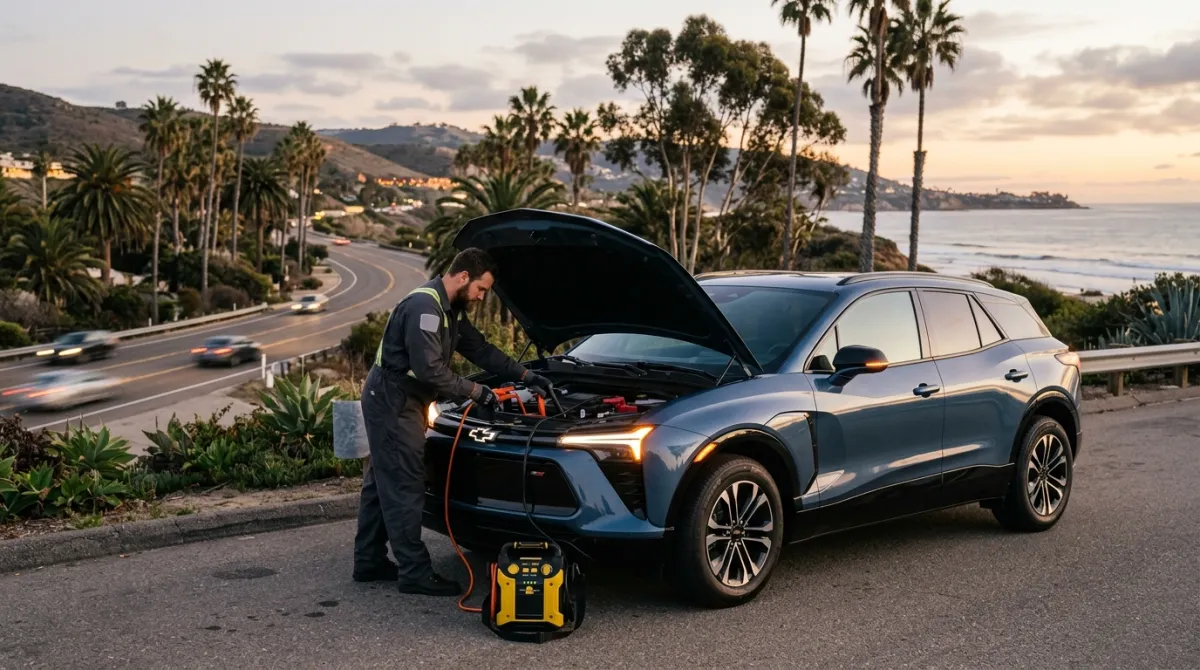
Why a Metro garage week hits the 12-volt first
WMATA park-and-ride garages around this metro are built for long sits. You leave a Blazer EV at a Silver Line lot, a Red Line garage, or a District structure. Then you ride. Body modules still draw a trickle. After several days that 12-volt can fall too low to boot.
This matches the airport pattern too. The most common stranded-EV call here is a car that won’t wake after a week in long-term parking. It’s almost never an empty traction pack. It’s a dead 12-volt. The same garage-and-trip sit shows up on GM Ultium crossovers like the Blazer EV.
At Dulles, MWAA publishes Level 2 charging in Garage 1 and Garage 2. MWAA also publishes no EV charging in the Economy Lot, the Terminal Lot, or Valet. The Economy Lot is the largest on-airport option. A shuttle runs from Curb 2F. Leave a Blazer EV there for a week and you return to whatever the 12-volt still holds.
Reagan National is a different layout. Complimentary EV charging for parking customers sits on Level 1 of Parking Garages 1 and 2. A stall without a plug still leaves you on the 12-volt alone.
Reston Silver Line parking is the same week-long pattern. For a dead car in that lot, start with EV roadside assistance in Reston.
Two batteries, and only one lets the car wake
A Blazer EV has two electrical systems. The Ultium pack turns the motors. A conventional 12-volt battery runs door locks, interior lights, and the center screen. It also powers the modules that must approve high-voltage start. If that 12-volt is dead, the car won’t enter Ready. Pack percent doesn’t save you.
The Blazer EV shares that Ultium layout with the Cadillac Lyriq and the Chevy Equinox EV. The no-start checks are nearly the same across that family.
The 12-volt on the Blazer EV sits in the front trunk, under a plastic panel. There’s no engine bay. If you learned cars on gas, you’ll look in the wrong place first. If the 12-volt still has a little charge, the frunk opens from the cabin switch or the fob. If it’s fully dead, the latch is electric. You’ll need the manual emergency release in the owner’s manual.
Read the cabin before you open the frunk
The center screen is the fastest clue you have.
- Dark screen, no dome light, dead fob: the 12-volt is fully dead.
- Dark screen, doors still unlock: the 12-volt is low. Try a jump pack.
- Screen flashes on, then dies: module boot loop. Try a 12-volt power cycle.
- Screen loads with a Service warning and no Ready: Ultium fault. Power cycle, then a Chevrolet dealer.
- Charge-port locked icon: latch fault. Free the port before you chase a no-start.
Total darkness with a silent fob is the Metro-garage case. Jump the front terminals, wait a minute, then try start. Most of those cars come back. Don’t mix that up with an empty traction pack. If the app still shows range and the car is only dark, you’re not out of miles. You’re out of 12-volt power.
Jump the bus bar, not the battery posts
Jump terminals sit on a dedicated bus bar in the front compartment. They’re separate from the battery posts. The positive post has a red cap. The negative point is a chassis bolt nearby. Clip a 12-volt jump pack to those two points. Wait 60 to 90 seconds so the modules can wake. Then press start.
Use the bus bar. Don’t clamp the battery posts. If you hit start too soon, the computers haven’t sequenced.
If the car starts and then dies again the next morning, the 12-volt is tired. A jump is a wake-up, not a repair. Independent operators in this network can jump or replace a dead 12-volt on site. They quote you before they start, and they bill you directly. For a failing auxiliary battery over time, use the 12-volt replacement guide.
When software, not a flat 12-volt, blocks Ready
Early Blazer EV builds had a rough software launch. In late 2023 and into 2024, GM stopped selling new inventory. The issue was code that could cause no-starts, power loss, and failed charge sessions. Over-the-air updates went out. Some builds still needed a dealer flash.
The screen may light, then quit. The car may hit Ready, then drop out before you can move. You may see Service High Voltage Charging System or Service EV System. The myChevrolet app can still show a normal charge level while the car refuses to drive.
The field reset is a full 12-volt power cycle. Open the frunk. Disconnect the negative 12-volt terminal. Leave it off for two minutes. Reconnect. Wait for relays to click as modules come back. Then try a normal start. That clears volatile memory and lets the battery management system initialize again. It fixes many hang-type no-starts with no extra tools.
If warnings stay after that cycle, stop. That’s dealer diagnostic work. Don’t force a charge session on a Blazer EV with active Ultium faults. A charge-port latch that won’t release can also block Ready. If the screen shows the port locked, deal with the latch first.
Where these no-starts actually happen here
The 12-volt doesn’t care which line you parked on. The setting around you still changes the next safe step.
Rail garages and mall decks. Tysons is a census-designated place, not an incorporated city. The mall is still Tysons Corner Center. Office and mall decks there hold cars all day. A Blazer EV that sits through a long workday can wake with a flat 12-volt. For the garage version of this, read what to do after a long sit in a Tysons garage. Silver Line parking in Reston is the same long-dwell pattern.
Older streets and apartments. Takoma Park’s housing stock is about 90 percent pre-1980. Annandale is about 80 percent. Wheaton is about 73 percent. The District is about 70 percent. Those figures come from Census ACS 2019-2023. Older buildings are a proxy for no driveway Level 2. Arlington, Alexandria, Silver Spring, Wheaton, Hyattsville, and Annandale also have dense apartment living. Many owners there charge at work or at a public stall, not at home. A dark car on the street is still usually the 12-volt if the app shows range.
I-270, I-66, and the Beltway. If the traction pack is actually empty, that’s a different job. You need a 240-volt top-up, not a jump. Sitting in gridlock with heat or AC on burns energy without covering distance. That’s the Beltway crawl and the I-95 standstill. Dulles runs colder and snowier than Reagan National. Loudoun, upper Montgomery, and Prince William feel that gap. Recurrent Auto’s winter study of more than 30,000 EVs found typical retention of about 80 percent of range at 32F, and about 70 percent at 20F. Cabin heat is the drain. Cold doesn’t prove the 12-volt is dead. A cold soak on an already weak 12-volt does make a no-start more likely.
Express Lanes and parkways. On the 495 Express Lanes, pull to the LEFT shoulder. Those lanes sit in the median. On the 95 and 395 Express Lanes, pull to the nearest shoulder. Stay in the car. Transurban’s Express Assist helps with minor mechanical issues and can call a tow. It doesn’t charge an EV. The Baltimore-Washington Parkway, George Washington Memorial Parkway, Clara Barton Parkway, Rock Creek, and Suitland Parkway have narrow or missing shoulders. Commercial vehicles and trucks over 10,000 lb are banned. A disabled vehicle on the Baltimore-Washington Parkway is reported to the US Park Police at 202-610-7500. The American Legion Bridge carries the Beltway between McLean and Montgomery County. The Woodrow Wilson Bridge carries it between Alexandria, Oxon Hill, and the District.
Who won’t charge the car, and who can jump it
Pepco serves the District, Montgomery County, and Prince George’s County. Its EV program is Pepco EVsmart. Dominion Energy Virginia serves most of Northern Virginia, with Schedule 1EV, the Off-Peak Plan, and EV Charger Rewards. NOVEC serves parts of Loudoun and Prince William, including much of Sterling, Ashburn, and Gainesville. None of the utility EV pages reviewed offer a service that charges a stranded car.
VDOT Safety Service Patrol covers Virginia interstates, including I-66 and I-95 in Northern Virginia. Drivers reach help through Virginia 511. Published VDOT material describes incident and debris clearance and short-term traffic control. It doesn’t describe EV charging.
MDOT SHA CHART Emergency Traffic Patrol works the Baltimore/Washington metro. Technicians can jump a 12-volt, change a tire, and add about a gallon of gas. Dial #77 on state primary roads such as I-495, I-270, US-50, and MD-295. A CHART jump is a 12-volt jump. It’s not a 240-volt charge into the Ultium pack.
The District has no DDOT motorist-assistance patrol in the materials reviewed. DC drivers rely on MPD, private roadside plans, and US Park Police on the parkways. None of the three vehicle codes reviewed has a special rule for running out of electric charge. Disabled-vehicle rules apply to a Blazer EV the same as any other car.
Independent local operators in the Charge Pro DC network handle GM vehicles through non-Tesla EV rescue. They bring a 240-volt Level 2 source to the car. A CCS or J1772 adapter covers a Blazer EV. A typical top-up adds about 10 to 20 miles in 15 to 30 minutes of charging time. That’s charging time, not a promise of when someone arrives. They can also jump or replace a dead 12-volt on site. The operator quotes you before work starts and bills you directly. Charge Pro DC matches you with that operator. It doesn’t own the truck, and it doesn’t do the work.
Frequently asked questions
Why won’t my Blazer EV start after a week in a Metro garage?
Modules keep a small draw while the car sleeps. After days in a WMATA lot or an airport garage, the 12-volt can fall too low to boot. The Ultium pack can still hold range. A dark screen and a silent fob are the tell. Jump the front bus-bar posts, wait 60 to 90 seconds, then try start. If it happens again, replace the 12-volt.
How do you jump start a Chevy Blazer EV?
Open the frunk with the cabin switch or the fob. If the 12-volt is fully dead, use the manual release in the owner’s manual. Under the plastic cover, find the bus-bar jump points. You’ll see a red-capped positive post and a chassis ground bolt. Connect the jump pack there, not to the battery posts. Wait 60 to 90 seconds, then press start.
Can a Blazer EV refuse to start with a full traction pack?
Yes. A dead 12-volt will block Ready even with a full Ultium pack. A battery-management hang can do the same on early builds. The myChevrolet app may still show charge. Try the two-minute negative-terminal power cycle. If Service warnings stay, you need a Chevrolet dealer scan, not another charge session.
If your Chevy Blazer EV won’t start in the District, Maryland, or Virginia, call Charge Pro DC at (202) 629-0844. An independent operator quotes the 12-volt jump or a 240-volt top-up before any work begins.