Tesla roadside assistance comes with every new Tesla for the first four years or 50,000 miles. The included help covers flat tires, lockouts, 12 volt jumps, and a limited tow. The line between included and billed is the part that surprises drivers in DC, Maryland, and Virginia when they actually need help. This post walks through where the free line sits, what you still arrange on your own, and why a quoted local mobile charge is the gap that affects every jurisdiction in our area.
What Tesla includes in warranty
Inside the New Vehicle Limited Warranty window (typically four years or 50,000 miles, whichever comes first), Tesla’s roadside covers the standard cases.
Flat tire service
If a tire is damaged, Tesla arranges a mobile tire repair or a tow to the nearest Tesla Service Center, a third-party tire shop, or a location of your choice within the policy distance. The actual cost of the tire repair or the replacement tire is always separate and always your responsibility, regardless of warranty status.
Out-of-charge recovery
For vehicles that run out of traction pack charge, Tesla will transport the car up to a policy distance to the nearest Supercharger, destination charger, or your home. This benefit is typically limited to one instance per year. A second out-of-charge event in the same twelve months is billed even if your Tesla is still under warranty.
Locked-out help
If you cannot get into the car, Tesla usually handles the situation remotely through the Tesla app unlock. If the remote unlock does not work, a technician is dispatched to your location.
Battery jump
A dead 12 volt falls under this. Tesla dispatches a technician with a low-amp jump pack. Free in warranty.
Towing for warranty-covered failures
A tow to the nearest Tesla Service Center for warranty-covered mechanical failures is included up to a published distance. A tow beyond that distance is billed.
Winching
If you are stuck in mud, sand, or off the road and a tow truck can reach you, Tesla may cover the cost. This is for non-accident situations.
You request all of this through the Tesla app or by calling Tesla. Response time varies by location, traffic, and which contracted provider is on call. In the DC area, urban calls tend to clear faster than calls on a snowy I-66 or a clogged Beltway shoulder at rush hour.
What Tesla includes only once or with limits
These are the benefits most DC, Maryland, and Virginia drivers only learn about when they have already used them once.
The one-per-year out-of-charge tow
The out-of-charge benefit is one tow per twelve months. A driver who commutes from Germantown to Bethesda every day and miscalculates the pack twice in a year will pay out of pocket for the second tow. The first tow is included, the second is not. A driver who commutes on the Beltway in both directions every weekday is the most likely to hit this ceiling.
The mileage cap on tows
The included tow covers up to a published distance. If you run out of charge on I-66 in Haymarket and the nearest Supercharger is in Manassas, that is well within the cap. If you run out of charge in the outer Prince William suburbs and the nearest Supercharger is across the county line, the per-mile fee for the excess distance starts at the published rate.
The lockout that is not a lockout
If you cannot get into the car because the 12 volt is dead, Tesla treats that as a battery jump, not a lockout. If you cannot get into the car because you lost your key card and the phone key is not provisioned, Tesla treats that as a lockout. The path is the same in both cases, but the billing path is different.
What Tesla does not include for any model
These are the cases where you arrange something on your own, regardless of warranty status.
On-site charging
Tesla roadside will not send a truck with a 240 volt Level 2 charger to your shoulder. The answer to an empty traction pack is a flatbed tow to the nearest Supercharger. A driver who stalls on the Beltway at 2 percent with the nearest Supercharger 25 miles away is looking at a long flatbed ride.
A tow beyond the policy distance
A tow that exceeds the included mileage is billed per mile. The exact rate depends on the dispatched contractor. A long tow from a Haymarket breakdown to a Tysons service center can run several hundred dollars.
Out-of-warranty service
The moment the New Vehicle Limited Warranty ends, every roadside event becomes a billable service. The same contractor pool is used. The dispatch fee structure is the same. The difference is who pays.
The service Tesla declines to send
If Tesla decides a roadside event is outside its coverage, the contractor dispatched may decline the work on arrival. A driver who needs a mobile charge rather than a tow is the most common case. The contractor is set up to flatbed, not to plug in.
How a quoted local operator fills the gap
Charge Pro DC is a referral line that connects DC, Maryland, and Virginia Tesla owners with independent local operators. The gap we cover is the one Tesla does not.
Mobile EV charging in your jurisdiction
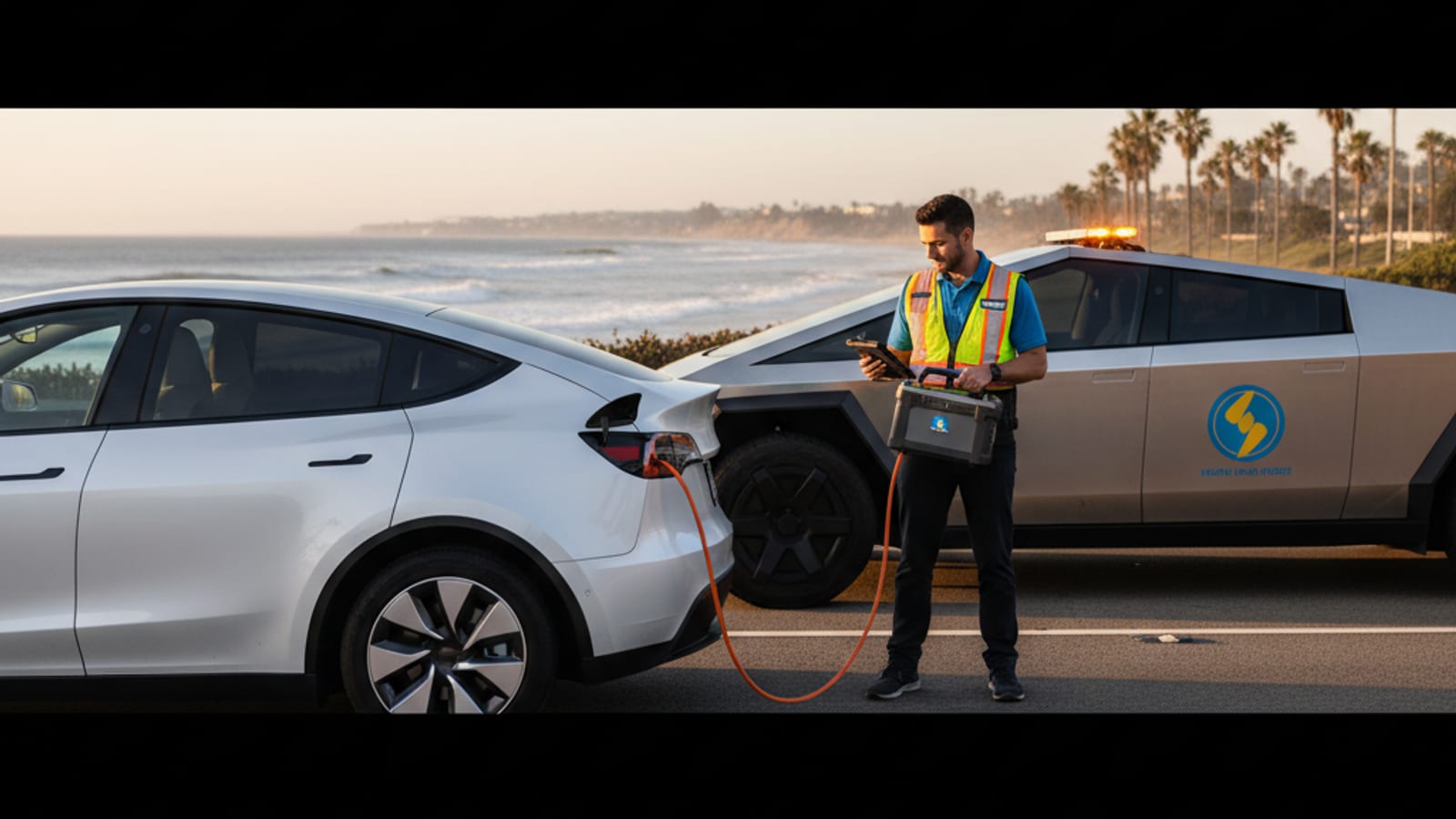
The independent operators we send carry a 240 volt Level 2 source on the truck. They plug in where the car sits. Fifteen to thirty minutes of charge adds 10 to 20 miles. That’s charging time, not an arrival promise. It is enough to drive off the shoulder and reach the next charger. For the full scope of what shows up on the truck, our mobile EV charging service page describes the equipment.
12 volt jumps and replacements
The operators we send also carry low-amp lithium jump packs rated for Tesla low-voltage systems. A dead 12 volt at a Tyson Corner parking deck or a Bethesda Metro garage is a one-visit fix in most cases. A weak 12 volt that will not hold a charge gets replaced on site for the common Model 3, Y, S, and X years. Our Tesla 12 volt dead guide walks through how to recognize the failure before it strands you.
The three-jurisdiction difference
DC, Maryland, and Virginia each handle towing, impound, and recording rules differently. Virginia has a statewide hookup-and-tow cap, with a Northern Virginia Planning Districts 8 and 16 floor set by local ordinance. Maryland is all-party consent for call recording, with serious penalties for violation. DC is one-party consent. DC impound goes through the Blue Plains facility. A local operator who works your jurisdiction every day already knows the rules. Our Tesla roadside versus a quoted local operator guide walks through how that comparison plays out.
When to call Tesla and when to call us
You can call both. Whoever arrives first, you cancel the other. Neither side charges a cancellation fee for a legitimate change of plan.
Tesla first
When the failure is a covered mechanical issue in warranty. When you need a flat tire loaner wheel in a safe location. When you need a tow to a Tesla Service Center for warranty work.
Local operator first
When your traction pack is empty and the nearest charger is more than a few miles away. When you want to drive off the shoulder under your own power instead of riding on a flatbed. When the 12 volt is dead and you do not have a low-amp jump pack on hand. When you are off the main corridors and the contractor pool is thin.
Need to compare options right now in DC, Maryland, or Virginia, call (202) 629-0844. We match you with a local operator who covers your jurisdiction and quotes you before starting.