Tesla, Rivian, and Lucid each run a roadside program. None of the three is a 240 volt referral line covering the District, Maryland, and Virginia. Each leans on the same playbook: warranty-tied coverage, contracted tow providers, and a tow to a charger or service center for an empty pack. The local operator we connect you with is the parallel path when 240 volts is what the car actually needs.
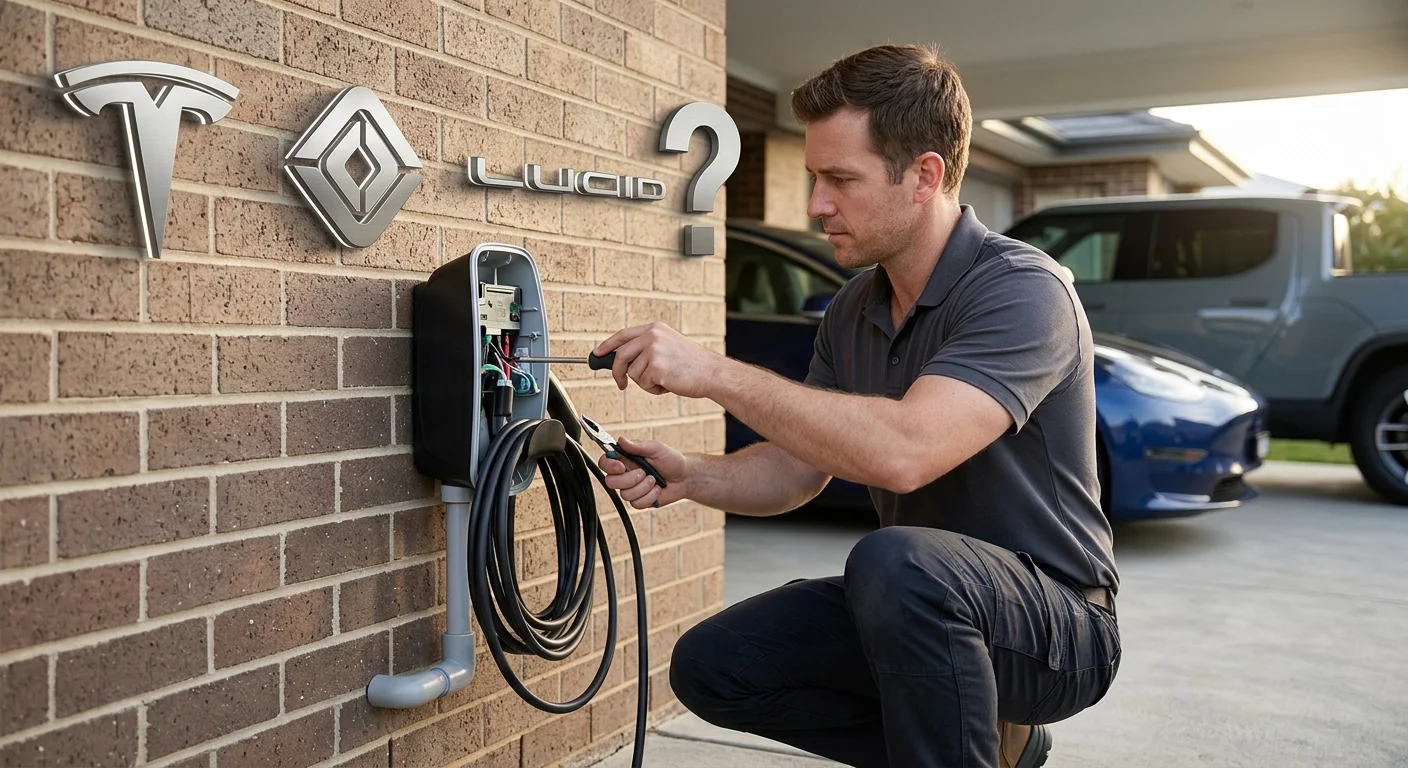
What each brand’s program covers
Tesla’s roadside assistance is built into the New Vehicle Limited Warranty and runs through the Tesla app. Tesla may send a Ranger, a contracted tow provider, or a loaner arrangement depending on the situation. Tesla’s published roadside page still says out-of-range help may be available and may not be covered financially. Confirm current terms in the app before you tap submit.
Rivian offers roadside assistance tied to its 5-year or 60,000-mile basic warranty. Rivian’s program covers breakdowns, flat tires, and out-of-charge events, aiming to get the vehicle to a Rivian service center or a suitable repair facility. Service is generally consistent across R1T and R1S models.
Lucid provides roadside assistance for 5 years or 60,000 miles, matching its basic limited warranty. Lucid’s program covers common roadside issues including towing due to mechanical failure, flat tire changes, 12-volt system jump-starts, and out-of-charge assistance. The premium support experience is what Lucid aims to deliver.
Where the three programs agree
All three treat out-of-charge as a tow event. Tesla, Rivian, and Lucid typically offer towing to the nearest charging station or service center for an empty pack. None of the three publishes an on-site 240 volt mobile charging service as part of the standard roadside benefit. That is the consistent gap across the three brands.
All three handle flat tires through tow or temporary fix, depending on the responder’s training. None of the three typically performs permanent on-site tire repair like a patch or plug. The tire is a tow to a service center or tire shop.
All three handle a dead 12-volt as a roadside event, but the coverage depends on whether the failure is tied to a covered component. Age-related 12-volt death is usually the owner’s cost.
Where this metro strains each program
The Beltway between Bethesda and Silver Spring is a stationary range problem in morning rush. I-66 inside the Beltway crawls in peak hours. I-270 between Rockville and Gaithersburg sits still most weekday mornings. None of those is a hill problem. It is heat or AC on, wheels stopped, pack dropping. A typical EV keeps about 80 percent of range at freezing. It keeps about 70 percent at 20F. Those numbers come from Recurrent Auto’s study of more than 30,000 EVs.
The 495, 95, and 395 Express Lanes sit inside the general lanes. On the 495 Express Lanes, Transurban says to pull to the left shoulder because those lanes run in the median. On the 95 and 395 Express Lanes, pull to the nearest shoulder. Express Assist runs on those lanes for minor mechanical issues and will call a tow. It doesn’t tow and doesn’t charge an EV.
NPS parkways wrap this metro. The Baltimore-Washington Parkway and the George Washington Memorial Parkway are limited-access scenic roads with narrow or absent shoulders. They ban commercial vehicles and trucks over 10,000 lb. A disabled vehicle on the Baltimore-Washington Parkway is reported to U.S. Park Police at 202-610-7500.
A stall on the Woodrow Wilson Bridge sits at the meeting point of Alexandria, Oxon Hill, and the District. The American Legion Bridge is the same pinch between McLean and Montgomery County. Tell whoever you call which end you’re on, and which direction.
What each program pays for, in plain terms
For covered warranty events, towing to a Tesla, Rivian, or Lucid service center is typically free. For out-of-charge, flat tire assistance beyond the loaner kit, towing after warranty expires, and any incident the manufacturer decides was driver behavior, the bill goes to your card on file.
Once a warranty expires, manufacturer-arranged towing in this metro can climb quickly. A simple tow to a service center can run into the low hundreds or more. Out-of-charge tows can run longer because the nearest charger is not always close. Long-distance flatbed tows for EVs run higher than traditional hook-and-chain.
The pros we connect you with skip that tow path. They bring a 240-volt Level 2 source to the car. They typically add 10 to 20 miles of range in 15 to 30 minutes of charging. That is charging time, never an arrival time. The operator quotes you before starting and bills you directly.
What the pros we connect you with handle that warranty does not
The pros we connect you with are licensed and insured independent operators. They handle 240-volt Level 2 charging, 12-volt jumps, and 12-volt replacement on site. They handle Tesla, Rivian, Lucid, and every major EV brand. They bring a native NACS plug, plus CCS or J1772 adapters for non-NACS cars.
A Rivian or Lucid 12-volt that won’t wake after sitting through a long visit to Tysons Corner Center or the Smithsonian gets a jump on site. A battery that won’t hold gets replaced before the truck leaves. The operator prices both and quotes you before starting.
Charge Pro DC is a referral line for the District, Maryland, and Virginia. We match stranded drivers with independent local operators. We don’t own trucks, employ technicians, set prices, or hold a trade license. We don’t promise an arrival time.
How to choose between the three and a quoted local operator
Use the manufacturer app or number first when you’re inside the warranty window and the dispatch ETA fits the stall. Then call us when the dispatch ETA has stretched past what the shoulder allows, when a 240-volt top-up at the car is the immediate need, or when a 12-volt jump is the only job.
For the manufacturer-side coverage details, see our Tesla roadside policy in 2026 for DC-area drivers note and our Rivian roadside phone number guide. For the broader picture on what warranty covers and what gets billed, see our what Tesla roadside covers versus a local quote note.
When to call Charge Pro DC
Call us when the dispatch ETA from any of the three has stretched past what the shoulder allows, when 240 volts is the immediate need, or when a 12-volt jump is the next step. Have model, pin, charge display, and warning text ready. Call (202) 629-0844 and we’ll connect you with a local EV rescue operator.