Searching for the Rivian roadside assistance phone number is a stall-day move. Don’t copy a number from an old result. This site’s verified facts don’t list a current Rivian number. Use Rivian’s official app or support site instead.
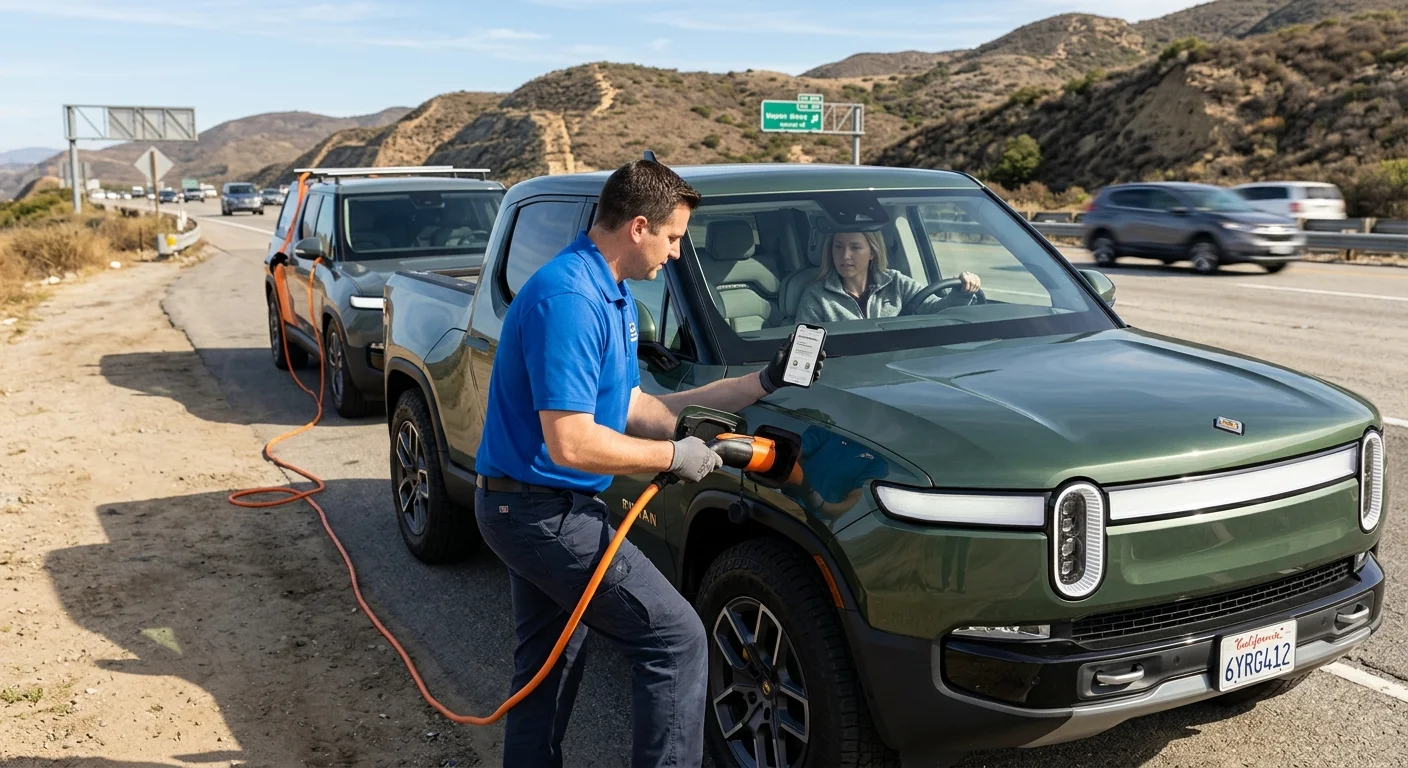
A saved contact only helps if Rivian still uses it. Forums, map listings, and search snippets go stale. The live path sits in a Rivian-controlled screen. If the app and the support site disagree, follow the newer official instruction. Charge Pro DC doesn’t speak for Rivian on coverage. We match stranded EV drivers with independent local operators.
Use Rivian’s own channel first
Open the Rivian app while you still have signal. Look for roadside or support, then use the contact shown there. You can also check Rivian’s official support site on a phone. The page should clearly belong to Rivian, not a reseller. Skip a screenshot a friend sent last year.
Our guide on Rivian Highway Assist versus a local operator covers what each path can do.
Keep manufacturer help and local backup as two separate routes. Rivian sets its own contact methods and coverage rules. We don’t confirm those terms, so ask Rivian before you authorize manufacturer work.
Say the model, the pin, and the exact warning
Whoever you reach needs a clean picture, not a guess. Start with R1T or R1S, then the exact place. Name the street, the nearest cross street, and any garage entrance. In a garage, give the level, aisle, and entrance. On a freeway, read the route and direction off the signs.
A stall on the Woodrow Wilson Bridge sits at three jurisdictions. Alexandria, Oxon Hill, and the District meet on that span. The American Legion Bridge does the same between McLean and Montgomery County. Say which side you’re on, and which direction.
Copy the warning text word for word, without adding a diagnosis. Take a screenshot of the display if it stays on. Report the last shown charge percent and any range figure. Don’t invent a cause for the stall.
Say whether it was parked, plugged in, or rolling. Note which controls still work: locks, lights, screens, charge port. If a connector is stuck, say so. If the port won’t open, say that too.
Tell them if the Rivian blocks a lane. Say if it sits in a tight garage or has room around it. On the 495 Express Lanes, pull to the left shoulder. Those lanes sit in the median, so the left shoulder is the safe side. On the 95 and 395 Express Lanes, pull to the nearest shoulder. Stay in the vehicle until help is with you.
Call 911 first if the scene is dangerous, then arrange vehicle help. Pass along new messages as they appear on the screen. They’re a record of what you can see.
When in-app help can’t send 240 volts
Rivian roadside is the right first call for policy, account, and vehicle-specific steps. It may not be the right tool for a 240-volt top-up at the curb. This site’s sources don’t verify Rivian hours or prices. They also don’t confirm whether Rivian sends a mobile charger. Ask Rivian what they can send for this event.
A local operator conversation can still make sense. That’s when you need a quoted 240-volt Level 2 source at the vehicle. Independent operators in this network typically add 10 to 20 miles of range. That charging time is 15 to 30 minutes, not an arrival time. They can also jump or replace a dead 12-volt battery on site.
Public patrols in this metro don’t fill that need. VDOT’s Safety Service Patrol works Virginia interstates, including I-66. You reach that patrol through Virginia 511. Published material covers incidents, debris, and short-term traffic control. That material doesn’t describe charging a stranded EV.
Maryland’s CHART patrol covers I-495, I-270, and US-50. Dial #77 for a breakdown on those state roads. Technicians change tires and jump-start 12-volt systems. None of that includes charging an EV pack. I-270 between Rockville and Germantown is a common empty-pack commute. A stall on I-66 is still a disabled vehicle, peak hours or not.
The District has no DDOT motorist-assistance patrol in the sources we checked. DC drivers use MPD, private plans, and US Park Police on the parkways. On the Baltimore-Washington Parkway, report a disabled vehicle to US Park Police at 202-610-7500. Those parkways ban commercial vehicles and trucks over 10,000 lb.
Pepco, Dominion Energy Virginia, and NOVEC publish home-charger programs. None of the utility pages we reviewed offer a stranded-car charge. Transurban’s Express Assist runs on the 495, 95, and 395 Express Lanes. It helps with minor mechanical issues and will call a tow. It doesn’t tow, and it doesn’t charge an EV.
Long-dwell parking is a common stall pattern here. Dulles Economy Lot has no EV charging, per MWAA’s parking guides. A week in that lot can leave the 12-volt too low to wake the truck. Reagan National puts complimentary charging on Level 1 of Parking Garages 1 and 2.
Pre-1980 stock is common in Takoma Park, Annandale, Wheaton, and much of Washington. Arlington, Alexandria, Silver Spring, Hyattsville, and Annandale have dense multifamily blocks. A dead Rivian in those lots is a curb problem, not a shop problem.
Winter cuts range even when the pack isn’t empty. Dulles runs colder and snowier than Reagan National. A typical EV keeps about 80 percent of range at freezing. It keeps about 70 percent at 20F. Those figures come from Recurrent Auto’s large-sample study. Sitting in Beltway or I-95 gridlock with heat on spends charge without covering miles.
Stuck in Bethesda with a dead Rivian is the same fork. Read in-app roadside versus a quoted local operator for that corridor.
Empty pack is not the same as a dead 12-volt
Don’t assume every unresponsive Rivian is out of traction charge. Don’t assume it’s the 12-volt unless the truck shows that warning.
For a possible empty pack, report the last visible percent. Include any charge or range warning before the stop. Say whether the display kept falling while you were still moving. If you tried a public charger, report only the on-screen messages.
For possible 12-volt trouble, quote the low-voltage wording exactly. Describe which screens, locks, and lights still respond. Don’t treat that as proof of a failed part. Wait for guidance before you attempt a jump. Our R1T or R1S won’t start checklist covers checks you can run without inventing a cause.
Mobile charging, a 12-volt jump, and a tow are different requests. An operator needs an accurate description before quoting. Connector type needs a vehicle-specific check as well. See what charger a Rivian uses at roadside before you ask for a 240-volt visit.
When a local match is the next step, start with non-Tesla EV rescue. The matched operator decides whether the work fits the truck and the spot.
What Charge Pro DC actually does
Charge Pro DC is a referral line for the District, Maryland, and Virginia. We match stranded EV drivers with independent local mobile rescue operators. We don’t charge vehicles, jump batteries, tow, or repair. We own no trucks and employ no technicians. We set no prices and promise no arrival time.
Have the same details ready when you call us. Bring the model, exact pin, displayed charge, warning text, and access notes. Say if you want a 240-volt top-up discussed.
The operator quotes you before starting and bills you directly. Ask what equipment they’re bringing to your Rivian. Confirm that gear fits your Rivian before you accept. Don’t assume a photo of a plug is enough. If a tow is on the table, confirm the destination first.
Disabled-vehicle rules in DC, Maryland, and Virginia treat an EV like any other car. None of the three codes we reviewed has a special out-of-charge rule.
Use mobile EV charging if the pack is empty. Use EV roadside assistance when you’re not sure which request fits.
Keep Rivian’s official guidance open during that talk. A local operator handles the curb problem in front of you. Rivian remains the source for manufacturer instructions and policy.
When a local backup is the call
Call us when in-app help can’t send 240 volts. Have location, model, charge display, and warning text ready. Call (202) 629-0844 and we’ll connect you with a local EV rescue operator.