A search for the Tesla Model 3 battery location can mean two different things. Before anyone lifts a panel or connects a cable, identify whether you mean the main traction battery or the low-voltage 12 volt battery. The right answer depends on which one you mean.
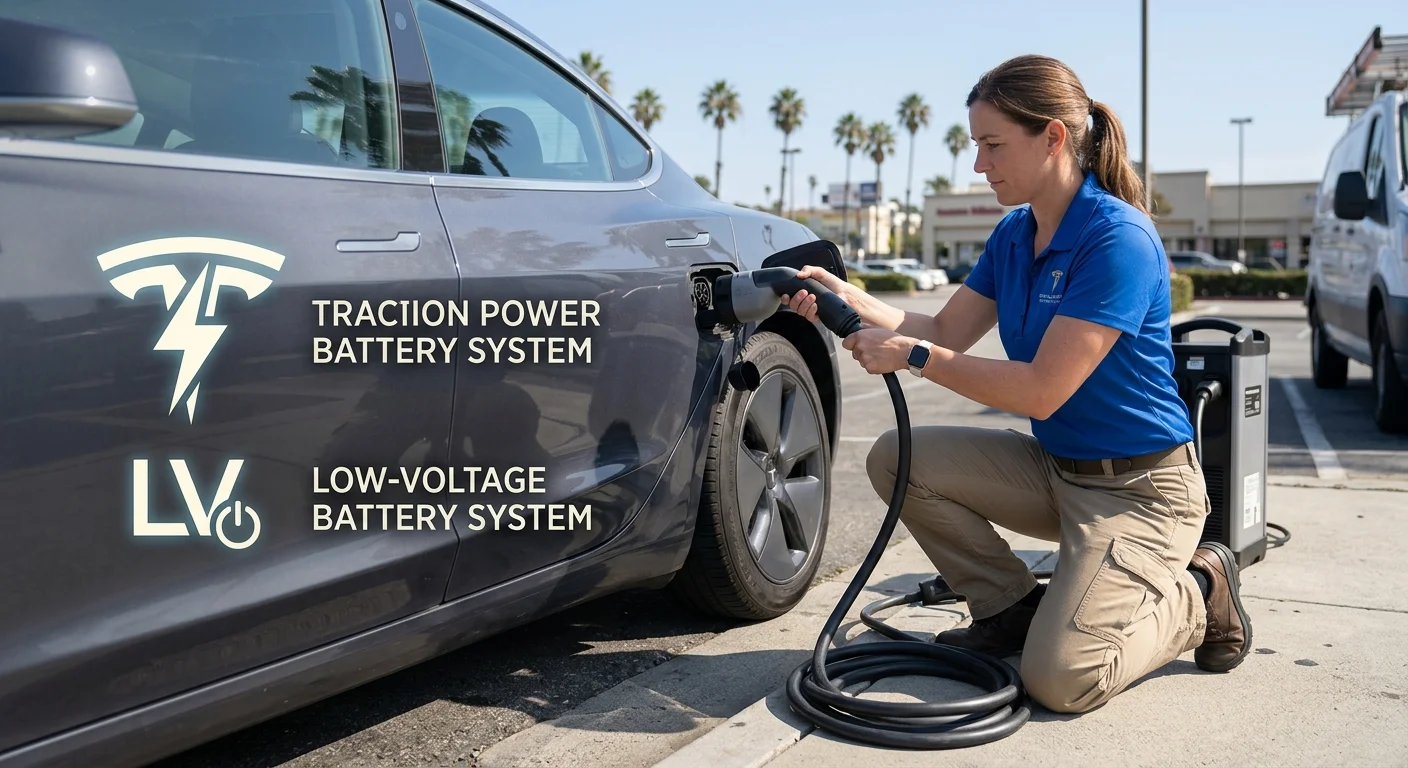
Separate the traction and low-voltage systems
“Battery” is not specific enough when you are looking for help with a Model 3. It can refer to the main traction battery or the separate low-voltage 12 volt system. Those are different search targets, and the correct answer depends on which one you mean.
Start with the reason you are searching. A question about driving range, charging, or main-battery replacement points toward the traction system. A question about a low-voltage warning, access instructions, or outside power points toward the low-voltage 12 volt system. This distinction helps you open the right Tesla manual section without guessing.
People often type “Tesla Model 3 12V battery location” even when they have not confirmed their vehicle’s system terminology. Do not treat that search phrase as proof of the battery type fitted to your Model 3. Current production Model 3 vehicles may use a lithium low-voltage battery, while earlier builds use a sealed lead-acid unit. Confirm which one your car has before assuming a procedure.
For the model-by-model breakdown, our Tesla 12 volt by model guide walks through which chemistry each Tesla uses. For the full Tesla battery failure picture, our Tesla battery dead symptoms versus 12 volt post covers how to tell which battery is the failure.
Where each battery actually sits on a Model 3
The traction pack sits under the floor of the car, between the front and rear axles. It is the heaviest component on the vehicle, weighing around 1,060 pounds depending on the variant. Service work on the traction pack is a Tesla Service Center job. No mobile operator is going to access it through the floorpan from a Metro garage.
The 12 volt accessory battery sits in the frunk, usually under a plastic trim cover. Access requires opening the frunk. That is the battery operators jump or replace on site, and it is the one a low-voltage warning is asking about.
The Model 3 jump posts are different from the 12 volt battery itself. They are exposed under the frunk hood trim panel, behind a small cover on the passenger side of the front bumper. Those posts let an operator apply temporary 12 volt power without removing the trim or touching the battery terminals directly. Operators use this port first when the goal is to wake the car.
Model year matters for the layout. Some early Model 3 builds have a manual release for the frunk behind the front bumper. Some later builds route the release cable differently. Operators confirm the layout for your specific car before connecting anything.
For the broader service-center-versus-mobile question, our EV rescue versus repair guide for the DC area walks through which jobs belong on scene and which belong at a shop.
Why model year changes the answer
Your Model 3’s model year changes the verification task. It does not automatically prove that a particular battery, location, or access method applies. It tells you which documentation to consult before relying on an answer.
Begin with the model year shown in your vehicle records. If you are not sure, confirm it from records tied to that specific vehicle. Do not select a manual because an online photo resembles your car. Similar-looking vehicles can still require different instructions.
Next, keep any configuration details available. That includes the exact wording shown by the vehicle and any information Tesla uses to identify the car. You do not need to interpret those details yourself. Their purpose is to help you and the operator consult matching instructions.
Be especially careful with articles that use “12V” as a universal label. The requested voltage, chemistry, and component position have not been confirmed here for every Model 3 year. The current vehicle-specific Tesla manual remains the deciding source.
Publication date matters too. An older guide may have been accurate for the vehicle it covered, yet still be wrong for yours. Look for documentation that clearly names the Model 3 and corresponds to your vehicle’s model year or configuration.
Use the current Tesla manual for confirmation
Use Tesla’s current owner documentation as the authority for your vehicle. Select the Model 3 material that matches the vehicle information you have confirmed. Then search within that documentation using the system name, not only the word “battery.”
For a traction-system question, search for the manual’s traction-battery terminology. For a low-voltage question, search for “low voltage,” the exact warning text, and any roadside or access topic connected to your situation. Follow the terms Tesla uses in the matching manual.
Check several details before treating a diagram as applicable:
- The document identifies the correct vehicle
- Its model-year or configuration guidance matches your records
- The warning text matches what your vehicle displays
- The illustration matches the surrounding parts you can see without disassembly
- The instructions cover your intended task, not merely a nearby component
Do not transfer instructions between model years because the exterior looks similar. Do not treat a forum image, video thumbnail, or search summary as a replacement for the current manual. Those sources may omit the vehicle identity or the limits attached to a procedure.
If Tesla’s current documentation does not resolve the location for your exact configuration, say that plainly when seeking help. You can tell the operator that you checked the official manual but could not confirm the component or approved access instructions.
How to share battery location details with the operator
Good roadside information starts with what you can confirm. Give the operator the vehicle model, model year, and exact location. Then read any visible warning exactly as displayed. Do not shorten it to “battery dead” unless that is the confirmed wording.
Explain what happened immediately before the problem. Say whether the vehicle was parked, connected to charging equipment, or being driven. Describe what still responds without assigning a cause. For example, report whether the display responds or whether you can access the vehicle. Let the operator interpret those observations.
Also share which battery system you are asking about. If you are not sure, say so. “I searched for the low-voltage battery but could not confirm the configuration” is clear and useful. It prevents a guessed diagnosis from shaping the entire request.
Have these details ready:
- The vehicle’s confirmed model year
- Your exact location in this metro
- The warning message copied word for word
- What the vehicle does when you try to use it
- Whether the current Tesla manual was available
- The manual section you reviewed
- Any safe, clear photos the operator requests
Do not report a battery location copied from another year as though you verified it. If a search result and your manual disagree, tell the operator about that conflict.
For tighter Model 3 service specifically, our jump start Tesla Model 3, Y, S, and X post walks through the model-by-model jump point locations. The matched operator can then review the vehicle details and decide what roadside work fits.
Charge Pro DC covers the District, Maryland, and Virginia. We connect you with independent operators. For a quote before work starts, call (202) 629-0844.
Frequently asked questions
Where is the 12 volt battery on a Tesla Model 3?
The 12 volt accessory battery sits in the frunk under a plastic trim cover on most builds. The Model 3 jump posts that an operator uses to apply temporary 12 volt power are different. They sit under the frunk hood trim panel, behind a small cover on the passenger side of the front bumper. Operators use the jump posts first to wake the car, then access the 12 volt battery directly for a jump or replacement.
Where is the traction pack on a Tesla Model 3?
The traction pack sits under the floor of the car, between the front and rear axles. It is by far the heaviest component on the vehicle. Mobile operators do not access the traction pack from underneath. If the traction pack itself is the failure, the right call is a Tesla Service Center and a transport plan. A mobile EV charge call addresses an empty pack by adding range through the charge port, not by accessing the pack through the floorpan.
Do all Model 3 years use the same battery locations?
Most share the same general layout, but the exact access steps, the 12 volt chemistry, and the manual release cable routing can vary by model year. Operators confirm the layout for your specific car before connecting anything. If you are not certain which build you have, say so when you call.
Is the 12 volt battery in a Tesla Model 3 the same as the one in other EVs?
No. Each EV brand uses its own 12 volt or low-voltage system. Tesla Model 3 uses a 12 volt accessory battery. Cybertruck uses a 48 volt lithium system. Most non-Tesla EVs use a 12 volt lead-acid or AGM battery in a different location than the Tesla frunk. Operators cover all of these, but the equipment, jump point locations, and replacement parts differ.