A Tesla that will not take a charge can mean several different things. The car may need charger help, mobile energy, low-voltage assistance, or transport. Picking the wrong service costs you time. Picking the right one starts with what the Tesla is doing right now.
What “Tesla charging service” usually means here
“Tesla charging service” gets used for at least two very different situations. One involves a home charger or a public charger that will not deliver energy. The Tesla still has usable range, and the problem is the equipment behind the wall or pedestal. The other involves a Tesla that lacks the energy to move.
Tesla’s own published support path focuses on the car, the app, and Tesla’s own Supercharger network. Tesla does not run a 240 volt truck service to your location in this metro. When the brand refers you to a third-party provider in the app, that provider may be a tow operator, a mobile EV charging service, or both.
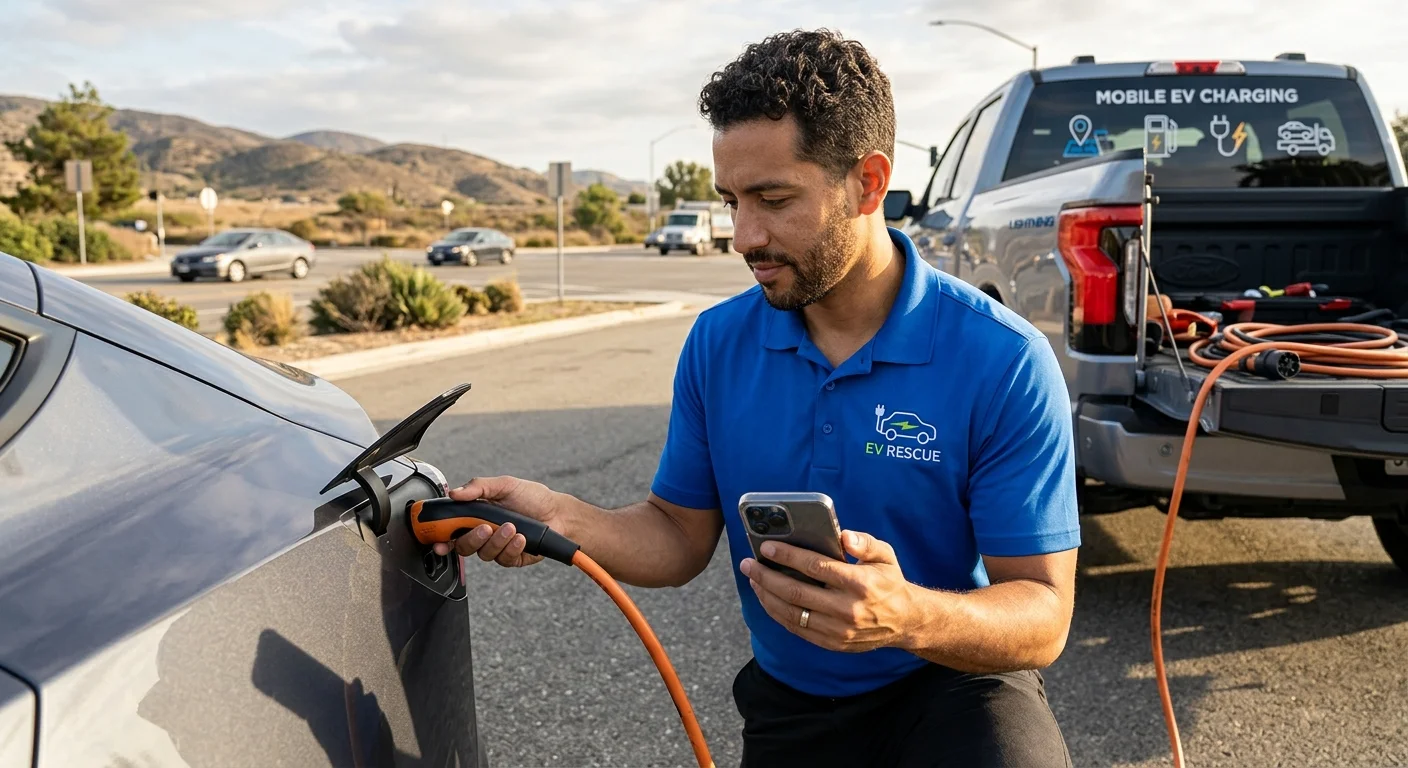
A local mobile EV charging operator is a different thing. The operator brings a 240 volt Level 2 source to the Tesla’s charge port, with native NACS and CCS or J1772 adapters for other EVs. Fifteen to thirty minutes of charging adds 10 to 20 miles of range. That is charging time, never an arrival promise. It is enough to get off a shoulder or out of a garage.
For background on what mobile EV charging actually involves, our how mobile EV charging rescue works post walks through the equipment and the steps. For a stranded Tesla, our mobile EV charging service connects you with an independent operator.
Split charger trouble from an empty battery
A charging problem does not always mean the traction pack is empty. It also does not prove the charging station or vehicle has failed. Sort the situation into four practical categories before requesting service.
Charging-equipment trouble
The vehicle has usable energy but will not charge at a fixed location. Record the charger location and any message shown by the car or station. If the problem involves home wiring or charging hardware, contact a qualified charging professional. A Tesla in a Bethesda garage with a tripped home charger circuit is not a mobile EV charging call.
Empty traction battery
The Tesla lacks enough stored energy to continue driving. Ask whether compatible mobile charging is available at the vehicle’s exact location. Do not assume every operator carries equipment suitable for every Tesla. Native NACS works for every current Tesla. CCS and J1772 adapters are useful if a different EV is also on the call.
Missing low-voltage power
The cabin, locks, screens, or controls may not behave normally. Report those observations without diagnosing the traction battery. Ask specifically whether the operator can assess a Tesla low-voltage problem. Our Tesla 12 volt battery jump service is the right page for that scenario.
Transport need
The vehicle may require transport when charging is not appropriate, compatible equipment is not available, or the Tesla still cannot move. Confirm that the operator can handle the vehicle correctly before accepting service.
What an operator covers around the District
A local operator covering the District, Maryland, and Virginia brings a mobile EV charging unit and the gear to handle a 12 volt jump on a Tesla that will not wake. The operator knows the local corridors. The Beltway (I-495), I-66, I-95, I-270, and the 495/95/395 Express Lanes are all daily routes. The Express Lanes sit in the median on the 495, so a stopped EV pulls to the left shoulder there. The Express Assist patrol runs free on those lanes and will call a tow but does not tow.
Garages stack up across the region. Bethesda Row, Pike & Rose, the Ballston Quarter, and the Springfield Town Center lots see the same long-dwell pattern. NIH and Walter Reed staff lots, Sibley Memorial, Suburban Hospital, and Westfield Montgomery hold cars for long days. Reagan National and Dulles hold cars for a week or more.
Pepco serves the District, Montgomery County, and Prince George’s County under the EVsmart program. Dominion Energy Virginia runs a residential EV rate Schedule 1EV and the EV Charger Rewards demand-response incentive for Northern Virginia customers. NOVEC covers parts of the western Prince William area. None of those utility programs covers a stranded-car charge.
How to read the on-screen guidance before you call
If the touchscreen is on, follow the active message. If it directs you to charge, compare that direction with a charger you can safely reach. A map pin is not permission to ignore a more restrictive warning.
If the screen offers more detail, review it while safely parked. Photograph the complete message, including any heading, supporting text, and visible symbols. Do not crop away details that may change the operator’s assessment.
Do not clear alerts before recording them. Avoid improvising with resets, disconnected batteries, or jump procedures because the word “battery” appeared. A low traction charge and a low-voltage alert call for different equipment and handling.
For the local context, our guide on what to do when an EV dies covers how to describe the situation to the operator. For a Teslaspecific decision on whether to call a tow, our tow a Tesla with no power in DC, Maryland, and Virginia post is the right read.
How Charge Pro DC connects drivers with operators
Charge Pro DC is a referral service. We connect drivers with licensed, independent local EV charging professionals who cover Tesla and every major EV brand. We do not perform the work, set the operator’s price, or promise an arrival window.
When you contact us, share the vehicle’s location and visible symptoms. Tell us whether the Tesla has remaining range, whether its controls respond, and whether it is connected to a charger. Include parking restrictions, garage access, or roadside landmarks that may affect the operator.
The operator who takes the job confirms whether compatible charging, low-voltage assistance, or transport is available. They explain pricing, service terms, and any warranty that applies. You contract with and pay that operator directly.
Charge Pro DC covers the District, Maryland, and Virginia. We connect you with independent operators. For a quote before work starts, call (202) 629-0844.
Frequently asked questions
Does Tesla send a 240 volt truck to my location in this area?
No. Tesla’s published options in this region include their own support line and third-party providers listed in the Tesla app. A local independent operator is the right call for a mobile EV charge to the car itself. Tesla does not run a 240 volt Level 2 truck service to your curb.
What is the difference between mobile EV charging and a tow?
A mobile EV charging operator brings 240 volt Level 2 energy to your car and adds 10 to 20 miles in 15 to 30 minutes of charging time. A tow loads the car onto a flatbed and moves it to a charger or a shop. Mobile charging is faster and cheaper for an empty traction pack that can accept energy. A tow is the right call for collision damage, a blocked charge port, or a Tesla that will not accept a charge at all.
Can a mobile operator handle a Tesla that will not wake up?
Yes, if the failure is the 12 volt. Operators bring a portable 12 volt supply and the right jump posts for the specific Tesla model. A jump restores the touchscreen, the locks, and the high-voltage relay. Most cars roll out under their own power. A 12 volt battery that will not hold a charge gets replaced in the stall.
How do I know whether to call Tesla or a local operator?
If the car is damaged, shows a fault code, or is part of a warranty repair, Tesla service is the right path. If the car is simply stranded with an empty pack, a dead 12 volt, or a confusing warning, a local operator with Tesla-specific experience usually moves faster. The operator’s quote, equipment, and warranty terms come from them, not from Charge Pro DC or from Tesla.