You walk up to your Tesla in a Bethesda Row garage, a Takoma Park apartment lot, or a Reagan National deck. Nothing. No lights, no app response, no handles presenting. You are not just out of charge. You are locked out. That is almost always the 12 volt auxiliary battery, not the high-voltage pack.
Why a dead 12 volt locks you out
Every Tesla runs a 12 volt low-voltage battery alongside the main lithium-ion traction pack. That small battery powers the door locks, the frunk release, the touchscreen, the windows, and the relay that lets the high-voltage pack reach the motors. When the 12 volt dies, those systems lose power. The car will not wake up, the app cannot connect, and the door handles will not present. You are effectively locked out.
The high-voltage pack can still hold plenty of charge. It does not help. Without the 12 volt closing the relay, the traction pack cannot feed the drivetrain. The car stays dark.
This pattern shows up most in long-dwell lots in this metro. A week in the Dulles Economy Lot, a workday at the Greenbelt Metro end-of-line garage, a Bethesda Row stay during a long meeting, and a Takoma Park apartment lot through a cold night all drain the 12 volt quietly. By the time you walk back, the traction pack is fine and the 12 volt has nothing left.
First steps when the Tesla is unresponsive
Take a breath. This is a common failure with a known fix. Work through these in order.
Check the Tesla app. If the car has just enough residual power, the app may connect briefly. Often it will not. If the app shows the car as asleep or unreachable, that is your first confirmation that the 12 volt is the suspect, not the pack.
Try the key card. Hold it against the B-pillar sensor. If the 12 volt is fully dead, this will not work, but it costs you nothing to try.
For Model S and Model X owners, these cars have a small mechanical key hidden inside the key fob. The mechanical key manually opens the driver door. Model 3 and Model Y do not have this feature. If you drive a 3 or Y, you need outside power to open the frunk first, and then the door.
Once the frunk pops, the rest of the unlock sequence follows. The Tesla app and key card will work again once the 12 volt system has enough power to close the relay and bring up the touchscreen. Most drivers find that the doors unlock normally within a minute of external 12 volt power being applied.
How the operator opens the car on site
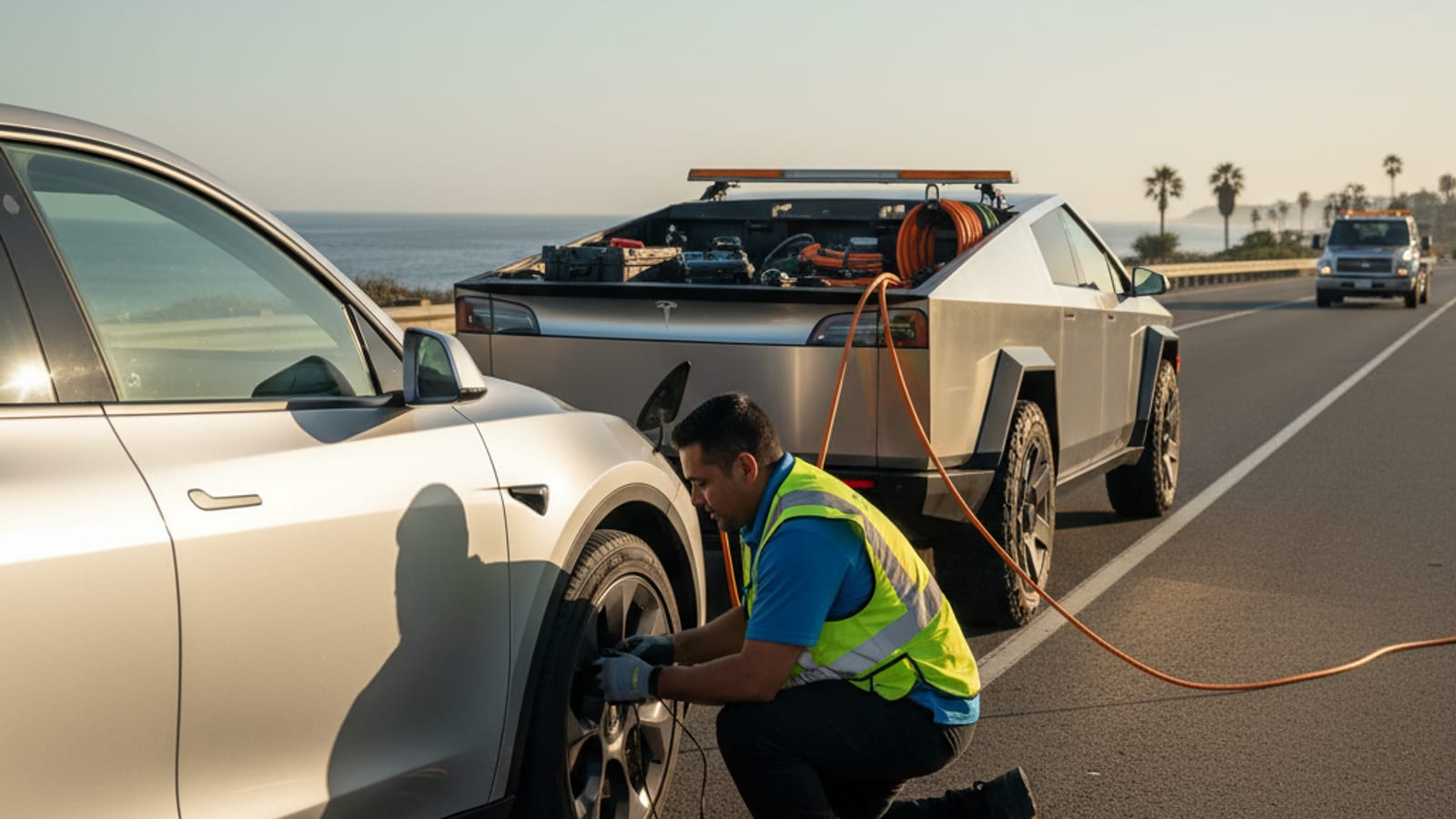
The matched operator’s job is to provide temporary 12 volt power to the Tesla so the frunk latch releases. From there, they can access the actual 12 volt battery, jump it, or replace it if it will not hold a charge. The sequence is similar to what Tesla’s own published emergency procedures describe, but operators use commercial equipment rated for the task.
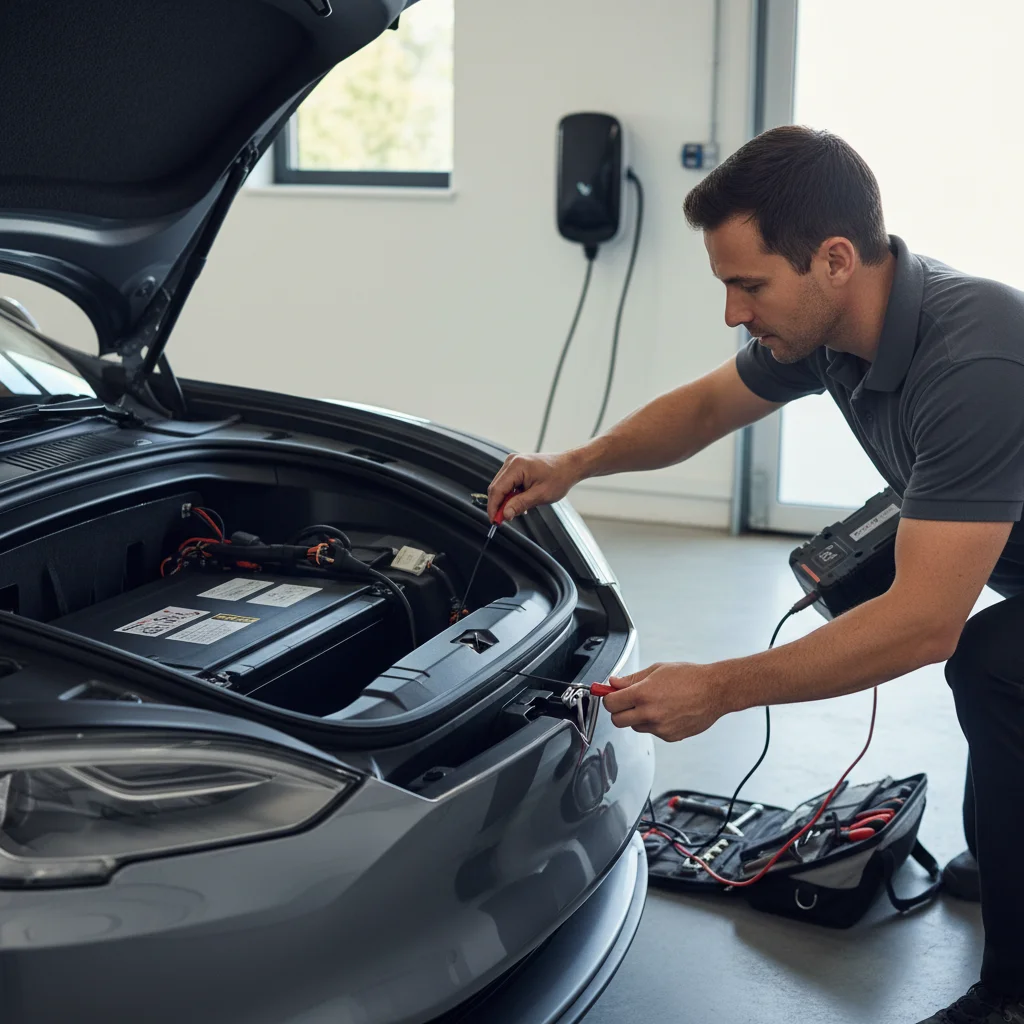
The operator locates the jump posts on your specific Tesla. Model 3 and Model Y hide the posts under the frunk hood trim panel, behind a small cover on the passenger side of the front bumper. Model S and Model X have posts that may sit behind a small panel near the front grille or under the front bumper. Model year matters, so the operator confirms the layout for your car before connecting anything.
The operator connects a portable 12 volt supply to the posts, observing polarity, and holds the connection for 30 to 60 seconds. You should hear a small click or pop as the frunk latch releases. The operator disconnects the external supply, opens the frunk, and the rest of the unlock sequence follows.
Once the frunk is open, the operator can jump the actual 12 volt battery directly or replace it on site if it has failed internally. A successful jump gets most cars moving again under their own power. A battery that will not hold charge after a jump gets swapped in the stall. You drive out instead of waiting on a flatbed.
Where this happens most in this metro
Long-dwell lots dominate the call list. The Dulles Economy Lot is one of the busiest. Reagan National charges on Level 1 of Parking Garages 1 and 2, first-come, first-served, but that does not keep a 12 volt alive through a week. The Dulles garages publish Level 2 in Garage 1 and Garage 2, again for parking customers, and the Economy Lot is the largest and cheapest option reached by a 24/7 shuttle at Curb 2F.
The Metro end-of-line garages in Greenbelt, Branch Avenue, Vienna, and the new ones at Potomac Yard hold cars for the workweek. NIH and Walter Reed staff lots, Suburban Hospital, Sibley Memorial, and the Westfield Montgomery and Westfield Wheaton decks hold cars through long days. A weak 12 volt fails quietly in any of those structures.
Apartment lots in Takoma Park, Columbia Heights, Silver Spring, and the District’s quadrant garages hit the same pattern. Cars that sit outside through a cold night, especially older 12 volt units, can fail at start the next morning.
What happens after the unlock
Once the operator opens the frunk and jumps the 12 volt, the Tesla’s touchscreen comes back. The app reconnects. The doors unlock normally. Most drivers roll out of the stall under their own power.
If the 12 volt battery was just discharged and not failed, the jump holds and the DC-DC converter tops the 12 volt back up from the high-voltage pack. You can drive to a service center for a written estimate on the 12 volt battery itself.
If the 12 volt will not hold a charge after the jump, the operator replaces it on site. A lead-acid 12 volt is a routine swap. A lithium 12 volt is also a routine swap, with different part numbers. The operator quotes the part and labor before starting.
For Bethesda drivers, our Bethesda EV roadside assistance page covers the local dispatch step. Silver Spring drivers have a separate page at Silver Spring EV roadside assistance. Takoma Park and Langley Park drivers reach us through the Takoma Park EV roadside assistance page.
Charge Pro DC covers the District, Maryland, and Virginia. We connect you with independent operators. For a quote before work starts, call (202) 629-0844.
Frequently asked questions
Can I unlock my Tesla without power at all?
Model S and Model X have a mechanical key hidden in the fob that opens the driver door. Model 3 and Model Y do not. If you drive a 3 or Y, you need external 12 volt power applied to the jump posts before the frunk will release. Once the frunk is open, the rest of the car follows. This is why a Tesla that locks you out usually needs an on-site operator with a portable 12 volt supply rather than a tow.
Is the 12 volt always the reason a Tesla locks you out?
Almost always when the traction pack still shows range. The 12 volt runs the locks, the handles, and the relay that lets the high-voltage pack feed the drivetrain. If the pack still has charge and the car is unresponsive, the 12 volt is the suspect. If the traction pack is also drained, the operator addresses both. Our out-of-charge recovery service covers the pack side, and our Tesla 12 volt battery jump service covers the 12 volt side.
Can I jump a Tesla 12 volt from another car with jumper cables?
You can, but polarity matters and the wrong connection can damage electronics. Operators use commercial 12 volt supplies rated for the job and apply power to the dedicated jump posts, not the 12 volt battery terminals directly. If you are not certain where to connect, do not guess. A mobile operator carries the right gear and knows the layout for each Tesla model.
Will Tesla service come to me instead?
Tesla’s own roadside options and the third-party providers listed in the Tesla app each have their own coverage rules and dispatch windows. Wait times vary by region and time of day. If you want a local independent operator with Tesla-specific experience, that is what our Tesla roadside rescue service connects you to. The operator who takes the job confirms scope, equipment, and price before work begins.