An empty EV on I-95 through Woodbridge or Dale City belongs on the nearest shoulder. Stay inside the car with the hazards on. Express Assist can handle a minor mechanical issue and can call a tow. It won’t put energy into the traction pack.
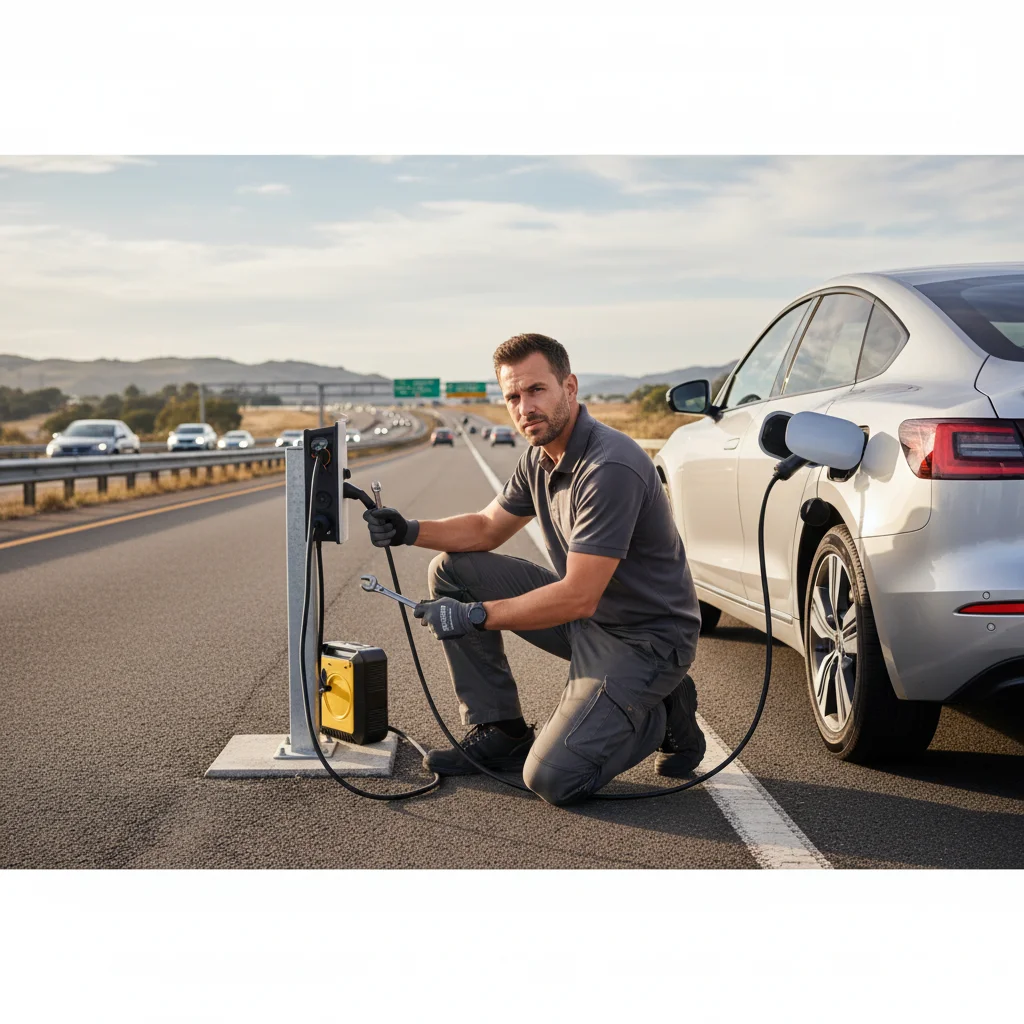
Nearest shoulder on I-95, left shoulder on 495
Woodbridge and Dale City sit on the Prince William stretch of I-95. They’re census-designated places, not incorporated cities. The road here mixes general lanes with the 95 Express Lanes.
Transurban operates those Express Lanes with VDOT. Tolls move dynamically on E-ZPass. E-ZPass Flex set to HOV-3 rides free on those lanes. When the car dies in the Express Lanes, the published rule is short. Pull to the nearest shoulder. Stay in the car until help arrives.
That’s not the 495 Express Lanes habit. On 495 the lanes sit in the median, so you pull left. People who drive both corridors mix the two rules. On I-95 through Woodbridge and Dale City, nearest means the shoulder you can reach without crossing traffic.
The 395 Express Lanes use that same nearest-shoulder rule. If you came south in managed lanes, don’t copy a Beltway left-pull. Get to the closest safe edge and stop.
In the general I-95 lanes, move out of live traffic while the car still rolls. Turn the hazards on before you finish the pull. Then stay belted in. If you’re already sitting in a travel lane, call 911 first. Virginia State Police and VDOT need that scene before anyone else rolls up.
Express Assist won’t charge the pack
Express Assist is the free roadside patrol on the Express Lanes. It helps with minor mechanical issues. They’ll call a tow. They don’t tow the car. They don’t plug into an EV.
VDOT’s Safety Service Patrol also works I-95 in Virginia. You reach that help through Virginia 511. Published material covers incident clearance, debris, and short-term traffic control. It doesn’t describe EV charging. Treat a Safety Service Patrol stop as traffic protection. Don’t wait on that truck for miles of range.
Dominion Energy Virginia serves most of Northern Virginia. NOVEC covers other parts of Prince William, including much of Gainesville. Confirm the serving utility by your home address. No utility EV page reviewed here offers a stranded-car charge. Pepco EVsmart is a District and Maryland program. It doesn’t reach this Prince William corridor.
Disabled-vehicle rules in Virginia, Maryland, and the District treat an empty EV like any other stalled car. None of the three codes reviewed names running out of charge as its own offense. You’re a disabled vehicle. You’re not in a special EV category.
A tow can clear the lane. It doesn’t put miles back in the pack. If the car can still accept a plug, mobile EV charging is the visit that restores motion without a hook.
Why I-95 through Prince William empties a pack
The drain on this corridor is time sitting still with climate control on. It’s not a puzzle about how far Woodbridge sits from the District.
Prince William winters run colder than the District and the inner Virginia core. Loudoun, upper Montgomery, and Prince William take more snow and harder freezes. Dulles weather is a closer proxy than Reagan National. Cabin heat on an EV comes from the traction pack.
A Recurrent Auto study of more than 30,000 EVs found typical cars keep about 80 percent of range at 32F. At 20F that figure is about 70 percent. Most drivers lose 20 to 35 percent in real cold. Heat-pump cars averaged about 83 percent retained. Cars without a heat pump averaged about 75 percent. Don’t treat those numbers as Tesla figures. They’re fleet-wide.
Then the car stops moving. Heat or AC still runs. Charge drops and you cover no distance. That’s the I-95 standstill problem, and it shows up in summer humidity too. A crawl toward Woodbridge with the cabin cold spends range you counted on for the last miles home.
The region’s hard reference is January 3 and 4, 2022. About 14 inches of snow and a multi-truck crash shut roughly 50 miles of I-95 in the Fredericksburg area, just south of where we connect drivers. The road closed about 5:30 p.m. on January 3. It reopened about 7:40 p.m. on January 4. Hundreds of people sat overnight for more than 36 hours. Heat on, going nowhere, is how packs die on this interstate.
If you live in Dale City and this is the daily commute, a home Level 2 plug is the long-term fix. The stall on the shoulder is a different job. You need energy where the car already sits.
Empty pack or a dead 12-volt
Not every dead EV on I-95 is out of traction charge.
A drained 12-volt battery leaves the car dark. Doors, screens, and contactors may not wake. The big pack can still hold plenty of energy. Operators in the network can jump or replace that 12-volt on site.
An empty traction pack is the other failure. The car rolled until it couldn’t. Displays may still work until the 12-volt sags too. That’s an out-of-charge recovery job: 240-volt Level 2 to the charge port.
Tell the operator which one you think it is. Say whether the car still shows a percent. Say whether it’ll unlock. Tesla and every major EV brand are in scope. Non-Tesla cars use a CCS or J1772 adapter. Teslas take a native NACS plug. More on that sits on non-Tesla EV rescue.
Don’t keep cycling climate control while you wait if the pack is already near zero. Every minute of heat or AC is range you’ll need to roll off the interstate.
What a referred operator actually does
Charge Pro DC is a referral line. We don’t own the truck. We don’t employ the technician. We match stranded drivers with independent local operators. The operator quotes you before any work starts. They bill you directly.
The operator brings a 240-volt Level 2 source to the car. This isn’t DC fast charging. It’s a parked-on-shoulder top-up. Typical charging time is 15 to 30 minutes. That usually adds 10 to 20 miles of range. Those minutes are plug time. They’re not a promise of when someone arrives. We don’t publish arrival times.
That range is meant to get you off I-95 under your own power. We don’t name a nearest public plug from the shoulder. Supercharger and public DC inventories weren’t verified for this page. Don’t aim a limping car through local streets on a guess. Go to a plug you already know. Or go home if those 10 to 20 miles cover it.
If the car can’t take a charge, or the 12-volt won’t hold, a tow may be the honest next step. The operator can tell you that before they roll. Virginia private-property tow rules are a separate issue from an interstate stall. Confirm current practice with the people on scene. We don’t set that.
For the rest of this county stretch, read EV roadside help on I-95 through Prince William. If you died in the 495 Express Lanes instead, the left-shoulder rule is in dead EV in the 495 Express Lanes.
Stay in the car and describe the scene
Once you’re on the shoulder, don’t get out to flag traffic. Express Lanes guidance is to stay in the car until help arrives. That’s the right habit on the general lanes too.
When you call, have this ready:
- Northbound or southbound
- General lanes or the 95 Express Lanes
- A named place you still recognize: Woodbridge, Dale City, Lake Ridge, or Springfield
- Make, model, and whether it’s a Tesla
- Pack percent, or a dark 12-volt
- Whether anyone is with you
Don’t walk the shoulder hunting a mile marker if traffic is tight. The last named place you passed is enough to start matching an operator.
Lake Ridge and Springfield are in the same service area. We connect drivers across those communities. We don’t send a fleet. There isn’t one.
Frequently asked questions
Will Express Assist put charge in my EV on I-95
No. Express Assist is the free patrol on the Express Lanes. It covers minor mechanical help and it can call a tow. It doesn’t tow. It doesn’t charge a traction pack. VDOT’s Safety Service Patrol, reached through Virginia 511, is traffic protection, not a plug. For energy in the pack you need a mobile Level 2 visit from an independent operator.
Which shoulder should I use through Woodbridge and Dale City
Use the nearest shoulder. On the 95 Express Lanes, published guidance is nearest, then stay in the car. That differs from the 495 Express Lanes, where you pull left because those lanes sit in the median. Don’t cross traffic to copy a 495 habit. If you’re already in a travel lane and the car has stopped, call 911 before you call anyone else.
Can an operator charge a non-Tesla on this stretch
Yes. Operators bring a native NACS plug for Tesla. They carry a CCS or J1772 adapter for other major EVs. The visit is still 240-volt Level 2. Typical charging time is 15 to 30 minutes, adding about 10 to 20 miles. That’s charging time on site, not an arrival window. The operator quotes before they start and bills you directly.
If you’re already on the shoulder through Woodbridge or Dale City, call (202) 629-0844. We’ll connect you with a local operator and stay on the facts: nearest shoulder, stay in the car, and a quoted top-up if the pack is empty.