A Tesla roadside request starts with your location, vehicle problem, and contact details. The next steps depend on where you stopped and what the responding provider can handle there.
The app request versus a phone request
Tesla publishes a clear request sequence for its app. Start at the bottom of the app home screen and select Roadside. Choose the vehicle issue, confirm the details, then submit the request. Include information that helps the provider locate you and understand the vehicle’s condition.
Location details matter around Washington. “On the Beltway” isn’t specific enough. Note whether you’re on the Inner Loop or Outer Loop. Include the nearest exit, roadway direction, and visible marker. On I-270, say whether you’re using the local or express lanes. In a garage, include the property name, level, row, clearance, and entrance.
The phone route is useful when the app won’t open or your account isn’t accessible. Tesla publishes a United States roadside number on its official Roadside Assistance page. Open that page for the current number rather than relying on an old screenshot or saved search result. Tesla says its roadside line is available around the clock.
Tesla’s public support instructions don’t publish a different service sequence for phone requests. They also don’t state that calling produces a faster arrival. For a fuller comparison, read our guide to using the Tesla roadside phone or app in DC, Maryland, and Virginia.
Whichever route you use, keep the request factual. Describe the warning shown on screen, whether the car can shift, and whether charging had begun. Don’t diagnose a high-voltage or low-voltage failure from symptoms alone.
Who Tesla actually sends in this metro
After Tesla accepts the request, the responding provider may be identified through the request flow. Tesla’s public roadside pages reviewed for this guide don’t publish a fixed DC-area provider roster. They also don’t promise that one named company handles every request across the region.
That distinction matters here. A stop near Dupont Circle presents different access problems than one on I-66, I-270, or the Baltimore-Washington Parkway. Garages may have height limits. Parkways may restrict commercial vehicles. Express lanes can also have specific shoulder procedures.
On the 495 Express Lanes, drivers should move to the left shoulder because those lanes sit in the median. On the 95 and 395 Express Lanes, use the nearest shoulder. The lane operator says drivers should remain inside the vehicle until help arrives. Express Assist can address minor mechanical issues and call a tow, but it doesn’t provide the tow itself.
Commercial vehicles and trucks over 10,000 pounds are prohibited on National Park Service parkways around Washington. Those roads include the Baltimore-Washington, George Washington Memorial, Clara Barton, Rock Creek, and Suitland parkways. Their shoulders can also be narrow or absent. Access may therefore require coordination that a normal parking-lot request doesn’t.
Tesla says help on restricted roads and in restricted-access areas is decided case by case. If the location is unsafe, Tesla directs drivers to emergency services. The public pages don’t provide a universal arrival-time promise.
Our guide to when Tesla roadside sends a contractor explains why the provider’s identity, equipment, and access plan deserve attention before work begins.
DC, Maryland, and Virginia are not one license map
The District, Maryland, and Virginia regulate trades separately. A provider working legally in one jurisdiction shouldn’t be assumed to hold every authorization needed elsewhere. Charge Pro DC doesn’t hold trade licenses or perform roadside work. We connect drivers with licensed, independent local operators.
The approved sources for this page don’t confirm which specific trade license applies to every possible Tesla roadside task. They also don’t establish one license that covers the entire metro. Ask the responding provider which company is coming, what work it proposes, and which jurisdiction authorizes that work.
This becomes especially important when a roadside request changes. A simple vehicle assessment may turn into towing, mobile charging, or electrical work. Those aren’t interchangeable services. The person answering the request should explain what can be done at your location and who will perform it.
Confirm these points before authorizing work:
- The provider’s legal business name
- The service being proposed
- Whether the vehicle will be charged, moved, or towed
- The destination if a tow is needed
- The full quoted amount and who will bill you
- The provider’s applicable license and insurance details
Tesla’s public roadside pages don’t publish one universal price, included-mile limit, or arrival window for every request. Check the current terms shown in your Tesla app. If the provider quotes work outside those terms, ask for the quote before approving it.
The line between the District and Maryland can arrive quickly on roads such as Eastern Avenue. A trip across the Potomac can move a vehicle between the District and Virginia. Give the provider your exact stopping location, not just the nearest city name.
What the contractor can finish on site
The Tesla app asks you to select the vehicle issue before requesting help. That selection gives the responding provider a starting point. It doesn’t prove that the problem can be completed on the shoulder.
Tesla’s public process pages don’t provide a single list of tasks that every responding provider can finish on site. They also don’t confirm that every vehicle, location, and coverage situation receives the same remedy. Review the issue-specific information displayed in your app and ask the assigned provider what equipment is coming.
Start with observable facts. Say whether the displays are awake. Report the exact warning text. Mention whether the charge-port door opens, whether a connector is attached, and whether the car shifts into drive. If a collision, smoke, fire, or another immediate danger is involved, contact emergency services.
Don’t force a frozen Tesla charge-port door. Tesla says extreme cold or ice can freeze the latch. App preconditioning may help thaw it, while rear defrost may activate an inlet heater on equipped vehicles.
Tesla’s manual charge-cable release addresses a cable that won’t detach. It isn’t the procedure for opening a closed charge-port door. The car must not be actively charging. Tesla also warns against pulling the cable while removing the connector or using the procedure when high-voltage conductors are exposed.
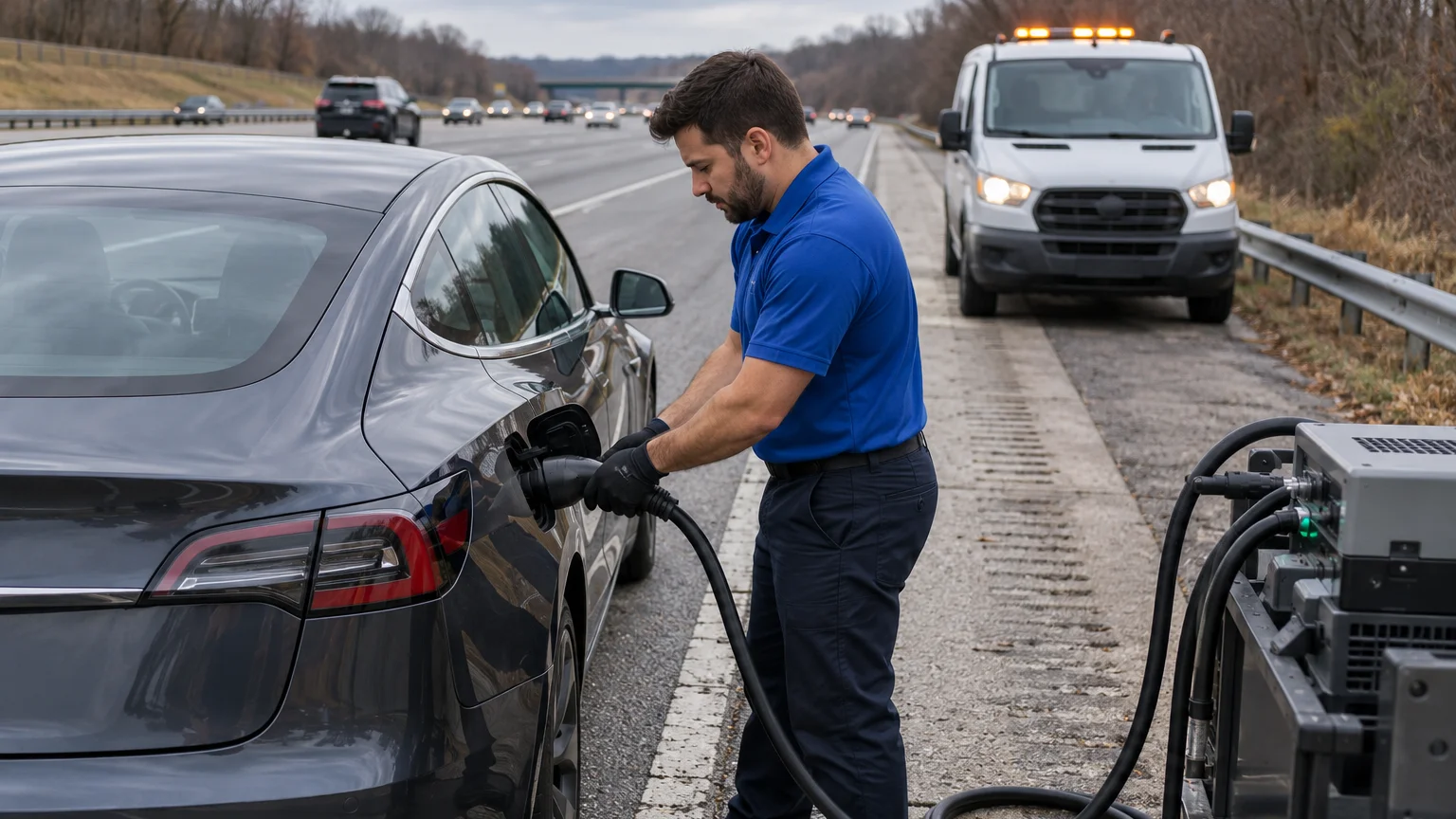
If the high-voltage battery is simply depleted, an equipped mobile operator may provide a rescue charge. A typical rescue charge supplies 10 to 20 miles of range through 15 to 30 minutes of Level 2 charging. That’s charging time, not an arrival estimate. Actual charging depends on the vehicle, battery state, equipment output, and other conditions.
When you still call a local operator
Tesla roadside may be your first request, but it doesn’t settle every stop. You may still need a local operator when the app can’t complete the request, the assigned provider can’t access the location, or the proposed service doesn’t match the problem.
Ask Tesla or its assigned provider to confirm the next step first. Don’t assume that mobile charging, towing, a low-voltage jump, or charge-port help is included. Tesla’s public pages don’t confirm one remedy, price, or mileage allowance for every roadside request.
A local operator can be another route when you need a separate quote. That operator should state what it can do, what equipment it will bring, and whether your location is accessible. Charge Pro DC doesn’t set the price, promise an arrival time, or perform the work. The driver contracts with and pays the independent operator directly.
For an out-of-charge Tesla, our Tesla Roadside Rescue service connects drivers with local operators serving the DC area. Our broader Emergency EV Roadside Assistance service covers other EV roadside situations.
Before accepting a local quote, give the operator the same precise details you gave Tesla. Include your model, visible warnings, battery status, lane or garage position, and access restrictions. Tell the operator if another provider has already inspected or moved the vehicle.
Never approve overlapping requests without understanding who may bill you. Cancel any request you no longer need through the channel that accepted it. Keep screenshots of the request status and written quote.
When to call us
Call when your Tesla needs a mobile rescue operator and Tesla’s process hasn’t produced a workable next step. We’ll connect you with a licensed, independent local operator who can assess the location and quote the requested service.
Call us at (202) 629-0844 and we’ll connect you with a local EV rescue operator.