Searching for the Tesla roadside phone number is a stall-day move. The cleanest path sits in the Tesla app, not in an old search result. This metro runs across three jurisdictions. DC is one-party consent. Maryland is all-party consent, with a felony penalty of up to five years. Virginia is one-party consent. Every call you make on this metro line must respect that, and the local operator we connect you with is the backup path when Tesla cannot send 240 volts to the car.
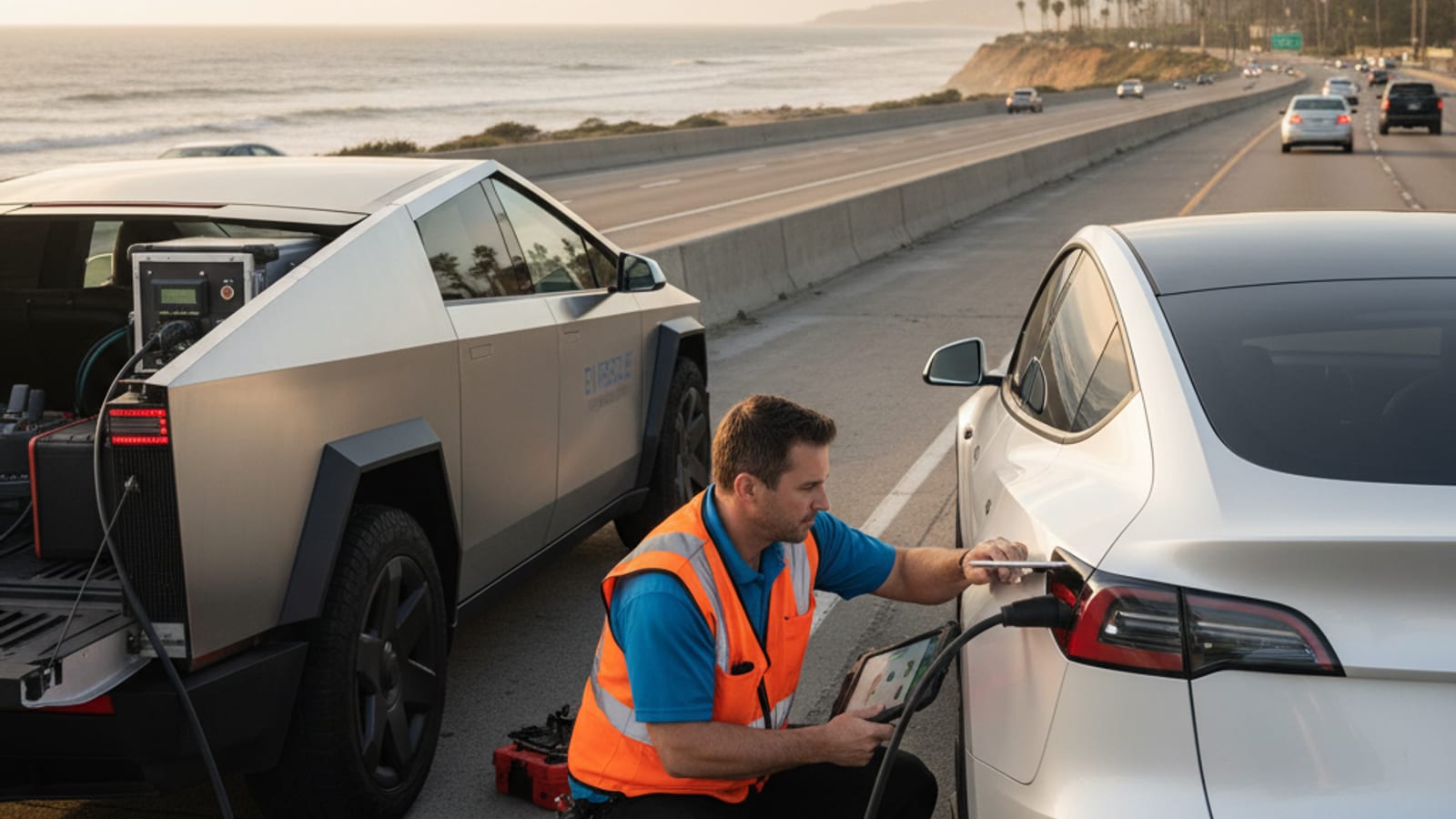
Use the app, not an old listing
A saved number from last year can be dead today. Tesla’s published support path lives in the app tied to the VIN that’s stuck. Open the Tesla app, look for Roadside or Service, and follow the contact shown there. The app reads your VIN, your GPS pin, and your diagnostic state without you typing any of it.
If your 12-volt is dead, the screen stays dark and the app shows the car offline. That blocks the in-app request. A voice call is the only path in that moment. Either way, Tesla’s app or Tesla’s official support page is the place to confirm the current contact. Don’t paste a number from a forum or a screenshot a friend sent. Charge Pro DC doesn’t speak for Tesla on coverage or hours. The pros we connect you with are independent. They quote you before starting and bill you directly.
What Tesla’s in-app request does for you
The app logs a timestamped request, attaches your location, and pulls your diagnostic data. That same data also tells the responder whether the car is out of charge, locked out, or has a dead 12-volt. A voice call can do the same triage with an agent, but the agent has to type what you say, which adds a step. The phone number Tesla lists today is on Tesla’s site. Confirm it there before you dial.
When a phone call beats the app
A dead 12-volt or a screen that will not wake means the app cannot push a request. A parking garage with poor reception can block the data path. In either case, voice is faster than waiting for cellular to come back. Have your VIN, your location, and a description of the symptom ready before you dial. The agent will ask for those anyway.
Calls on this metro have a consent rule
DC is one-party consent under DC Code § 23-542. Virginia is one-party consent under Va. Code § 19.2-62. Maryland is all-party consent under Md. Courts and Judicial Proceedings § 10-402, and a violation is a felony punishable by up to five years. This matters for any call that touches a Maryland line. The pros we connect you with operate across the District, Maryland, and Virginia, so a recording-consent notice plays before any operator call connects on a Maryland number.
That rule is also why a referral line asks for a clean location, not a guess. The operator you reach needs the street, the nearest cross street, and the garage level if you’re underground. That detail goes into the quote, not into the call recording.
What the pros we connect you with handle when Tesla cannot
Tesla handles warranty issues through its own channels. For 240-volt Level 2 charging at the car, the path runs through independent operators we connect you with. They typically add 10 to 20 miles of range in 15 to 30 minutes of charging. That’s charging time, never an arrival time. They handle Tesla and every major EV brand. They bring a native NACS plug, plus CCS or J1772 adapters for non-Tesla cars.
A jump or a 12-volt replacement is also part of that same visit. The operator quotes both options before starting and bills you directly. Confirm the quote covers the work you accepted. If a tow is on the table, confirm the destination before the truck rolls.
Where these stalls happen in this metro
A stall on the Capital Beltway sits in three jurisdictions at once when it lands on the Woodrow Wilson Bridge. The span carries I-495 between Alexandria, Oxon Hill, and the District. The American Legion Bridge does the same, with McLean on one bank and Montgomery County on the other. Say which end you’re on, and which direction.
I-66, the Dulles Toll Road, and the Dulles Greenway are different operators than the general Beltway lanes. The Dulles Greenway is a privately operated toll road, so an operator’s approach differs. A stall on I-270 between Rockville and Gaithersburg is a stationary range problem, not a hill problem. Cabin heat on a Beltway crawl burns charge without covering miles.
NPS parkways wrap this metro. The Baltimore-Washington Parkway and the George Washington Memorial Parkway are limited-access scenic roads with narrow or absent shoulders. They ban commercial vehicles and trucks over 10,000 lb. A disabled vehicle on the Baltimore-Washington Parkway is reported to U.S. Park Police at 202-610-7500.
The 495, 95, and 395 Express Lanes sit inside the general lanes. On the 495 Express Lanes, pull to the left shoulder because those lanes run in the median. On the 95 and 395 Express Lanes, pull to the nearest shoulder. Stay in the car until help arrives. Transurban’s Express Assist runs on those lanes for minor mechanical issues and will call a tow, but it does not tow and does not charge an EV.
Maryland’s CHART, Virginia’s VDOT, and Park Police do not charge EVs
Maryland’s CHART Emergency Traffic Patrol covers I-495, I-270, US-50, and MD-295. Dial #77 on those state primary roads. CHART technicians change tires, jump-start a 12-volt, add about a gallon of gas, and top radiator water. They run around the clock in the Baltimore/Washington metropolitan area. CHART does not describe charging an EV pack in published pages.
VDOT Safety Service Patrol covers Virginia interstates including I-95, I-64, I-81, I-85, and I-66, roughly 1,079 interstate miles. Drivers reach that patrol through Virginia 511. Northern Virginia’s I-66 corridor is on that map, with shoulder and express work in weekday peaks. VDOT describes incident clearance, debris, and short-term traffic control, not EV charging.
Inside the District, we found no DDOT motorist-assistance patrol in published materials. A stall often means MPD, a private plan, or U.S. Park Police on a parkway.
Pepco, Dominion Energy Virginia, and NOVEC publish home-charger programs. None of the utility pages we reviewed will charge a stranded car. Pepco’s EVsmart program covers the District, Montgomery County, and Prince George’s County. Dominion Energy’s Schedule 1EV rate and Off-Peak Plan sit in Northern Virginia. NOVEC covers parts of Loudoun and Prince William. None of those is a road-call line.
Have these details ready before you call
Whoever you reach, manufacturer or local operator, needs a clean picture. Start with the model: Model 3, Model Y, Model S, Model X, or Cybertruck. Then the exact pin. Name the street, the nearest cross street, and any garage entrance. In a garage, give the level, aisle, and entrance. On a freeway, read the route and direction off the signs.
Copy the warning text word for word, without adding a diagnosis. Take a screenshot of the display if it stays on. Report the last shown charge percent and any range figure. Don’t invent a cause for the stall.
Say whether it was parked, plugged in, or rolling. Note which controls still work: locks, lights, screens, charge port. If a connector is stuck, say so. If the port won’t open, say that too. Tell the responder if the Tesla blocks a lane or sits in a tight garage with no room around it. If a tow is on the table, confirm the destination before the truck rolls.
A winter stall gets a different note. A typical EV keeps about 80 percent of range at freezing. It keeps about 70 percent at 20F. Those numbers come from Recurrent Auto’s study of more than 30,000 EVs. Sitting still with heat on spends charge without covering miles, which is the I-95 standstill through Prince William, the I-66 crawl through Arlington, and the Beltway backup between Bethesda and Silver Spring.
When to make the local operator call
Use Tesla’s app or Tesla’s official number first when you’re inside the published warranty window. The app still controls the dispatch and the billing record. Then call us when you need a 240-volt Level 2 source at the car, when Tesla cannot send anyone, or when a 12-volt jump is the immediate need and Tesla’s wait has stretched past what the shoulder allows.
Charge Pro DC is a referral line for the District, Maryland, and Virginia. We match stranded drivers with independent local operators. We don’t own trucks, employ technicians, set prices, or hold a trade license. The operator quotes you before starting and bills you directly. We don’t promise an arrival time. For more on the matching flow, read how to find mobile EV charging near you in DC, Maryland, and Virginia and what Tesla roadside covers versus a local quote.
When to call Charge Pro DC
Call us when Tesla cannot send 240 volts or when you’ve decided the wait isn’t worth it on the shoulder. Have model, pin, charge display, and warning text ready. Call (202) 629-0844 and we’ll connect you with a local EV rescue operator.