A Tesla’s charge time depends on the plug in front of you. A Model 3 or Model Y on a Supercharger usually hits about 80% in 25 to 40 minutes. Overnight Level 2 at home usually takes 6 to 10 hours from a low pack. A 120-volt wall outlet adds about 3 to 5 miles per hour. A near-empty car can sit two to three days on that plug. If you’re already empty on the Beltway or I-270, those windows don’t apply. The operators we connect you with bring a 240-volt Level 2 source to the car. They typically add 10 to 20 miles in 15 to 30 minutes of charging. That’s charging time on site, never an arrival time.
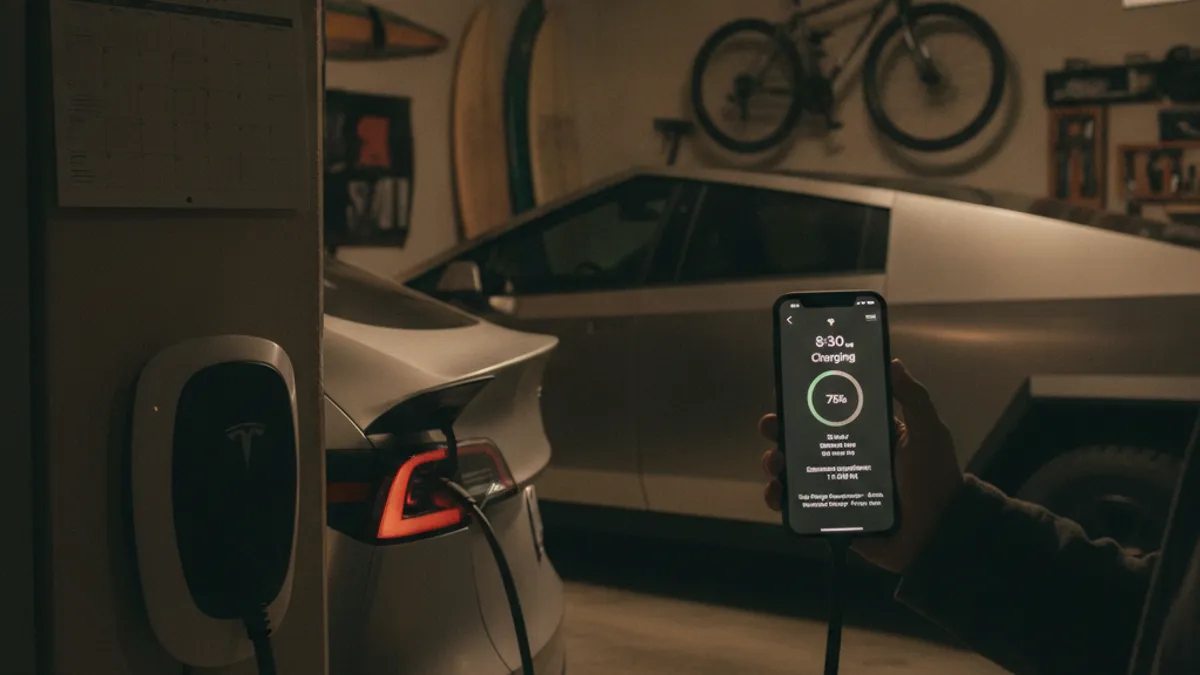
Roadside 240 volts is a top-up, not a full charge
Home charging and a stall on I-66 aren’t the same problem. You need enough range to leave the shoulder, reach a Supercharger, or make the driveway.
A mobile Level 2 visit uses the same 240-volt idea as a wall connector. The operator plugs native NACS on a Tesla. Non-Tesla EVs get a CCS or J1772 adapter. Fifteen to 30 minutes of charging typically adds 10 to 20 miles. That’s enough to roll, not a substitute for overnight charging. Our mobile EV charging page spells out what that visit is.
If the car won’t even wake, the 12-volt battery is often the real issue. The traction pack can still hold charge while the small battery is dead. Operators can jump or replace that 12-volt on site. Start with our Tesla 12-volt checks if the screens stay dark.
For an empty pack, out-of-charge recovery is the matching service. The operator quotes you before any work starts and bills you directly. Charge Pro DC doesn’t own the truck and doesn’t set the price.
Overnight at home: 240 volts in the garage
Most Tesla owners in this metro charge while they sleep. A Level 2 wall connector runs on a 240-volt circuit. It adds about 20 to 44 miles of range per hour. That depends on the car’s onboard charger and the breaker. From a low pack, a full charge commonly takes 6 to 10 hours. That fits a normal night if you can plug in at all.
About 90% of homes in Takoma Park were built before 1980. Annandale, Wheaton, and much of the District sit in the same older band. Many of those houses never had a 240-volt run to the garage. Ashburn, Gainesville, Centreville, and Germantown are much newer, so a wall connector is far more common.
Pepco serves the District, Montgomery County, and Prince George’s County. Dominion Energy Virginia covers most of Northern Virginia. None of those utilities offers a stranded-car charge on the EV pages we reviewed.
Apartment and condo drivers in Arlington and Alexandria often have no assigned plug. The same pattern shows up in Silver Spring, Hyattsville, and the District. They live on public Level 2 at the office or a mall, plus Superchargers. When that plan slips, they’re sitting at 2% after a Beltway crawl. Home 240-volt charging versus a roadside top-up walks through that split. That commute drain is in how long a Tesla charge lasts on a DC-area commute.
A wall outlet if that’s all you have
A standard 120-volt household outlet is Level 1, and it works. It’s also the slowest option Tesla supports. Figure 3 to 5 miles of range per hour. A Model 3 or Model Y rates around 250 to 330 miles. Filling from near empty on a wall outlet can take two to three days. It can’t rebuild a drained pack after a Prince William commute on I-95. If the garage charger failed overnight, a mobile 240-volt visit still uses the car’s charge port.
Superchargers and the last 20 percent
Direct-current fast charging skips the onboard charger and feeds the pack directly. Ten to 80% on a newer Supercharger often takes 25 to 35 minutes. Older Model S and Model X cars, and older stalls, run slower. Lithium-ion cells accept charge fastest in the middle of the range. Eighty to 100% on the same stall can take nearly as long again. Road-trip drivers stop around 80% for that reason. Tesla’s nav can precondition the pack when you route to a Supercharger. A cold pack charges slower until it warms.
Weather and sitting still change the clock
Summers run hot and humid, with stretches above 90°F. Winters swing from mild to sudden ice. Dulles runs colder and snowier than Reagan National. Loudoun, upper Montgomery, and Prince William see harder freezes than the District.
A Recurrent Auto study of more than 30,000 EVs put winter loss in range. A typical EV keeps about 80% of range at 32°F. At 20°F it’s about 70%. Heat-pump cars averaged about 83% retained versus about 75% without. A Tesla that sat in the Dulles Economy Lot overnight in January can look worse. The same car in an Alexandria garage often holds up better.
Beltway gridlock with heat or AC on burns charge without covering miles. Maryland’s CHART units can jump a 12-volt. VDOT’s Safety Service Patrol clears incidents. Neither publishes EV charging. The District has no DDOT motorist-assistance patrol that we found.
How to pick a window before you leave
Match the charger to the clock you actually have. A Supercharger stop fits a short break. Home Level 2 fits a night’s sleep. A wall outlet only works if the car will sit for a day or more. A roadside 240-volt visit is for the gap in between. You need 10 to 20 miles now, not a full pack by morning.
If you’re planning a week at the airport, know the lot. Reagan National has complimentary EV charging on Level 1 of Parking Garages 1 and 2. Dulles has Level 2 charging in Garage 1 and Garage 2. There’s no EV charging in the Economy Lot, the Terminal Lot, or valet.
When the pack is already empty, stay with the car and call. Tesla out of battery on the road covers that sequence. Charge Pro DC matches you with independent mobile rescue operators in the District, Maryland, and Virginia. Call (202) 629-0844 when you need that match. The operator quotes before starting. We don’t set the price or the clock.
Frequently asked questions
How long does a Supercharger take from empty?
Most Model 3 and Model Y cars reach about 80% in 25 to 40 minutes. Charging past 80% slows a lot, so most drivers stop there.
How long does home Level 2 take overnight?
A 240-volt wall connector typically takes 6 to 10 hours from a low pack to full. That’s why it’s an overnight habit, not a quick stop.
Can a regular wall outlet charge a Tesla?
Yes, a 120-volt outlet adds about 3 to 5 miles per hour. A full charge from empty can take two to three days.