EV roadside assistance in Olney starts after an I-270 backup burns range in place. Drivers heading home often leave the freeway already thin. Georgia Avenue or MD-108 then has to finish the trip. That last stretch is where the car actually stops.
Why an I-270 crawl shows up in Olney
Olney sits on the I-270 side of Montgomery, north of the Beltway on the Piedmont. About 36,000 people live in this census-designated place. It’s not an incorporated city. Pepco serves the homes. Roughly a third of the housing predates 1980, and most lots have driveways. A lot of those driveways already hold a Level 2 charger. The usual rescue here is a trip that ran out between the freeway and that driveway.
You were in Rockville or Germantown. I-270’s general lanes are free, and they still clog. Cabin heat or AC kept drawing while the wheels barely turned. Sitting still with climate control on eats a buffer without covering miles.
Cold makes it worse up here. Olney’s rolling country runs colder at night than the inner suburbs. Recurrent Auto studied more than 30,000 EVs in winter. A typical car keeps about 80 percent of range at 32F. At 20F it keeps about 70 percent.
Then you leave the interstate. Olney isn’t on I-270. You reach it on Georgia Avenue, which is MD-97. The other main road is MD-108, Olney Sandy Spring Road. MD-97 also continues north toward Brookeville. Those two-lane roads are the actual last miles. A gauge that looked fine at the Rockville ramps can change by Town Center.
If the car already stopped on I-270, say so. That’s a freeway stall. A stall on MD-108 is a local-road stall. The next person who hears you needs that split.
Move out of the travel lane before you troubleshoot
On I-270, get as far right as the pavement allows. Turn the hazards on. If the car can still creep, use that motion. Pass a merge or a blind curve before you stop. A dead EV on a grade toward Frederick is hard to see. A car already on a wide shoulder is easier to spot.
If it won’t move, stay inside with the seatbelt fastened. Don’t climb out to inspect the charge port beside live lanes.
Maryland’s CHART Emergency Traffic Patrol covers I-270. From a breakdown on that freeway, dial #77. CHART technicians change tires and jump-start 12-volt batteries. They can add about a gallon of gas and radiator water. Published CHART pages don’t describe charging a traction pack. Use #77 for safety and a possible 12-volt jump. Don’t expect a Level 2 fill from that patrol. If a lane is blocked, people are hurt, or you see smoke, call 911 first. The officers’ instructions override this page.
Once you’re off the freeway, the picture changes. Georgia Avenue and MD-108 through Olney aren’t limited-access roads. Shoulders can be thin. A stop next to Olney Town Center is a parking-lot problem. So is a stall at MedStar Montgomery Medical Center or the Olney Theatre Center. Name the landmark you can actually see. A hospital garage with a height bar is a different job. A surface pull-off toward Sandy Spring is another.
Stay with the car unless you’re directed out of it.
Two ways an EV dies on this commute
Owners say the car died. That sentence hides two failures.
A depleted traction pack usually warns you first. You saw a low-charge or zero-range message. Then the accelerator stopped answering. That’s an out-of-charge stall. It’s the I-270 idle-drain ending.
A 12-volt failure often goes dark instead. Locks, handles, or the screen quit. The car may refuse to leave park. The last range number you remember can still look fine. The small battery that wakes the computers and contactors is the one that failed. Operators in this network jump or replace a dead 12-volt on site. They handle Tesla and every major EV brand.
Write the warning text down before it scrolls away. Don’t paraphrase it later. Check whether the phone app still reaches the car. Check interior lights and the charge-port door. A car that unlocks and lights up but won’t drive is one report. A black cabin is another.
Leave the traction pack alone. Don’t copy a jump sequence from a different model. If you have the owner’s manual for your exact year, use it. The 12-volt and towing pages are the only steps that apply. If the manual is at home, say that.
Give a pin a human can drive to
Olney covers a little more than 16 square miles. Saying you’re in Olney doesn’t pick a road.
Start with the road and the heading. Northbound Georgia Avenue past Town Center. Eastbound MD-108 toward Sandy Spring. MD-97 toward Brookeville. If you just left I-270, name the exit you used. Then say which way you turned after it. A mile marker, an overpass, or a readable sign beats a subdivision name.
Name the landmarks that actually sit here. Olney Town Center. MedStar Montgomery Medical Center. Olney Theatre Center. If you’re in a garage at the hospital, say the level. If you’re in a surface lot at the theatre, say that. A 12-volt can die after a show or a visit.
Access decides what a service vehicle can even attempt. Open shoulder, gated driveway, cul-de-sac, low garage beam, after-hours gate. Mention a keypad or a guard if there’s one. If you’re not the owner, say so. Say whether someone who can approve work is with the car.
Nearby places help with routing. Rockville, Wheaton, Germantown, and Silver Spring sit around this pocket. An approach off I-270 from Germantown is one path.
The idle-drain pattern on the freeway itself is in our I-270 out-of-charge notes. For charging visits along that corridor, see mobile EV charging along I-270.
When a mobile 240-volt visit can fit
Bring up a mobile charge when the dash points to an empty traction pack. A dark 12-volt is a different job. The car also has to sit where a service vehicle can work. It can’t occupy a live lane.
A paved lot at Town Center. A driveway off MD-108. A shoulder that’s actually wide. Those are settings where a 240-volt session can be discussed. A live I-270 travel lane usually can’t.
Charge Pro DC is a referral line. It matches stranded drivers with independent local operators. It doesn’t hold a trade license, own trucks, or employ technicians. It doesn’t set the price or promise an arrival window. The matched operator reviews your make, the messages, and the pin. Then that operator quotes you before any work starts. That operator bills you directly.
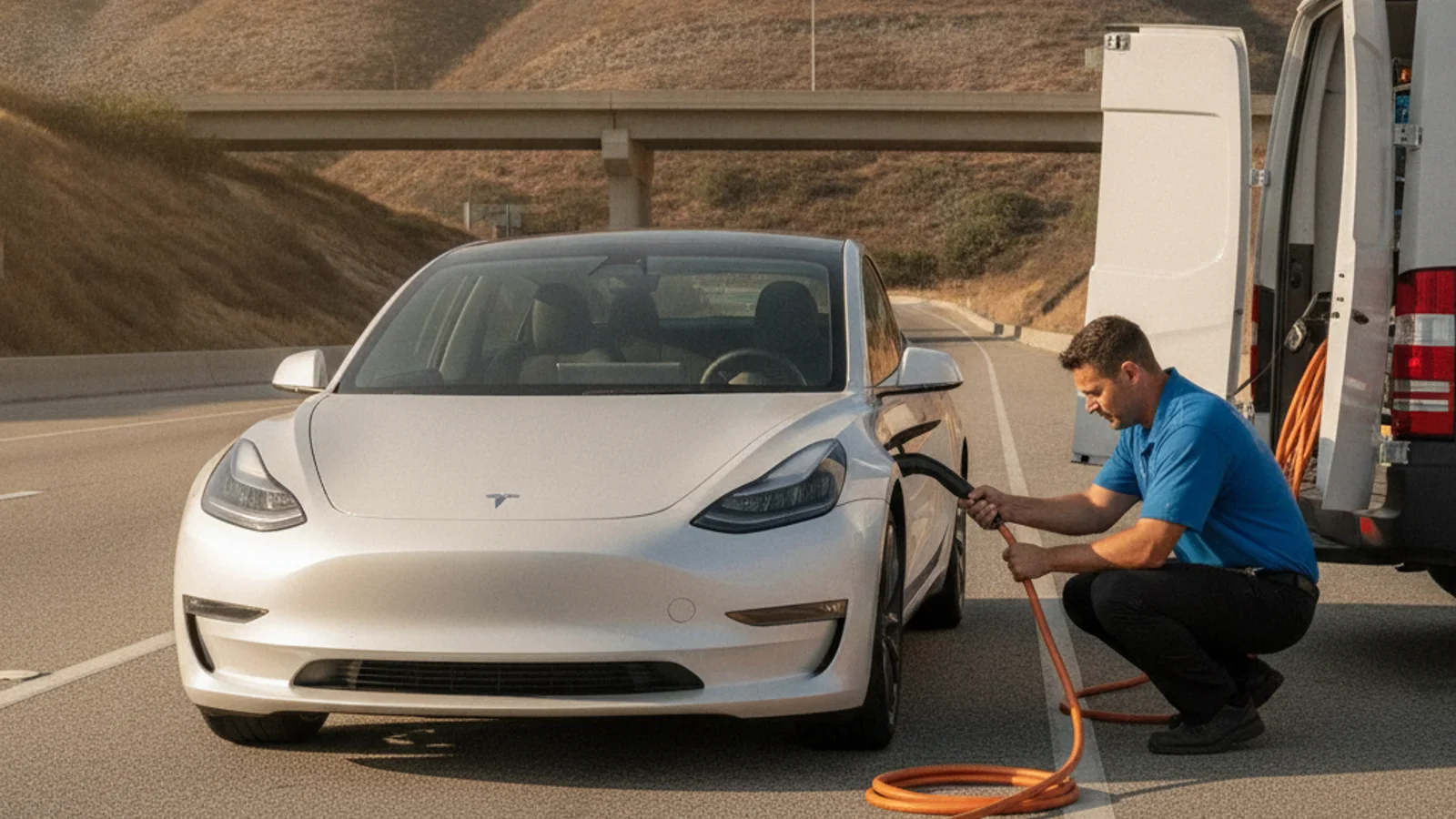
Operators in this network bring a 240-volt Level 2 source to the car. Tesla vehicles use a native NACS plug. Other EVs use a CCS or J1772 adapter. A typical session adds about 10 to 20 miles of range. That takes 15 to 30 minutes of charging. That clock is time on the connector. It isn’t a clock for when someone shows up. The usual aim is enough range to reach your next charger.
Ask about mobile EV charging when you call. Give the vehicle and the pin so the operator can say whether a top-up fits. If you’re planning a later drive through this pocket, use the Olney charging page.
When moving the car is the better path
A tow is more likely when the 12-volt is dead. The same is true if the port won’t take a plug. The same is true if the spot is unsafe for charging gear. A live I-270 lane is one of those spots.
Maryland’s disabled-vehicle rules sit in Transportation Article Title 21. They apply to an empty EV the same as any stalled car. The codes reviewed for this metro don’t carve out a separate out-of-charge rule. You still have to get out of the travel lane.
Don’t instruct the crew on tow mode, loading, or the parking brake. Those steps change by brand and year. Hand them the towing section of the manual if you have it. If you don’t, say so.
Out-of-charge recovery is how we connect you with those operators. They decide from the actual car and the actual shoulder. Saying you don’t know what failed is cleaner than a guessed cause. For the split between a boost and a hook, see mobile charging versus a tow. EV roadside assistance is the service page if you’re still sorting the symptom.
Call when the last miles didn’t finish
Call when the car has stopped on the I-270 approach to Olney. The same goes for Georgia Avenue or MD-108. You may not know whether it needs a charge or a move. Read the warning text. Name the road, the direction, and the pin. We match you with a local independent operator. That operator quotes before work starts and bills you directly.
Call (202) 629-0844 when you want to be matched.