A dead EV in Chantilly is usually a car that sat all week. You left it for a Dulles trip or a Westfields shift. You come back and the dash stays dark. That’s EV roadside assistance in Chantilly. Charge Pro DC is a referral line. We match stranded drivers with independent local operators. The operator quotes you before starting. Then they bill you directly.
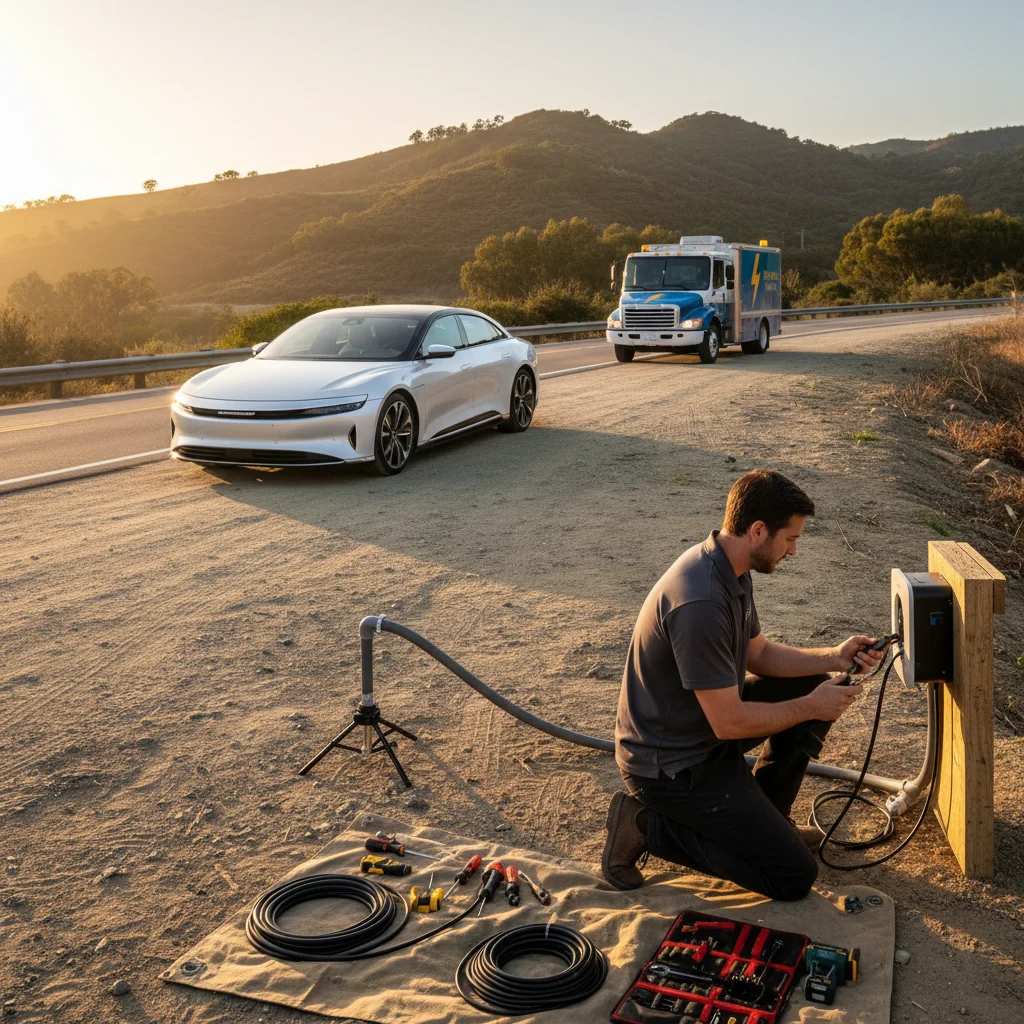
Why Chantilly cars sit cold all week
Chantilly is an unincorporated Fairfax County community. It isn’t an incorporated city. It sits at VA-28 and US-50 on the western Fairfax plain. Census ACS 2019-2023 counts 23,744 people on about 12 square miles. Only 19.1 percent of housing here was built before 1980.
That housing age explains who gets stuck. Newer subdivisions came with garages and wall circuits. Many residents plug in at home. They leave with a charged pack. The car that dies here often isn’t that commuter. It’s a visitor’s car. It’s a contractor’s car. It’s a traveler who parked for a flight and came back to a silent dash.
Westfields is the weekday version of that sit. Long shifts in the business park leave cars cold. Data Center Alley work in nearby Ashburn does the same. People park, work a long shift, and return to a car that won’t wake. The Steven F. Udvar-Hazy Center holds museum visitors for a full afternoon. The Dulles Expo Center does too. Sully Historic Site is another long-dwell lot on this western edge.
Fairfax County and the City of Fairfax are separate jurisdictions. Don’t tell a matcher you’re in Fairfax City if you’re on Westfields Boulevard. They’re not the same place.
Dominion Energy serves most addresses in this part of the county. NOVEC covers some nearby ones. Confirm the serving utility on your bill. Don’t guess from a map pin. Dominion publishes Schedule 1EV, an Off-Peak Plan, and EV Charger Rewards. None of those pages send a charger to a stranded car. Check current details on Dominion’s site. A rate plan won’t roll to a Westfields stall.
Herndon has the same Dulles-adjacent sit. Stay on the Chantilly pin if that’s where the car is.
Dulles trips, Westfields, and the museum lot
Dulles International sits next to this community. MWAA publishes Level 2 charging in Garage 1 and Garage 2. Confirm current stall counts with MWAA before you park. The Economy Lot is the largest on-airport option. You reach it by shuttle from Curb 2F. A week in that lot is hard on the 12-volt. You fly home. The traction pack may still hold energy. The small battery that wakes the computers may not.
That’s the pattern this corridor produces. If the car is still on airport property, use the Dulles guide. Read mobile Tesla charging when yours won’t wake at Dulles. If you already drove it onto a Chantilly street, use that street pin. An expo garage and an airport garage are different access problems.
The Udvar-Hazy Center is the Air and Space Museum annex. People park for hours, not minutes. Winters here run colder than Reagan National. Dulles gets more snow and harder freezes than the inner Virginia core. A car that sat in that cold can refuse to boot. A thin 12-volt is enough to do it. The pack doesn’t have to be empty for that to happen.
US-50 here is Lee Jackson Memorial Highway. VA-28 is Sully Road. Westfields Boulevard ties the business park to both. A stall on Sully in peak traffic isn’t a stall in an expo garage. Give the road name, the direction, and a dropped pin. “Near the airport” isn’t a location.
If you still have motion, get out of the travel lane. Turn hazards on if they work. Stay belted inside on a fast road. Don’t push the car. Traction packs make these vehicles heavy. Call 911 if you’re blocking live traffic.
VDOT’s Safety Service Patrol covers Virginia interstates. Drivers reach it through Virginia 511. Published VDOT material describes incident and debris clearance. It doesn’t describe EV charging. VA-28 and US-50 aren’t that interstate patrol. Don’t wait for a patrol truck to bring 240 volts.
Centreville, Reston, and Ashburn sit on the same Dulles-corridor edge. If the car already rolled into Centreville, say Centreville. Don’t describe a Sully Road stall as “near 66.”
Empty pack on VA-28, or a 12-volt that won’t wake
Two failures look the same from the sidewalk. They’re not the same job.
An empty high-voltage pack is a range problem. You used the last miles on Sully in traffic. Cabin AC in a humid summer eats more than the dash predicted. Cabin heat in a Dulles-cold winter does the same. Recurrent Auto studied more than 30,000 EVs. A typical car keeps about 80 percent of range at freezing. At 20F it’s about 70 percent. Sitting still with climate on burns that remainder. You don’t cover any miles while you wait.
True zero on the pack is heavier. Contactors can open. You may not shift to neutral. Hazard lights can fail. Without shift, you’re sitting in a heavy EV that won’t roll.
A dead 12-volt looks like that brick. After days in a garage, it sags first. The 12-volt runs computers, locks, and contactors. Those contactors let the big pack talk. Jumping or replacing it on site is often the whole rescue. That’s the pattern in a 12-volt failure after a long sit.
Don’t guess which battery failed. Read the exact message if the screen still lights. Note whether the car powers on. Note whether it shifts. Note whether the charge port opens. Tesla, Rivian, Ford, Hyundai, Chevy, and the rest all split this way. Operators in the network handle Tesla and every major EV brand. They can jump or replace a dead 12-volt on site.
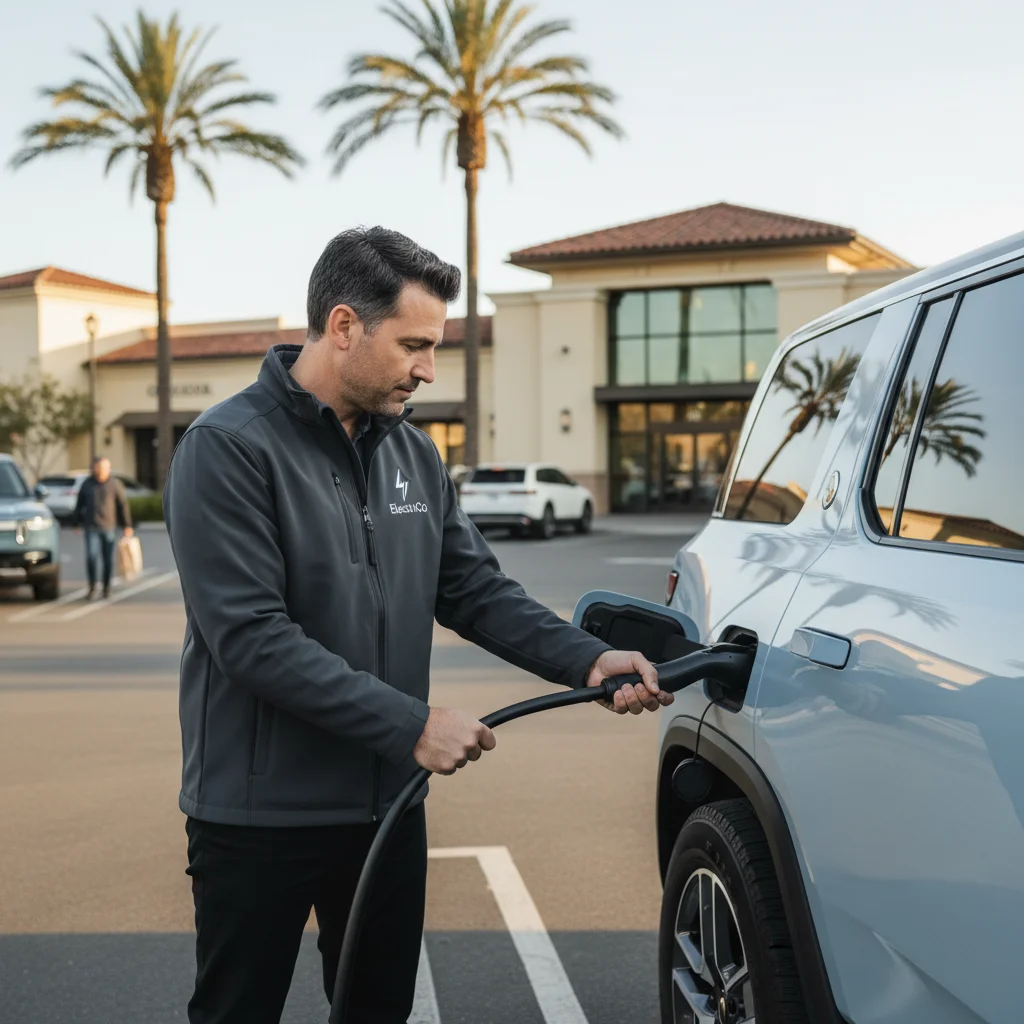
What a mobile 240-volt visit actually does
Charge Pro DC doesn’t own trucks or chargers. We don’t employ technicians. We don’t set prices. We match you with a licensed, independent local operator. That person quotes the job. Then they bill you.
Mobile EV charging brings a 240-volt Level 2 source to the car. Tesla owners get a native NACS plug. Other EVs use a CCS or J1772 adapter. A typical session adds about 10 to 20 miles of range. Charging time is usually 15 to 30 minutes. That’s charging time. It isn’t an arrival time. Nobody on this line promises when an operator will show up.
The point is enough energy to leave the stall under the car’s own power. It isn’t a full pack fill in a Westfields aisle. Ask the operator what their equipment can add. Make and model matter. Confirm the price before they start.
If the dash is dark, they treat the 12-volt first. A jump can close the contactors. Then the pack can accept charge. If the 12-volt is the only failure, you may not need a traction boost.
Share a dropped pin, the make and model, and a number that rings. Mention a garage gate, a height bar, or a tight ramp. Copy the warning text. Don’t paraphrase it. Say whether you need enough range to drive. Say whether you need a 12-volt wake-up.
Charge it where it sits, or wait on a tow
A tow is sometimes the right tool. A car in a travel lane that won’t shift may need a wrecker. Improper towing can damage a single-speed EV drivetrain. That’s especially true with a dead 12-volt and no neutral. A tow still leaves you at a lot. The pack is still empty.
Virginia disabled-vehicle rules treat an EV like any other car. The three codes reviewed for this metro don’t write a special empty-charge statute. Fairfax County can set private-property tow rules by ordinance. Confirm the current local rule with the county before you sign a ticket. Charge Pro DC couldn’t confirm a Fairfax County private-property tow fee. The county is who sets it.
A mobile charge skips the flatbed question when the car is in a safe stall. The operator comes to Westfields, to an expo lot, or to a legal shoulder. Energy goes into the car. You drive it out. Compare that path with mobile EV charging or a tow when stranded.
Don’t ask the matcher to guess the stop. A Udvar-Hazy lot, a Westfields garage, and a Sully shoulder are three different jobs. The quote follows the stop you actually have.
When this is the right call
Call when the car won’t wake after a week at Dulles or Westfields. Call when a Udvar-Hazy or expo visit ends with a dark dash. Call when VA-28 traffic leaves the pack too low to finish the last miles.
Stay with the car on a high-speed road. In a garage, stay where the operator can find the stall number. Don’t walk an airport roadway for a shuttle while the car blocks a lane.
For the referral itself, start with EV roadside assistance. We connect Chantilly drivers with local mobile rescue operators. We don’t perform the work. Call (202) 629-0844 and the operator quotes you before starting.