I-66 can land a Centreville EV at two percent after a long idle. Cabin heat or AC keeps drawing while you cover almost no miles. Get out of the travel lane and stay with the car. Then call for a quoted mobile rescue. Charge Pro DC is a referral line. We match stranded drivers with independent local operators. The operator quotes you before starting and bills you directly. That’s EV roadside assistance in Centreville.
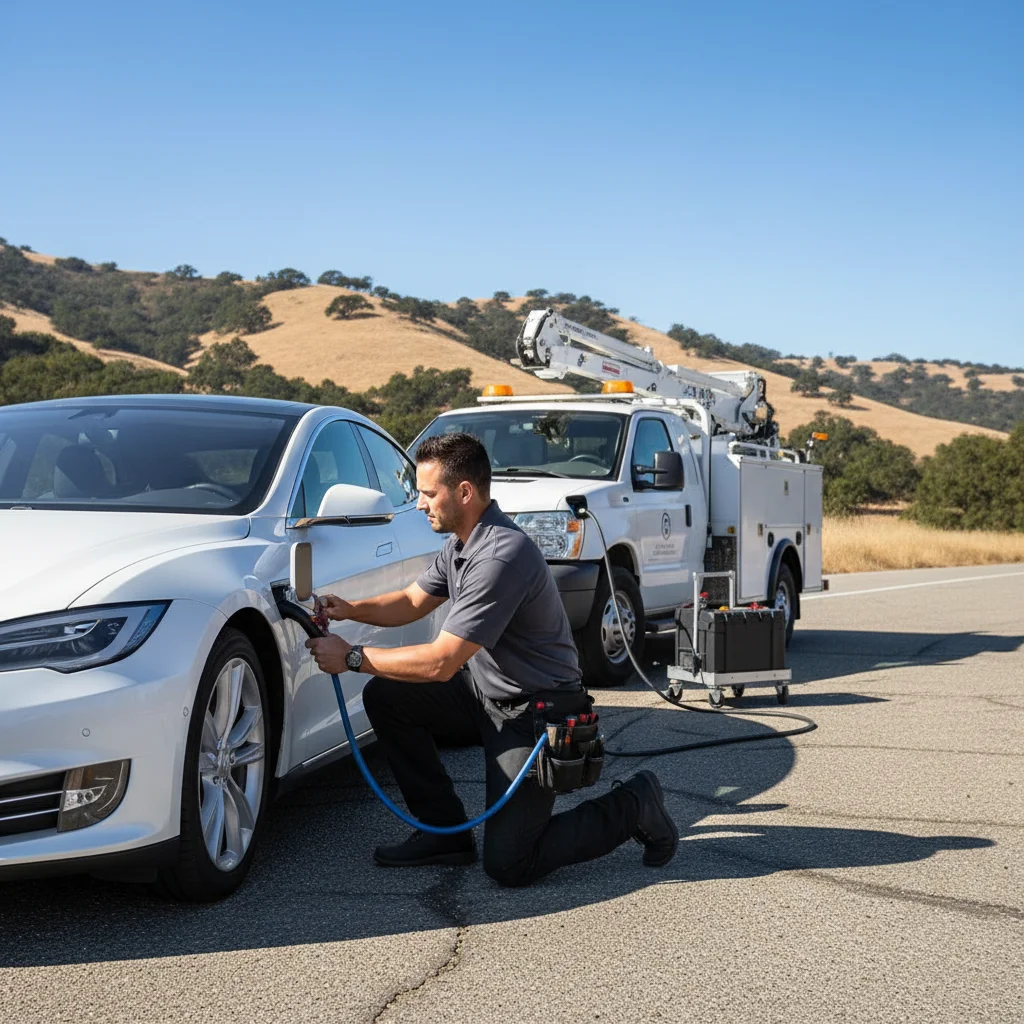
Why this Fairfax CDP dies on the interstate, not the driveway
Centreville is a census-designated place in Fairfax County. It’s not an incorporated city. Don’t call it the city of Centreville. Fairfax County and the City of Fairfax are separate jurisdictions. If you tell a matcher Fairfax, add the county.
Census ACS 2019-2023 counts 71,885 people here on about 11.9 square miles. Only 11.1 percent of housing was built before 1980. That’s among the newest stock in this metro. Many residents plug in overnight on Dominion Energy. NOVEC serves some nearby addresses, so confirm the utility on your bill. Dominion publishes Schedule 1EV, a voluntary Off-Peak Plan, and EV Charger Rewards. None of those pages send a charger to a stranded car.
This is a large bedroom community at the western end of I-66 in Fairfax. From here the interstate opens toward Prince William. Home charging is widespread, so the driveway isn’t the usual failure. Drivers ride 66 east into the metro, then come home on very little. The I-66 park-and-ride lots produce the other pattern: a car that sat all day.
Chantilly, the City of Fairfax, Gainesville, and Manassas sit next door. Manassas is an independent city, not a Fairfax County neighborhood. If the car already rolled west into Gainesville, say Gainesville. Gainesville after an I-66 crawl is a longer finish. Stay on the Centreville pin if that’s where you stopped.
Idle time on 66 is what spends the last percent
Peak I-66 inside the Beltway uses dynamic tolls. Outside the Beltway, Express Lanes keep the same stop-and-go. Paying a toll doesn’t save battery. The cabin still draws while the wheels barely turn.
Research for this corridor names the eastbound morning as the long stationary stretch. You can leave a charged garage and still burn percent in place. The westbound evening is the empty-pack finish. Then you idle toward Lee Highway with the climate on. Two percent at the Centreville exits is that evening story.
Centreville sits where I-66 begins to open toward the exurbs. Summers here are humid. Winters run colder, with more snow than inside the Beltway. Dulles runs colder and snowier than Reagan National. Cabin load on this western Fairfax edge is heavier than a mild Arlington afternoon.
Recurrent Auto published a winter-range study of more than 30,000 EVs, read in 2026. At 32F a typical car holds about 80 percent of its range. At 20F that falls to about 70 percent. Real cold costs most drivers 20 to 35 percent. Cabin heat comes from the pack. Don’t read those as Tesla-only numbers.
Sitting still with climate on is a charge leak. In January 2022, snow shut I-95 near Fredericksburg for more than 36 hours. That crash is south of this service area. It’s still the local picture of heat running in a stopped car.
If you still have motion, use it to leave the travel lane. Don’t gamble on one more exit at two percent. Stranded EV on I-66 walks through the interstate stop itself. We won’t guess how far the next public charger sits. That distance wasn’t verified here. If you can’t safely reach an exit you already know, stop and call.
Lee Highway, Sully Road, Braddock, and the park-and-ride lots
Name the road. Centreville is too big a pin by itself. I-66 is the commute spine. US-29 is Lee Highway, with Centreville shopping along it. VA-28 is Sully Road, toward Chantilly. Braddock Road cuts the south side. A stall on 66 isn’t a stall in a shopping lot. Give the road, the direction, and a dropped pin.
The I-66 park-and-ride lots are a full-day sit. You park at dawn, ride in, and come back after work. The traction pack may still hold energy. The small 12-volt that wakes the computers may not. Summer heat in a closed cabin wears that battery. A western Fairfax freeze does too.
Bull Run Regional Park is hours, not minutes. People hike, picnic, and return to a car that sat. Cub Run is another local landmark on this western Fairfax edge. A park lot isn’t a freeway shoulder.
Lee Highway errands after a drained 66 run mix both problems. You leave the interstate with two percent, then try one more stop. Park instead, and turn hazards on if they work. Stay with the car on a fast road. If you still have creep, get fully out of the travel lane. Don’t stop in a gore, on a curve, or in a merge.
If you leave 66 onto the 495 Express Lanes, pull left. Those lanes sit in the median. Stay in the car until help arrives. Transurban’s Express Assist will call a tow. It doesn’t tow, and published material doesn’t describe EV charging. Sully Road, Lee Highway, and Braddock aren’t the interstate patrol. Don’t wait there for a truck to bring 240 volts.
Two percent on the pack, or a car that won’t boot
An empty traction pack and a dead 12-volt can look identical from the shoulder. They aren’t the same job. An empty high-voltage pack is a range problem. You used the last miles in 66 traffic. Contactors can open, and you may not shift to neutral. Without shift, you’re sitting in a heavy EV that won’t roll.
A dead 12-volt looks like that brick. After a day in a park-and-ride, it sags first. The 12-volt runs computers, locks, and contactors. Jumping or replacing it on site is often the whole rescue. Operators in the network handle Tesla and every major EV brand. They can jump or replace a dead 12-volt on site. Tesla owners can ask for a Tesla 12-volt battery jump.
Don’t guess which battery failed. Read the exact message if the screen still lights. Note whether the car powers on, shifts, or opens the charge port. A westbound I-66 stop into Centreville at two percent is a charge job. A car that won’t unlock after hours in a park-and-ride is a 12-volt job.
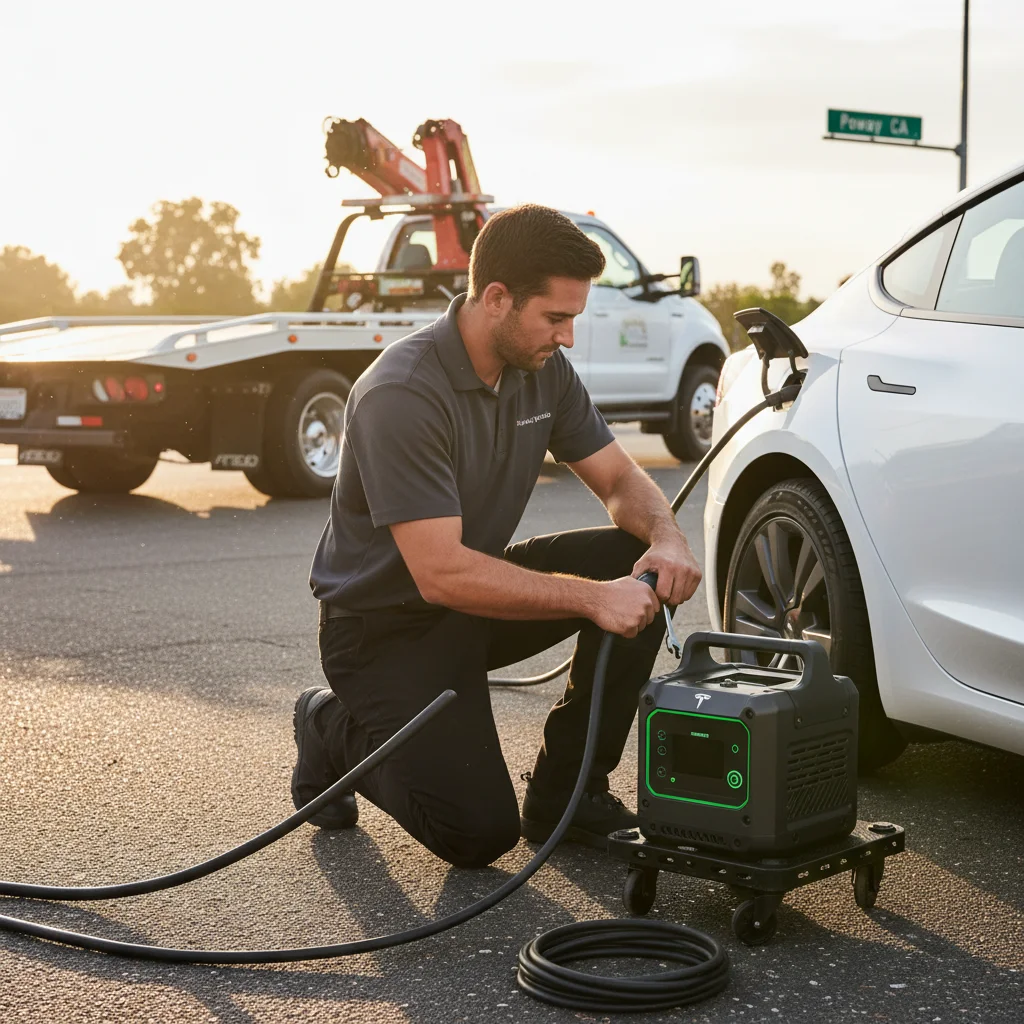
What a quoted 240-volt visit actually does
Charge Pro DC doesn’t own trucks or chargers. We don’t employ technicians or set prices. We match you with a licensed, independent local operator. The pros we connect you with are licensed and insured. That person quotes the job, then bills you.
Mobile EV charging brings a 240-volt Level 2 source to the car. Tesla owners get a native NACS plug. Other EVs use a CCS or J1772 adapter. A typical session adds about 10 to 20 miles of range. Charging time is usually 15 to 30 minutes. That’s charging time. It isn’t an arrival time. Nobody on this line promises when an operator will show up.
Ten to twenty miles is usually enough to leave the interstate. It isn’t a full pack fill in a Lee Highway lot. Ask the operator what their equipment can add, and confirm the price before they start. If the dash is dark, they treat the 12-volt first. A jump can close the contactors, then the pack can accept charge.
Give a dropped pin, the make and model, and a number that rings. Mention a lot gate or a height bar. Copy the warning text instead of summarizing it.
Patrol, a tow, or energy where the car sits
Virginia’s Safety Service Patrol works I-66 along with other interstates. VDOT puts the statewide interstate coverage at about 1,079 miles. Northern Virginia’s I-66 shoulder and express patrol runs in weekday peak windows. Drivers reach that help through Virginia 511. Published VDOT pages describe incident clearance, debris, and short-term traffic control. They don’t describe charging an EV.
A wrecker is the right tool in a live lane that won’t shift. A single-speed EV drivetrain can be damaged if it’s towed wrong, especially with no neutral. A flatbed still leaves you at a lot with an empty pack.
Virginia disabled-vehicle rules treat an EV like any other car. The three codes reviewed for this metro don’t write an empty-charge statute. Fairfax County can set private-property tow rules by ordinance. Charge Pro DC couldn’t confirm a current Fairfax County private-property tow fee. The county is who sets it. Confirm the current local rule before you sign a ticket.
A mobile charge avoids the flatbed when the car is already in a safe stall. The operator comes to a legal shoulder, a park-and-ride, or a Lee Highway lot. Compare that path with mobile EV charging or a tow when stranded. An I-66 shoulder, a park-and-ride stall, and a Bull Run lot are three different jobs.
Maryland’s CHART patrol is a different agency on a different set of roads. I-66 is Virginia, so don’t dial Maryland #77 for this shoulder stop. No utility EV page reviewed for this metro offers a stranded-car charge. A Dominion rate plan won’t roll to Cub Run.
Stay with the car on a high-speed road. Call Virginia 511 so Safety Service Patrol can treat the stop as an incident. The charge is a separate call. For the referral itself, start with EV roadside assistance. We connect Centreville drivers with local mobile rescue operators. We don’t perform the work. Call (202) 629-0844 and the operator quotes you before starting.