You left home with a full pack after overnight charging. Your Gainesville driveway already has a plug. Then I-66 stopped and the cabin heat kept drawing. The dash hit two percent before the I-66 and US-29 interchange. New housing here usually has a home charger. I-66 backups still dump drivers at two percent. That’s when you need EV roadside assistance in Gainesville.
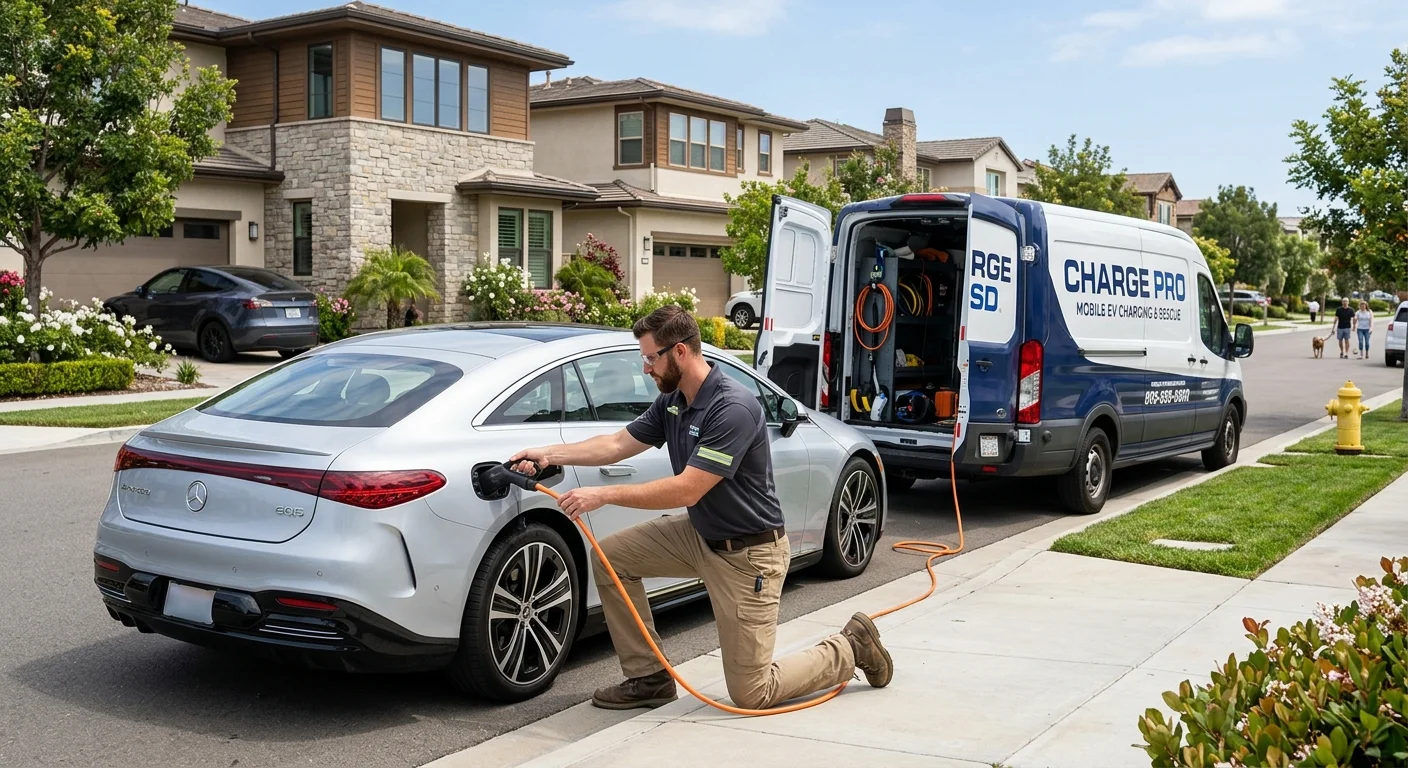
New homes have a plug. I-66 still empties the pack
Gainesville sits in Prince William County. It’s the western edge of the continuous I-66 suburbs. About 18,036 people live here, per Census ACS 2019-2023 5-year estimates. Only 3.8 percent of housing was built before 1980. That puts Gainesville with Ashburn among the newest housing in the DC area. Most of those houses went up with a garage circuit. Many added a 240-volt charger soon after.
NOVEC serves much of this part of Prince William. Dominion Energy Virginia serves other addresses here. Confirm the utility on your bill before you assume a rate or rebate. NOVEC and Dominion publish home EV rates and charger programs. Those pages don’t offer a service that charges a car that’s already stranded.
The usual Gainesville call isn’t a renter without a plug. It’s a driver who charged overnight, then sat in an I-66 crawl. Idle heat or AC burns charge with no miles gained. That’s how a full pack becomes two percent before you exit.
I-66, US-29, and the roads that feed them
I-66 is the spine through Gainesville. US-29, Lee Highway, meets it at the interchange locals treat as the front door. Virginia Gateway traffic funnels through that junction. US-15, James Madison Highway, and VA-55, John Marshall Highway, feed the same cluster. When the interstate locks up, those roads fill too.
If you stall in the I-66 Express Lanes, get to a legal shoulder. Stay in the car with the hazards on. Farther east, the 495 Express Lanes sit in the median. Transurban’s published rule there is to pull to the left shoulder. Express Assist on the 495, 95, and 395 Express Lanes helps with minor issues. It’ll call a tow. It doesn’t charge an EV.
VDOT’s Safety Service Patrol covers I-66, including this corridor. Drivers reach that help through Virginia 511. The patrol handles incidents, debris, and short-term traffic control. Published VDOT material doesn’t describe EV charging. A safety truck can make you visible. It won’t add range.
For the full interstate steps, read stranded EV on I-66. If you already know you need a charge on site, start with EV roadside assistance.
Concert lots sit longer than a commute
Virginia Gateway and the Atlas Walk district hold people for hours. Jiffy Lube Live, the amphitheater, is where cars wait through a full show. They sit in fields and lots until the lights come up. A 12-volt that looked fine at the gate can refuse to wake later.
That’s a different failure from an empty traction pack. The big battery may still hold miles. The small 12-volt that closes contactors and runs computers is the one that died. An operator on site can jump or replace that 12-volt. A tow for a car that only needs a jump is the long way around.
Weekday stalls look more like Centreville’s I-66 pattern than an apartment lot. If you stalled on that side of the interchange, EV roadside assistance in Centreville matches the same crawl. Manassas and Manassas Park sit just east if you were headed that way.
Two percent on the dash
Get out of the travel lane if you can. Turn on the hazards. Stay with the car unless you’re in immediate danger. Then call Charge Pro DC. We’re a referral line. We match you with an independent local mobile rescue operator. We don’t own trucks, employ technicians, or set prices. The operator quotes you before any work starts and bills you directly.
Have this ready: your exact spot, a landmark, and the make and model. Virginia Gateway, Atlas Walk, or Jiffy Lube Live beat a vague pin. The I-66 and US-29 interchange is a clean landmark too. Say whether the car won’t wake, or it wakes with an empty pack. Those are two different jobs.
Winter hits this western edge harder than the inner suburbs. Dulles runs colder and snowier than Reagan National. Gainesville sits in that colder belt, with the Bull Run Mountains to the west. Recurrent Auto’s study of more than 30,000 EVs is the range reference. A typical EV keeps about 80 percent of range at freezing, 32F. At 20F it’s about 70 percent. Cars with a heat pump average about 83 percent retained versus about 75 percent without. Cabin heat is the drain, because an EV makes that heat from the pack. Sitting still with the heat on is how a full charge falls short.
In January 2022, snow shut I-95 near Fredericksburg and stranded drivers overnight. That sit lasted more than 36 hours. That stretch sits south of this service area. It’s still the region’s reminder that idle heat empties a pack.
What the operator brings
Operators we connect you with bring a 240-volt Level 2 source to the car. Tesla owners get a native NACS plug. Other EVs use a CCS or J1772 adapter. A typical session adds 10 to 20 miles of range. That takes 15 to 30 minutes of charging. That’s charging time on scene, never an arrival time.
That bump is usually enough to finish the last stretch home. It can also get you to a public charger you already planned to use. It’s not a full pack. It’s a rescue. Details sit on mobile EV charging. If the pack is empty and you can’t roll, use out of charge recovery.
A tow is a different tool. Many EVs need a flatbed, because the drive wheels can’t stay on the ground. You still have to charge after the drop. If you only need range or a 12-volt wake, charge on site. The operator on the phone will tell you which job they can do. Compare the two paths in mobile EV charging or a tow.
Gainesville is a long run from the inner District. Say where you are so the operator can judge the trip. The local map is the Gainesville EV charging page.
When the house charger is fine and the car still dies
A failed wall unit is the rarer Gainesville case. Newer construction usually has the circuit. If the home charger trips on a morning you have to leave, call. A mobile 240-volt visit can still add enough range for the day. That doesn’t replace an electrician. It gets the car off the driveway.
If the car won’t wake in the garage after sitting, start with the 12-volt. Teslas, Hyundais, Fords, and Rivians boot from that small battery. A jump on site often ends the stall. A high-voltage pack failure is the uncommon case. It doesn’t look like a two-percent commute.
Call from the shoulder, not from the travel lane
Don’t wait for zero if you can still creep to a legal pull-off. Once you’re stopped, stay put and make the call. We connect drivers in Gainesville and across the DC area. That covers the District of Columbia, Maryland, and Virginia.
Call (202) 629-0844. Tell the operator where you are and what the car is doing. Say whether you charged at home last night. They quote before they start. You pay them, not us.