A Tesla can still sit dark in a WMATA garage with range left. The same 12-volt death shows up after a week in Dulles parking. It shows up after a long day at Tysons Corner Center too. Brand service calendars watch miles, filters, and fluids. They don’t watch a small battery that drained on the Silver Line. They also miss a sit during a meeting.
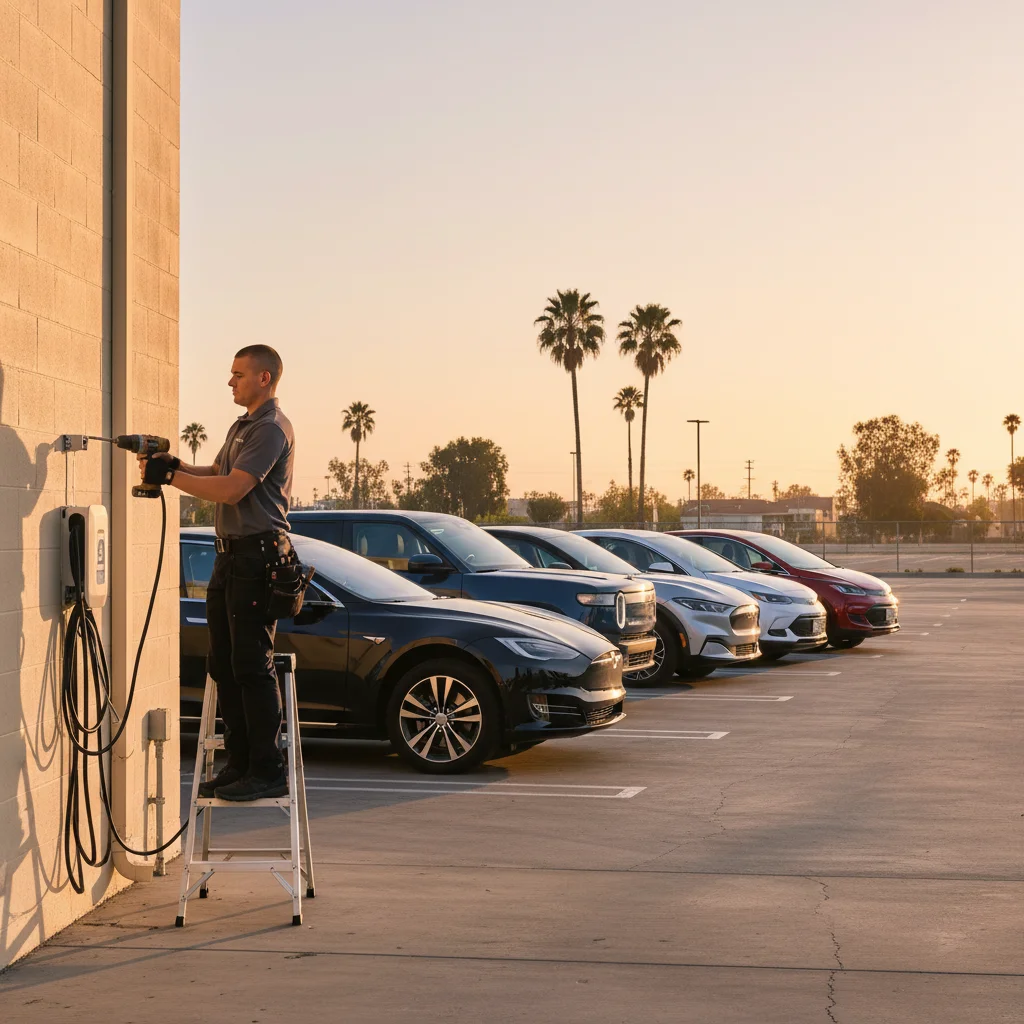
Tesla, Rivian, Ford, Hyundai, and Chevy each publish a light EV maintenance list. It won’t wake a car whose 12-volt died overnight. Charge Pro DC is a referral line for the District, Maryland, and Virginia. We match stranded drivers with independent local operators. We don’t run a shop, own a fleet, or perform the service below. A dead 12-volt on the pavement is a different job.
The owner’s manual assumes you drove home
Mileage intervals assume a commute, then a plug, then another commute. Many DC-area EVs don’t live that loop. Takoma Park’s housing is about 90 percent pre-1980. Annandale sits near 80 percent, Wheaton near 73, the District near 70. Those buildings were framed before driveway Level 2 existed. Arlington County and Alexandria add apartment density. Cars sit in shared garages and on the curb. The traction pack can still hold miles. The 12-volt hates a long, dark sit.
Airport parking stretches that sit across a full trip. Reagan National lists complimentary EV charging on Level 1 of Parking Garages 1 and 2. It’s first come, first served, with limited spaces. Dulles lists Level 2 charging in Garage 1 and Garage 2. Many travelers still use the Economy Lot and the shuttle at Curb 2F. The common return call isn’t an empty pack. It’s a car that won’t wake. Union Station’s garage and WMATA park-and-ride decks produce the same pattern.
A published tire rotation doesn’t catch that week. For a garage or airport sit, read what happens when an EV 12 volt dies in a garage or airport lot. For a Dulles return that won’t unlock, see mobile Tesla charging when yours won’t wake at Dulles.
Shared jobs every EV still needs
Four items show up across brands. The intervals differ.
Tires. Extra weight and instant torque wear tread faster than a gas car. Check pressure every month. Rotate on the miles your brand prints. Soft tires also waste range on I-270, I-66, and the Capital Beltway.
The 12-volt. It powers computers, locks, and the wake sequence. If it’s dead, a full high-voltage pack won’t help. Screens stay dark. Doors might not release. None of the brand lists below replace a load test after a long sit.
Brakes. Regenerative braking saves pads and rotors. Brake fluid still absorbs moisture. Brands want a test or a flush on a clock. Cars that mostly glide in traffic can grow rotor rust.
Cabin filter, wipers, washer fluid. Humid summers and pollen load the HVAC filter. Replace it on the brand interval. Change streaking blades before a wet night on the George Washington Memorial or Baltimore-Washington parkways.
For a brand-agnostic walkthrough, read our EV maintenance schedule for owners. Confirm every number in the current owner’s manual or the in-car service screen. Automakers revise these lists.
Tesla: alerts on the screen, silence in the garage
Tesla stepped away from a mandatory yearly service. It publishes item-by-item intervals. The center screen will nag you about some of them.
Tesla items to track
- Tire rotation, balance, and alignment: every 6,250 miles. Do it sooner if tread depth differs by 2/32 inch or more between tires.
- Brake fluid: a health check every two years. Replace it if the test fails.
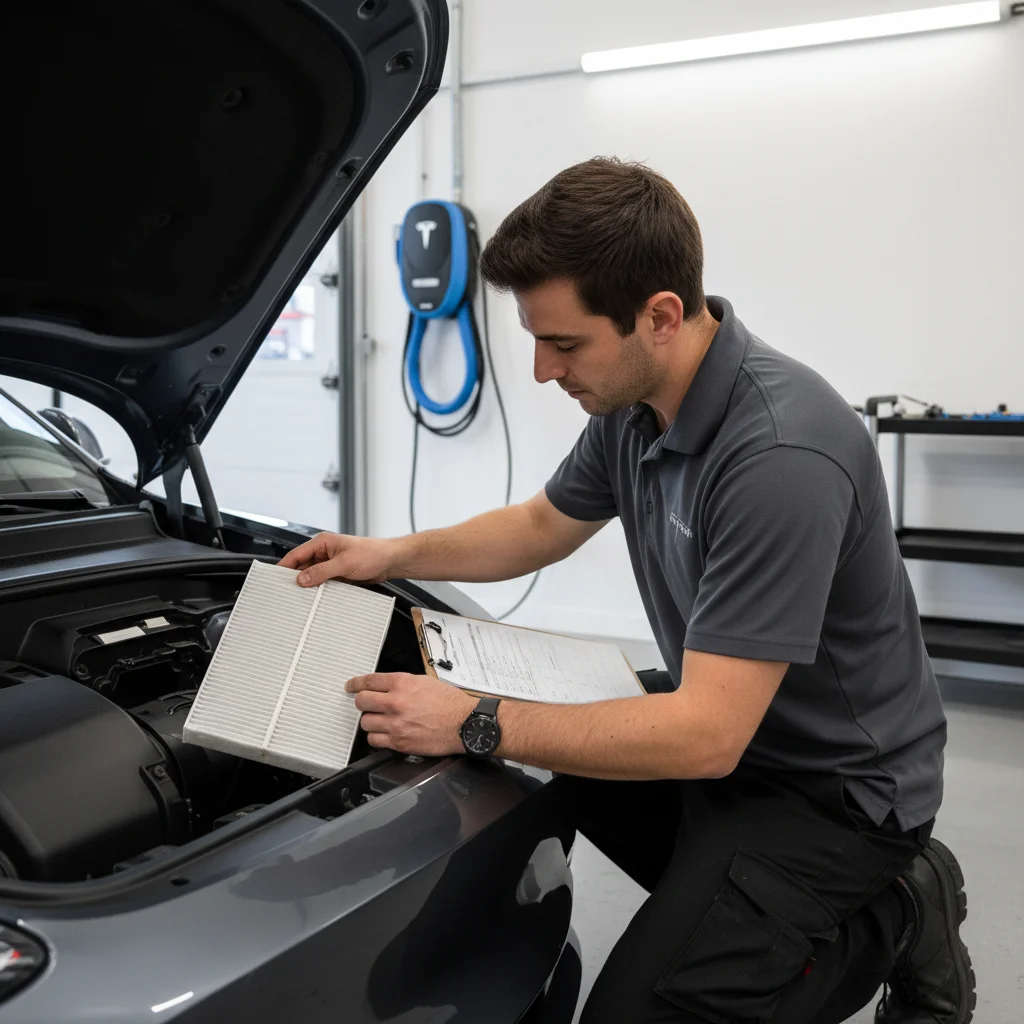
- Cabin air filter: every two years. Newer Model S and Model X HEPA and carbon filters: every three years.
- A/C desiccant bag: every three to six years, by model. Model 3 and Model Y: every four years. 2012 to 2020 Model S: every three years.
Tesla may run a multi-point look when the car is already in for other work. That isn’t a required annual visit. Keep the rotations current. Trust the alerts. A 6,250-mile rotation can still leave you dead on a Tuesday in a Metro garage. Miles and calendar days aren’t the same clock. Treat a car that won’t wake after a garage sit as a 12-volt event. The operators we connect you with can jump a Tesla 12-volt on site.
Ford Mach-E and F-150 Lightning: a thinner shop binder
Ford kept a mileage-and-calendar visit that feels familiar if you came from a gas Ford.
Ford EV checklist
A multi-point inspection every 10,000 miles, or at least once a year, is the backbone. That visit covers tires, brakes, cooling hoses, half-shaft boots, steering, and suspension.
Longer items sit behind that yearly pass:
- Cabin air filter: every 20,000 miles.
- F-150 Lightning rear eAxle fluid on all-wheel-drive trucks: 150,000 miles.
- High-voltage battery coolant: first change at 100,000 miles, then every 50,000 miles after that.
That list doesn’t include a 12-volt wake test after the truck sat in a Reston Silver Line garage. A Mach-E or Lightning that won’t power up needs the small battery checked first.
Hyundai Ioniq 5 and Chevy Bolt: short inspections, late fluid work
Hyundai and Chevrolet lean on short inspection loops. The heavy coolant work is far down the odometer.
Hyundai Ioniq 5
Hyundai builds the calendar on 8,000-mile steps.
- Every 8,000 miles: rotate tires.
- Every 16,000 miles: inspect brakes, steering, and suspension.
- Every 24,000 miles: replace the cabin air filter.
- Every 40,000 miles: inspect battery coolant. First coolant replacement is published at 120,000 miles, then every 40,000 miles after that.
- Every two years: flush and replace brake fluid.
Chevy Bolt EV and Bolt EUV
Chevrolet uses 7,500-mile steps.
- Every 7,500 miles: rotate tires and run a multi-point inspection.
- Every 22,500 miles: replace the cabin filter.
- Every five years: flush and replace brake fluid.
- Every five years or 150,000 miles: drain and fill the coolant circuits, including the battery, power electronics, and cabin-heater loops.
Ioniq 5 and Bolt drivers in older Montgomery and Prince George’s neighborhoods often park on the street or a condo deck. That’s more sitting than an 8,000-mile tire card assumes. Keep the inspections. Don’t confuse them with a car that went to sleep after three days in a lot.
Rivian R1T and R1S: extra hardware, still a light calendar
Rivian’s truck and SUV add gear most commuter EVs never see. The published list is still short. It isn’t a copy of Tesla or Ford.
Rivian intervals
- Tire rotation: every 7,000 miles.
- Wheel alignment: every 14,000 miles, or when inner or outer tread looks uneven.
- Drive unit fluid: 140,000 miles. That fluid lives in the motor gearsets.
- Air suspension: inspect for leaks or damage every 28,000 miles. Replace the compressor filter at 56,000 miles.
- Cabin air filter: each year, or every 14,000 miles.
- Brake fluid: every three years.
Loudoun and western Fairfax County climb off the tidal Potomac toward the Piedmont. Ashburn and Gainesville have newer housing, so home charging is common there. An R1T still spends nights in Bethesda and Arlington garages. An air-suspension leak is a shop visit. A 12-volt that won’t unlock the door is a car that won’t move.
Heat, ice, and the week the odometer didn’t see
Brand calendars count miles and years. This metro adds heat, ice, and standing traffic. Those don’t wait for 10,000 miles.
Dulles runs colder and snowier than Reagan National. Loudoun, upper Montgomery, and Prince William take harder freezes than the inner District core. Recurrent Auto studied more than 30,000 EVs in winter. A typical EV keeps about 80 percent of range at 32F. It keeps about 70 percent at 20F. Cabin heat is the drain. Cars with a heat pump held about 83 percent of range. Cars without averaged about 75 percent. That’s traction-pack range, not 12-volt health. For commute wear, see how heat, ice and Beltway idling wear an EV battery.
Sitting in Beltway or I-95 traffic with climate control on burns charge without covering miles. The January 2022 I-95 shutdown south of this metro is the local memory of that. About 14 inches of snow and a crash closed roughly 50 miles near Fredericksburg. Drivers sat with the heat on for more than 36 hours. That isn’t a maintenance interval. A pack that looked fine at last service doesn’t describe a car that sat in the cold.
Heat and humidity also age 12-volt batteries in closed garages. A Tysons office deck in August isn’t a 7,500-mile inspection. For that stall, read what to do when an EV dies in a Tysons garage after a long sit.
Pepco EVsmart covers the District, Montgomery County, and Prince George’s County. Dominion Energy Virginia publishes Schedule 1EV for most of Northern Virginia. NOVEC serves parts of Loudoun and Prince William. Confirm the serving utility by address. Those programs talk about home and workplace charging. None of the utility EV pages used for this piece describe charging a car that’s already stranded. A rebate on a wall unit doesn’t jump a 12-volt in a Metro garage.
Patrols clear lanes, not your service schedule
VDOT Safety Service Patrol covers Virginia interstates, including I-66 in Northern Virginia. Reach it through Virginia 511. It publishes incident and debris work, not EV charging.
MDOT SHA CHART covers the Maryland metro side. Dial #77 on roads like I-495, I-270, US-50, and MD-295. Technicians publish tire changes and jump starts. They don’t publish a 240-volt top-up.
No DDOT motorist-assistance patrol showed up in the District sources used for this page. DC drivers rely on MPD, private plans, and US Park Police on the parkways. On the Baltimore-Washington Parkway, report a disabled vehicle to US Park Police at 202-610-7500.
On Transurban’s 495 Express Lanes, pull to the left shoulder. Those lanes sit in the median. On the 95 and 395 Express Lanes, use the nearest shoulder. Stay in the car.
A stall on the Woodrow Wilson Bridge sits where Alexandria, Oxon Hill, and the District meet. The American Legion Bridge does the same between McLean and Montgomery County. Disabled-vehicle rules in all three jurisdictions apply to an EV like any other car. The three codes reviewed for this page have no separate out-of-charge statute.
None of that replaces a Ford 10,000-mile inspection. None of it wakes a 12-volt.
When the calendar is current and the car still won’t move
Charge Pro DC doesn’t perform the maintenance in this guide. Operators in the network bring a 240-volt Level 2 source to the car. They use a native NACS plug, or a CCS or J1772 adapter for non-Tesla EVs. They typically add 10 to 20 miles of range in 15 to 30 minutes of charging time. That’s time on the plug, never a promise of when someone arrives. They can also jump or replace a dead 12-volt on site. They handle Tesla and every major EV brand. The operator quotes you before work starts and bills you directly.
If the pack is empty after a Beltway crawl, that’s a charge rescue. If the car is silent in a garage with range still showing in the app, start with the 12-volt. For either case, EV roadside assistance is the match, not a wait for a dealer loaner on the shoulder.
Call (202) 629-0844 and we’ll connect you with a local operator. Ask for the quote first. Then decide.