A Centreville home battery keeps lights and the fridge alive when Dominion Energy drops. It doesn’t automatically put 240 volts into the EV in the garage. People searching “centreville home battery ev” mix those two jobs. One is a panel project. The other is a car that won’t move.
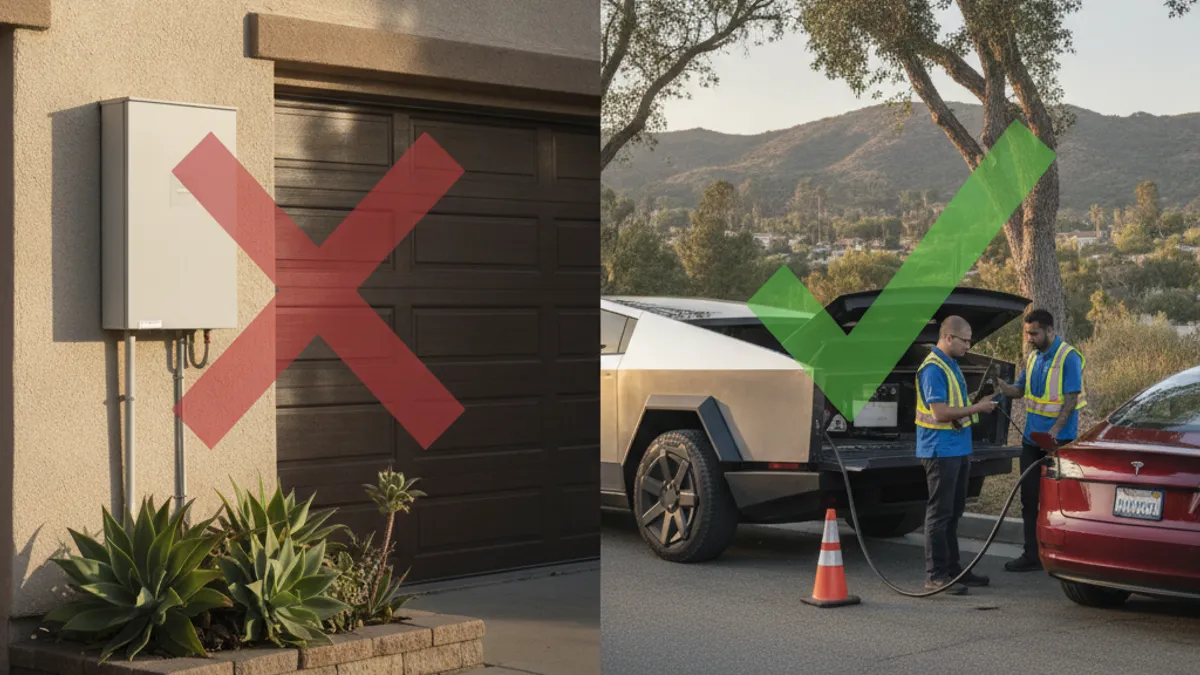
Newer homes still go dark
Centreville is an unincorporated community in Fairfax County. It sits at the western end of I-66 in the Dulles Corridor. Census figures put the population at 71,885. Only 11.1 percent of homes here were built before 1980. Level 2 wall chargers are already common. New construction still sits on the same grid. When Dominion goes out, the driveway charger usually goes with it. NOVEC serves some lots. Confirm yours by the meter. A backup system only feeds the car if it was sized and wired for that load.
A house battery and an EV charger can share a garage wall. They still do different work. An outage doesn’t merge them.
What a home battery actually covers
Wall units such as a Tesla Powerwall or an Enphase IQ Battery store household power. That power comes from the grid or from rooftop solar. They keep the panel, or selected circuits, running through a blackout. That’s a licensed electrical job. Confirm the permit path with Fairfax County before you sign. Confirm interconnection with Dominion or NOVEC, depending on the address.
Charge Pro DC doesn’t sell those systems, install them, or service them. We’re a referral line. We match stranded EV drivers with independent local operators. We own no trucks and we don’t set prices.
Utility EV programs here are rate programs, not rescue. Dominion publishes Schedule 1EV, a voluntary Off-Peak Plan that needs a smart meter, and EV Charger Rewards demand-response. No Dominion or NOVEC EV page we found offers a visit that charges a stranded car. If the house is the goal, call an electrician. For a side-by-side of the two jobs, see mobile EV charging vs a home battery when the power’s out.
The car still needs 240 volts
Home EV charging is 240-volt Level 2. A backup bank that keeps essential circuits alive often leaves that breaker off. EV charging is a heavy continuous load. Many installers keep it off the backup panel on purpose, so the house lasts longer. Some whole-panel systems can run it. That’s only if the bank was sized for that draw. Don’t assume that from a brochure. Ask which circuits stay live, in writing.
So the outage scene in a Centreville garage looks like this. Lights work. The wall charger is dead. Or it’s live and the pack was already too low. Either way, the car still needs 240 volts at the inlet.
The operators we connect you with bring a 240-volt Level 2 source to the vehicle. Teslas take a native NACS plug. Other brands use a CCS or J1772 adapter. On-site charging typically adds about 10 to 20 miles of range. That takes 15 to 30 minutes of charging time. That clock is plug time. It isn’t an arrival window. The operator quotes you before starting and bills you directly.
See home 240-volt charging vs a roadside top-up for the voltage story.
I-66 is still the range story
Outages are one reason a Centreville EV sits. The commute is the more common one. Drivers take I-66 east into the metro. They crawl home on US-29, VA-28, or Braddock Road with little left. Sitting in peak traffic with heat or air on burns charge without covering distance. This stretch is where I-66 opens toward Prince William. Winters here run colder and snowier than inside the Beltway. A Recurrent Auto study of more than 30,000 EVs found typical range near 80 percent at freezing. At 20F it was near 70 percent.
I-66 park-and-ride lots add a second pattern. A car that sits for a long day, then won’t wake, is often a 12-volt failure. The small battery runs locks, the screen, and the computers that let the high-voltage pack work. If that 12-volt is dead, the car stays dark even with miles still in the pack.
VDOT’s Safety Service Patrol covers I-66. Drivers reach them through Virginia 511. Published patrol work is incident and debris clearance and short-term traffic control. It doesn’t describe charging an EV.
If you’re already on the interstate at empty, read stranded EV on I-66. Off the highway, the local pattern is in Centreville EV roadside assistance.
Driveways, Lee Highway, and a dark charger
Centreville shopping on Lee Highway, Cub Run, and the lots near Bull Run Regional Park are long-dwell stops. You come back to a car that sat. That’s a 12-volt risk as much as a range risk. Nearby Chantilly, Fairfax City, Gainesville, and Manassas share the same western web of I-66 and VA-28. A stall on Sully Road is the same vehicle problem as a stall in a Centreville garage.
The default here isn’t a house without a wall charger. It’s a charger that went dark with the grid. It may be a charger that tripped, or a pack that arrived home empty. If the wall unit itself failed while the house still has power, a mobile 240-volt visit still works.
What to ask a home-battery installer
Bring the EV into that conversation. Ask whether the 240-volt EV circuit is on the backup panel. Ask how many hours the proposed bank covers for your actual household. Ask if the quote includes Fairfax County permitting and the utility interconnection paperwork. Get the serving utility in writing. Two quotes beat one.
When to call for the car, not the house
House dark, fridge dark: that’s an electrician. Car that won’t start, doors that won’t unlock, or a pack at zero: that’s the vehicle. Charge Pro DC refers those jobs. Independent operators handle Tesla and every major EV brand. They can jump or replace a dead 12-volt on site, or put 240 volts into the inlet.
For the local map, start at EV charging in Centreville. For what an operator actually brings, see mobile EV charging.
If the car is the thing that won’t go, call (202) 629-0844. The operator quotes before any work starts.
Frequently asked questions
Does Charge Pro DC install home batteries in Centreville?
No. We refer stranded EVs to independent mobile operators. A home storage system is an electrician or solar contractor job. Confirm permits with Fairfax County and interconnection with the utility on the meter.
Can my home battery charge the EV during an outage?
Only if that 240-volt circuit is on the backup panel and the bank can carry the load. Many setups leave the EV charger off so the house lasts longer. Confirm with the installer who wired yours.
What if the EV is dead in the driveway right now?
Stay with the car. A mobile operator can bring 240-volt Level 2 charging or jump a dead 12-volt on site. Ask for the quote before work begins.