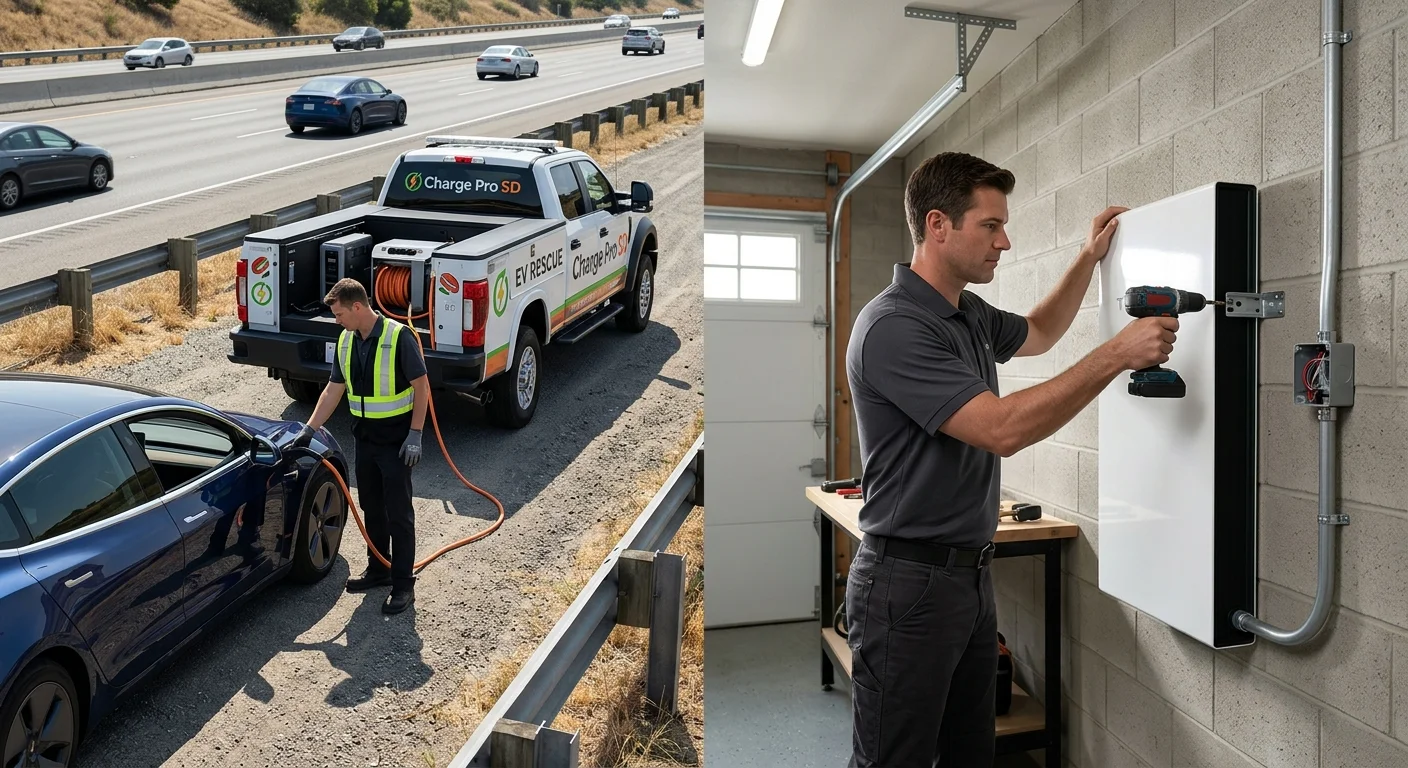
When a Pepco, Dominion, or NOVEC feeder drops, two EV problems get lumped together. One is a dark house and a dead wall charger. The other is a car that already stopped on the Beltway. It also happens on I-270 and in Metro garages. A home battery can cover the house. It can’t roll out to the car.
The mix-up starts on the utility EV page
Pepco’s EVsmart pages talk smart chargers and multifamily equipment. Pepco serves the District, Montgomery County, and Prince George’s County. Dominion Energy Virginia serves most of Northern Virginia. It publishes Schedule 1EV, the Off-Peak Plan, and EV Charger Rewards. NOVEC covers parts of Loudoun and Prince William. That includes much of Sterling, Ashburn, and Gainesville. BGE touches parts of Laurel. SMECO sits toward Clinton. The City of Manassas runs its own municipal electric utility. Confirm the serving utility by address before you assume a program.
None of those EV pages offers a charge-a-stranded-car service. A rebate form won’t send a truck to I-66. A time-of-use rate won’t wake a pack in a Tysons garage. That absence is the reason this page exists.
A wall battery is a house product. Mobile charging is a roadside product. Treating them as one thing wastes the outage.
A home battery is for the building
A home battery is a fixed storage unit on the wall. Tesla Powerwall is the name most owners use. Other brands sell the same kind of box. It stores grid power, or solar if you have panels. When the utility feed fails, it carries selected circuits. Lights, refrigeration, a furnace blower, maybe the router. Some installers put the EV charger on the backup load panel. Many don’t. Ask the electrician who signed the permit. Don’t guess from a brochure.
That setup is a residence project. It needs panel work and interconnection. It needs a contractor who pulls permits in the District, Maryland, or Virginia. Charge Pro DC doesn’t do that work. We’re a referral line for stranded cars. We’re not a solar shop.
Outages here come from summer storms, ice, and heat. Dulles runs colder and snowier than Reagan National. Loudoun, upper Montgomery, and Prince William feel that first. The District and the inner Virginia core often stay milder. A house battery is sized for that home, on that feeder. It isn’t a spare charger for the region.
In a Germantown power outage, backup can keep a garage charger alive. Germantown housing is relatively new. Only about 14 percent of it predates 1980. Ashburn, Gainesville, and Centreville sit even newer. Those driveways often already have Level 2. The car can still leave empty. The wall pack stays on the house. A Rockville blackout is the same split. Keep the house up, or rescue the EV. Those are different calls.
The car that isn’t in that garage
Most stranded calls aren’t in the driveway. They’re on I-66. They’re on the Capital Beltway. They’re on I-95 through Prince William. They’re in a garage after a long sit.
The 12-volt pattern is the common one at airports and transit lots. Reagan National has EV charging on Level 1 of Parking Garages 1 and 2. It’s complimentary for parking customers, first-come, first-served. Dulles has Level 2 charging in Garage 1 and Garage 2. Union Station in the District has a long-dwell garage. WMATA park-and-rides across the metro produce the same week-long sit. A dead car in a Reston Silver Line lot is usually a 12-volt sit. Cars come back to a 12-volt that won’t wake the contactors. A home battery in McLean or Bethesda doesn’t jump that battery.
On the 495 Express Lanes, pull to the left shoulder. Those lanes sit in the median. Express Assist, run with Transurban and VDOT, helps with minor mechanical issues. It will call a tow. It doesn’t tow. It doesn’t charge an EV. On the 95 and 395 Express Lanes, pull to the nearest shoulder. Stay in the car until help arrives. The American Legion Bridge and the Woodrow Wilson Bridge are high, wind-exposed spans. Shoulders are limited. A breakdown on the Wilson Bridge sits at three jurisdictions at once. Virginia, Maryland, and the District all meet there.
A wall battery can’t reach any of that.
Older housing makes the home-plug story weaker still. About 90 percent of Takoma Park housing predates 1980. Annandale is about 80 percent. Wheaton is about 73 percent. The District is about 70 percent. Apartment and condo density drives the no-home-plug calls. That includes Arlington, Alexandria, Silver Spring, Hyattsville, and Annandale. You can’t lean on a backup system you were never allowed to install.
What a mobile 240-volt visit actually is
Mobile EV charging brings a 240-volt Level 2 source to the bumper. An independent operator does that work. Teslas take a native NACS plug. Other brands take CCS or J1772 through an adapter. The typical result is 10 to 20 miles of range. That takes 15 to 30 minutes of charging. That’s charging time. It isn’t an arrival time.
The goal is enough range to leave the shoulder, not a full pack. That’s out-of-charge recovery. If the 12-volt is the failure, operators can jump or replace it on site. Tesla and every major EV brand are in scope.
If the house is dark, the wall unit is dead. The truck still has its own source. That’s why a mobile 240-volt visit still works when the home charger fails. For the home-versus-roadside comparison on a normal day, read home 240-volt charging vs a roadside top-up.
Charge Pro DC matches you with those operators. We own no trucks and employ no technicians. The operator quotes you before starting and bills you directly. We don’t set the price.
Roadside patrols won’t fill the pack
VDOT’s Safety Service Patrol covers Virginia interstates, including I-66 in Northern Virginia. Reach them through Virginia 511. Published pages describe incident and debris clearance. They also cover short-term traffic control. They don’t describe EV charging.
MDOT SHA’s CHART Emergency Traffic Patrol covers this Maryland metro. Technicians change tires and jump-start 12-volt systems. They can provide a little gas or radiator water. On a breakdown on I-495, I-270, US-50, or MD-295, dial #77. CHART doesn’t publish a traction-pack charge.
No DDOT motorist-assistance patrol turned up in the District material we reviewed. Drivers there use MPD, a private plan, or US Park Police on the parkways. National Park Service parkways ban commercial vehicles and trucks over 10,000 lb. The Baltimore-Washington and George Washington Memorial Parkways are the usual examples. Shoulders are narrow or missing. Disabled-vehicle rules treat an empty EV like any other car. That holds in DC, Maryland, and Virginia. None of the three codes we reviewed has a special out-of-charge statute.
Cold, idle, and an outage on the same night
Range drops in the cold because cabin heat comes from the pack. Recurrent Auto’s winter study of more than 30,000 EVs found a typical pattern. A typical car keeps about 80 percent of range at 32F. It keeps about 70 percent at 20F. Cars with a heat pump average about 83 percent retained. Cars without a heat pump average about 75 percent. Sitting still with heat or AC on burns charge without covering miles. That’s the Beltway-in-gridlock problem. It’s also the I-95 standstill problem.
The January 2022 I-95 shutdown is the local reference. About 14 inches of snow and a multi-truck crash closed a long stretch. That was in the Fredericksburg area, just south of this metro. The road closed the evening of January 3 and reopened the evening of January 4. Hundreds of drivers sat overnight with climate control running. A home battery in Centreville or Reston would have kept the house up. It wouldn’t have reached those lanes.
We connect you with rescue, not a wall pack
If you want house backup, hire a solar or electrical contractor in your jurisdiction. That’s panel work. It isn’t a roadside call.
If the EV is already dead, a Powerwall installer is the wrong number. Call for a quoted mobile operator. Charge Pro DC covers the District of Columbia, Maryland, and Virginia in this metro. For a quote before work starts, call (202) 629-0844.