Allstate roadside assistance for EVs covers a jump and a tow. It doesn’t roll up with a 240-volt charger. On the Beltway, I-270, I-66, and I-95, that still leaves the pack empty. Allstate Motor Club sends a contractor for a jump or a hook. An empty traction pack is a different job.
What Allstate’s plan actually covers
Allstate sells roadside as an add-on through Allstate Motor Club. The listed benefits match a gas car: lockouts, flats, jumps, fuel, and tows. Tiers differ, so read your own declarations page.
A dead 12-volt is the case where that jump still helps. The small battery runs computers, locks, and the screen. When it drops, the car looks dead even with range left. A jump at the scene can wake the systems. If it doesn’t hold, the plan’s next step is a tow.
An empty high-voltage pack isn’t a jump job. Allstate’s usual move is a tow to a shop or a plug. There’s no portable Level 2 kit on that dispatch. The tow takes the car to power, and it doesn’t bring power to you.
Ask what towing distance your tier covers. Ask whether a cap sits on each tow. Don’t pull those figures from a blog. Your policy is the only document that binds.
Why a tow still burns the afternoon
A tow to a plug doesn’t finish the work. You still wait through the charge after you arrive. A slower Level 2 stall stretches that wait. Add the contractor, the hook, the ride, and the session. A short top-up turns into a long stop. The same pattern shows up in our tow versus charge breakdown.
Public motorist patrols here don’t bring a 240-volt source. Maryland’s CHART Emergency Traffic Patrol works the Baltimore/Washington area. On state primary roads you can dial #77 for I-495, I-270, US-50, and MD-295. CHART techs change tires, jump 12-volts, and add gas or water. Published CHART pages don’t describe charging an EV.
VDOT’s Safety Service Patrol covers Virginia interstates, including I-66. Drivers reach that help through Virginia 511. VDOT describes debris, incidents, and short traffic control, not EV charging. The District has no DDOT motorist-assistance patrol in the pages reviewed. DC drivers rely on MPD, a private plan, or US Park Police on the parkways.
Pepco serves the District, Montgomery County, and Prince George’s County. Dominion Energy Virginia serves most of Northern Virginia. NOVEC covers parts of Loudoun and Prince William. None of those utility EV pages offer a stranded-car charge.
On the 495 Express Lanes, pull left, since the lanes sit in the median. Express Assist helps with minor mechanical issues and will call a tow. It doesn’t tow, and it doesn’t charge the pack. Stay in the car until help arrives.
A stall on the Woodrow Wilson Bridge sits in three jurisdictions. Alexandria, Oxon Hill, and the District meet on that span. The American Legion Bridge does the same between McLean and Montgomery County. Disabled-vehicle rules treat an EV like any other car. None of the three codes reviewed adds an out-of-charge rule.
Where cars actually sit still
The call is often a car that sat, not a highway stall. Dulles Economy Lot has no EV charging, and the Terminal Lot and Valet don’t either. Leave an EV there for a week and the 12-volt is the usual failure. Reagan National puts charging on Level 1 of Parking Garages 1 and 2. See mobile Tesla charging when yours won’t wake at Dulles.
Apartment and condo drivers hit the same sit-still pattern. Takoma Park’s housing is about 90 percent pre-1980. Those buildings often predate a garage Level 2 circuit. Arlington, Alexandria, Silver Spring, Hyattsville, and Wheaton show the same no-home-plug calls. Allstate can still jump a 12-volt in those lots. It still won’t refill the traction pack in place.
The Baltimore-Washington and George Washington Memorial Parkways ban commercial trucks over 10,000 lb. Clara Barton, Rock Creek, and Suitland Parkway follow the same rule. A disabled vehicle on the Baltimore-Washington Parkway goes to US Park Police at 202-610-7500.
Winter cuts range before the Beltway even moves. A typical EV keeps about 80 percent of range at freezing, per Recurrent Auto’s study. Cabin heat and gridlock on I-95 or I-270 drain charge with no miles gained. You still get a jump or a tow from Allstate, not a charge.
What a quoted local operator brings
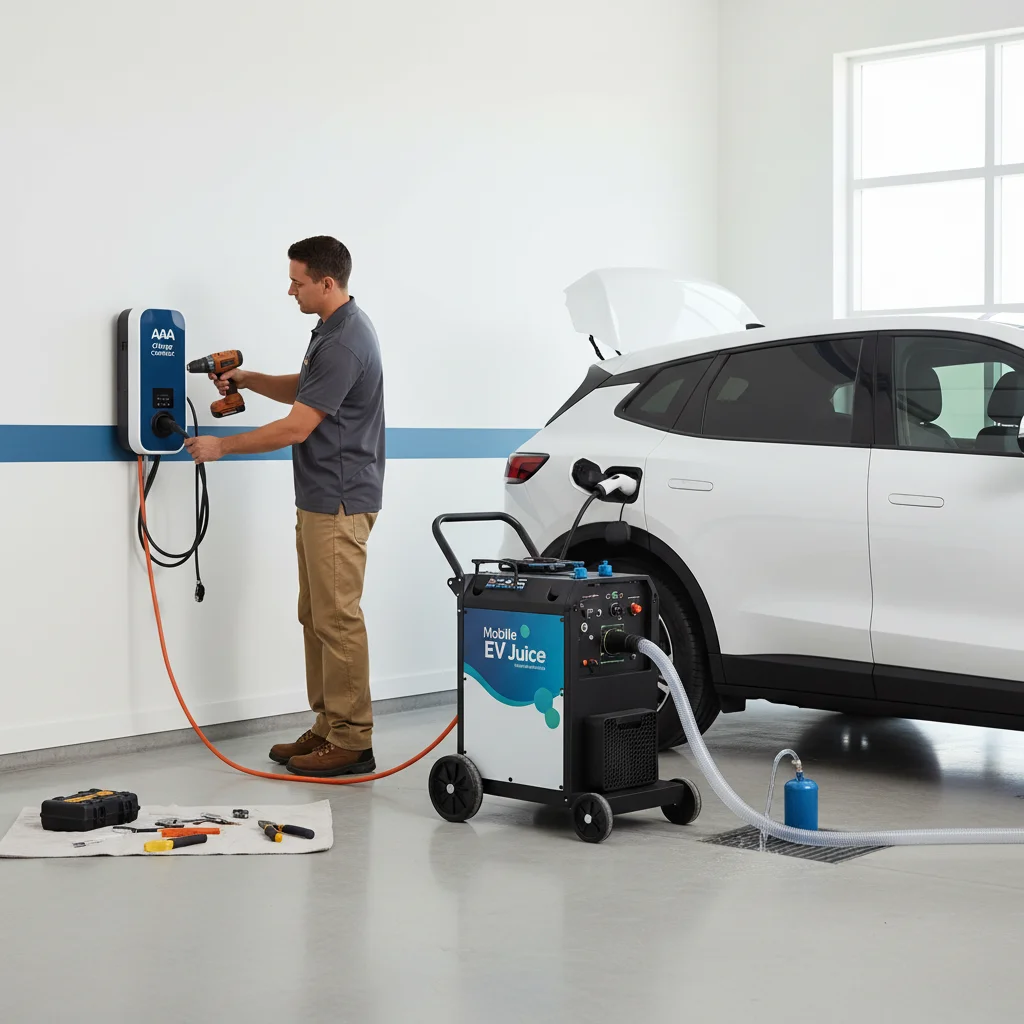
A mobile EV charge is a different call. Independent operators we connect you with bring 240-volt Level 2 to the car. Teslas take a native NACS plug, and other brands use a CCS or J1772 adapter. Typical charging time adds 10 to 20 miles in 15 to 30 minutes. That’s charging time, never an arrival time. The operator quotes you before work starts and bills you directly. Charge Pro DC matches the stranded driver with that operator. It doesn’t own the truck or set the price.
Use that visit when the car is fine and only needs power. Use a 12-volt jump when the accessory battery is the failure. Use Allstate for a flat, a lockout, or a shop tow. See Geico roadside for your EV and when AAA can’t charge your EV. Most EVs should ride a flatbed if they must move. Ask the Allstate dispatcher to confirm a flatbed.
Keep Allstate and add a charging backup
Don’t drop Allstate roadside because it skips on-site charging. Flats, lockouts, and shop tows are still real. Keep the Motor Club number in the glove box. Keep a separate plan for an empty pack. If you’re stopped in DC, Maryland, or Virginia, call Charge Pro DC at (202) 629-0844. An operator quotes the visit before any cable goes in.
Allstate questions from this metro
Does Allstate roadside assistance charge EVs on site?
No, standard Allstate roadside doesn’t include on-site charging. For an empty pack, the plan arranges a tow to a plug.
Who actually shows up when I call Allstate?
Allstate Motor Club dispatches a contracted provider, the same network used for gas cars. That truck isn’t a Charge Pro DC operator.
Will Allstate flatbed-tow my EV?
Ask the dispatcher to send a flatbed. Most EVs need the wheels off the pavement. Confirm it before the truck is assigned.