Uber’s in-app roadside partner in this metro runs through a third party. The published service list covers jump starts, towing, lockouts, flat tires, and fuel delivery. It is not built to add range to a fully depleted EV battery pack. Uber roadside in this metro does not send a 240 volt Level 2 source to a stranded EV. The pros we connect you with handle that exact situation.
What Uber’s roadside partner actually offers
Uber’s in-app roadside assistance routes through a partner provider, available to drivers through Uber Pro Rewards. Drivers who reach Gold, Platinum, or Diamond status get a set number of free services each year. Drivers outside those tiers can typically add coverage for a small monthly fee.
The services on offer are the standard roadside menu: towing, lockout assistance, fuel delivery, flat tire changes, and jump starts. That jump start service is the part drivers most often assume covers a dead EV. It is worth understanding what jump start usually means in that context before you count on it during a real shift.
Why a jump start doesn’t fix an empty EV pack
A jump start restores power to a car’s 12 volt system, the small battery that runs the computer, the locks, the lights, and the ignition electronics. In a gas car, that is usually the whole problem. Dead 12 volt, dead car. In an EV, the 12 volt and the main high-voltage pack that actually drives the motor are two separate systems. A jump can bring a dead 12 volt EV back to life in minutes. It does nothing for a main pack that has run down to zero.
If your EV coasted to a stop because you simply ran out of range, a standard roadside jump start won’t get you moving again. At that point, the typical path through a generic roadside provider is a tow, either to a charging station or to your home. Towing is the tool most roadside networks are actually equipped to offer.
That is a slower and more disruptive fix for a problem a mobile charging call solves by adding range on the spot instead of hauling the car somewhere else to get it.
What Uber’s option still handles well
There are situations where the in-app option through the partner is genuinely the right call. A flat tire, a lockout, or a true 12 volt-only failure with no range issue are all things that service handles fine. If you already have free access through your Uber Pro tier, there is no reason not to use it for those specific problems. The gap only shows up when the real issue is an empty battery pack, which is a range problem, not a jump-start problem.
When mobile charging is the faster answer
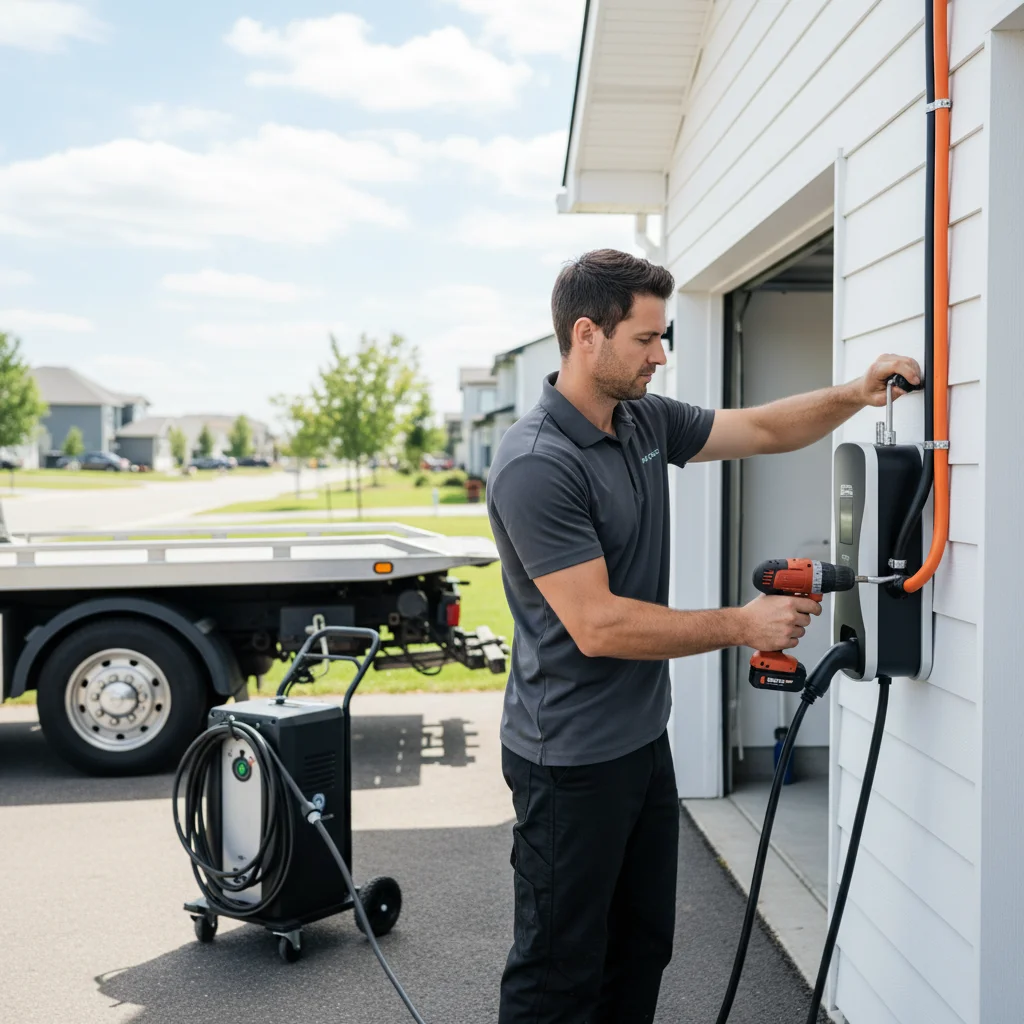
If your EV has an empty main pack and is otherwise mechanically fine, no collision, no warning lights, no fault codes, a mobile charging call almost always beats a tow on both time and hassle. The pros we connect you with bring a 240-volt Level 2 source to the car. They typically add 10 to 20 miles of range in 15 to 30 minutes of charging. That is charging time, never an arrival time. The operator quotes you before starting and bills you directly.
The pros we connect you with handle Tesla and every major EV brand. They bring a native NACS plug, plus CCS or J1772 adapters for non-NACS cars. A 12 volt jump or replacement is also part of that same visit. The operator prices both and quotes you before starting.
Charge Pro DC is a referral line for the District, Maryland, and Virginia. We match stranded drivers with independent local operators. We don’t own trucks, employ technicians, set prices, or hold a trade license. We don’t promise an arrival time.
Where this matters in this metro
A stall on the Capital Beltway sits in three jurisdictions at once when it lands on the Woodrow Wilson Bridge. The span carries I-495 between Alexandria, Oxon Hill, and the District. The American Legion Bridge is the same pinch between McLean and Montgomery County. Tell whoever you call which end you’re on, and which direction.
I-66 inside the Beltway crawls in peak hours, and so does the Dulles Toll Road. A typical EV keeps about 80 percent of range at freezing. It keeps about 70 percent at 20F. Sitting in a Beltway crawl with heat on spends charge without covering miles.
The 495, 95, and 395 Express Lanes sit inside the general lanes. On the 495 Express Lanes, pull to the left shoulder because those lanes run in the median. On the 95 and 395 Express Lanes, pull to the nearest shoulder. Transurban’s Express Assist runs on those lanes for minor mechanical issues and will call a tow. It doesn’t tow and doesn’t charge an EV.
NPS parkways wrap this metro. The Baltimore-Washington Parkway and the George Washington Memorial Parkway are limited-access scenic roads with narrow or absent shoulders. They ban commercial vehicles and trucks over 10,000 lb. A disabled vehicle on the Baltimore-Washington Parkway is reported to U.S. Park Police at 202-610-7500.
A rideshare driver running low between Dulles and Bethesda, or between Reagan National and Tysons, is a 240 volt problem the partner’s published service list does not cover. The pros we connect you with are built for that.
How a quoted local operator confirms before any work
Have model, pin, charge display, and warning text ready. Tell the operator which side of the bridge you’re on, the nearest cross street, and the garage level if you’re underground. On the Beltway, name the direction and the nearest exit. On the 495 Express Lanes, confirm which shoulder you’re on. The operator confirms whether the work fits the truck and the spot before quoting.
Confirm the quote covers the work you accepted. If a tow is on the table, confirm the destination before the truck rolls. The pros we connect you with operate across the District, Maryland, and Virginia. They handle Tesla and every major EV brand.
For more on the matching flow, see our how to find mobile EV charging near you in DC, Maryland, and Virginia guide and our mobile EV charging versus tow comparison.
When to call Charge Pro DC
Call us when the partner’s published service list doesn’t cover what your EV actually needs, when the dispatch ETA has stretched past what the shoulder allows, or when 240 volts is the immediate need. Have model, pin, charge display, and warning text ready. Call (202) 629-0844 and we’ll connect you with a local EV rescue operator.