Phone or app, which one starts Tesla help in this metro depends on three things: the state you’re calling from, the state of your 12-volt, and the data signal at your shoulder. DC is one-party consent. Maryland is all-party consent and a violation is a felony. Virginia is one-party consent. Every call you make on this metro line touches one of those rules, so the pros we connect you with play a recording-consent notice before any operator call connects on a Maryland number.
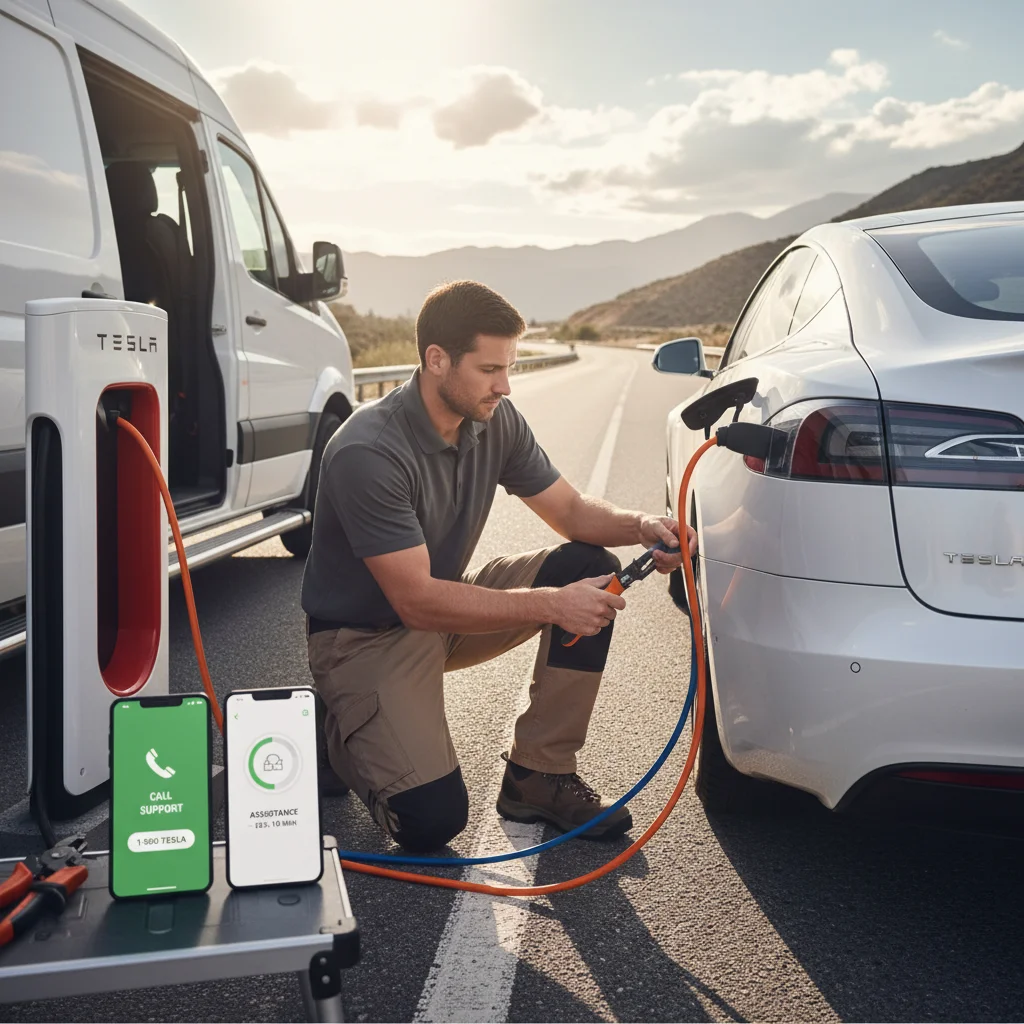
The app wins in most stalls
The in-app request path is the cleanest. It logs a timestamped ticket, attaches your location pin, and pulls your diagnostic data. The responder sees whether the car is out of charge, locked out, or has a dead 12-volt before they roll. Voice calls can do the same triage with an agent, but the agent has to type what you say, which adds a step.
The app has two weak spots. First, it needs a sustained data connection to submit. A parking garage in Bethesda or Tysons can have data go dead even when voice still works. Second, a dead 12-volt blocks the car from communicating with the app at all, which means the app cannot push a request. That is when a voice call wins.
When the phone wins
Three real scenarios where voice beats the in-app request.
First, spotty signal. A voice call goes through on one bar where data won’t load. The Bethesda Row garage is a known weak spot. The Westfield Wheaton decks and the Silver Spring Metro garage have the same pattern. The Reagan National garages run hot on signal during peak arrival times. Dial first in any of those.
Second, a dead 12-volt. The app needs the car to be awake. A car that sat all weekend at the Union Station garage often comes back to a 12-volt too low to wake the screens. The doors don’t unlock from the fob, the frunk won’t release, and the app shows the car offline. A voice call to Tesla’s published support line, plus a local operator who can physically access the jump posts, is the path.
Third, an unusual situation. The in-app menu is built for common problems: out of charge, won’t start, flat tire, locked out. If your situation doesn’t fit a category, a stuck connector with a stuck charge port, a trailer hitch blocking the port, an unfamiliar warning text, a live agent can triage better than a dropdown. Have the model, the VIN, the warning text, and the location ready.
The recording-consent rule on every Maryland call
DC is one-party consent under DC Code § 23-542. Virginia is one-party consent under Va. Code § 19.2-62. Maryland is all-party consent under Md. Courts and Judicial Proceedings § 10-402, and a violation is a felony punishable by up to five years. That is why every operator call we route on a Maryland number plays a consent notice at the start. The pros we connect you with operate across the District, Maryland, and Virginia, so the notice is automatic on a Maryland line.
The rule also explains why some Tesla voice agents transfer you to a different line if your number area code is Maryland. Tesla’s recording policies must match the local rule. Our referral line plays the same notice on Maryland numbers so the operator and the driver both know the call is recorded.
Where the app request lands you on this metro
The Beltway is a stationary range problem in morning rush. The Bethesda to Silver Spring stretch sees most stalls. I-66 inside the Beltway crawls in peak hours. I-270 between Rockville and Gaithersburg sits still most weekday mornings. None of those is a hill problem. It is heat or AC on, wheels stopped, pack dropping.
The 495, 95, and 395 Express Lanes sit inside the general lanes. On the 495 Express Lanes, pull to the left shoulder because those lanes run in the median. On the 95 and 395 Express Lanes, pull to the nearest shoulder. Transurban’s Express Assist runs on those lanes for minor mechanical issues and will call a tow. It doesn’t tow and doesn’t charge an EV.
NPS parkways wrap this metro. The Baltimore-Washington Parkway and the George Washington Memorial Parkway are limited-access scenic roads with narrow or absent shoulders. They ban commercial vehicles and trucks over 10,000 lb. A disabled vehicle on the Baltimore-Washington Parkway is reported to U.S. Park Police at 202-610-7500. The app request still works there if your data signal holds, but the dispatch ETA stretches.
When neither has been confirmed in 30 minutes
Thirty minutes without a confirmed ETA is the threshold where you stop waiting and start acting. Check the app for a case number and call Tesla’s published number with it. Ask for the dispatched provider’s name and an updated ETA. If no provider has been assigned, ask for escalation.
If you need a 240-volt Level 2 source at the car, the pros we connect you with are the parallel path. We match stranded drivers with independent local operators. The operator brings a 240-volt Level 2 source to the car and typically adds 10 to 20 miles of range in 15 to 30 minutes of charging. That is charging time, never an arrival time. A 12-volt jump or replacement is part of that same visit.
Charge Pro DC is a referral line for the District, Maryland, and Virginia. We don’t own trucks, employ technicians, set prices, or hold a trade license. The operator quotes you before starting and bills you directly. For more on the matching flow, see our how to find mobile EV charging near you in DC, Maryland, and Virginia guide.
What a quoted local operator confirms before any work
Have model, pin, charge display, and warning text ready. Tell the operator which side of the bridge you’re on, the nearest cross street, and the garage level if you’re underground. On the Beltway, name the direction and the nearest exit. On the 495 Express Lanes, confirm which shoulder you’re on. The operator confirms whether the work fits the truck and the spot before quoting.
Confirm the quote covers the work you accepted. If a tow is on the table, confirm the destination before the truck rolls. The operator brings a native NACS plug, plus CCS or J1772 adapters for non-Tesla cars. They handle Tesla and every major EV brand.
For the app-versus-phone dispatch flow on the manufacturer side, see our Tesla roadside policy in 2026 for DC-area drivers note.
When to call Charge Pro DC
Call us when Tesla cannot send 240 volts, when the dispatch ETA has stretched past what the shoulder allows, or when a 12-volt jump or replacement is the immediate need. Have model, pin, charge display, and warning text ready. Call (202) 629-0844 and we’ll connect you with a local EV rescue operator.