Tesla roadside assistance is built into every new Tesla for the first four years or 50,000 miles, whichever comes first. The included coverage differs by situation more than by model, but a few differences show up by vehicle. A DC area driver with a Model 3, Model Y, Model S, or Model X gets a battery jump, a lockout, a tow, and a flat tire service in warranty. The gap that matters for our area is the same across all four models: Tesla will not bring a 240 volt Level 2 charger to your shoulder. A local independent operator will.
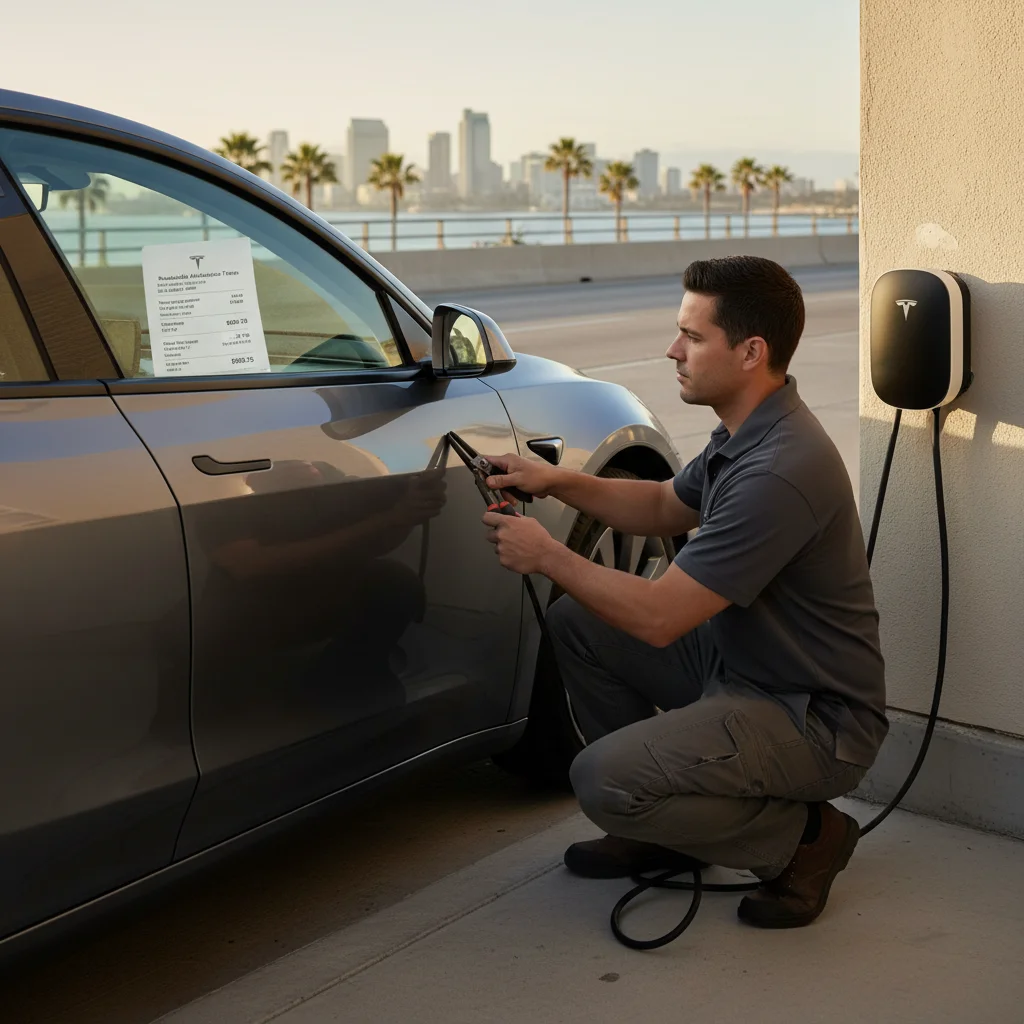
What Tesla includes in warranty across every model
During the New Vehicle Limited Warranty window, Tesla roadside covers the situations that come up most often for any of the four models.
- A 12 volt jump. Tesla dispatches a technician with a low-amp jump pack. Free in warranty.
- A lockout. Often handled remotely through the Tesla app unlock. If remote unlock fails, a technician is dispatched.
- A tow. To the nearest Tesla Service Center, Supercharger, or wherever you direct within policy limits. Free up to a mileage cap.
- A flat tire service. Either a mobile tire repair or a loaner wheel install, depending on the case.
- Winching. If you are stuck in mud, sand, or off a road, and a tow truck can reach you.
The dispatch is run through the Tesla app. Response time varies by traffic, weather, and which contracted provider is on call. In the DC area, urban and Inner Fairfax calls often see faster turnaround than a breakdown on a snowy I-66 or a Beltway shoulder at rush hour.
Where the differences show up by model
The dispatch and per-mile tow math is the same across the four models. The parts and labor that show up in any out-of-pocket repair are not.
Model 3 and Model Y
These share the newer platform and the newer 12 volt hardware. The 12 volt lives in the frunk under a removable panel. Failures on this platform usually trace to a long parking stay that drains the 12 volt. Parts are cheaper than on the S or X.
Model S
The Model S has the longest production run and the most years in the field. The classic Model S through 2020 used a lead-acid AGM 12 volt that sits under the frunk floor liner. The refresh from 2021 onward uses a lithium low-voltage battery in a different spot. A Model S that strands is more likely to need a manual frunk access step before any 12 volt work. Our Model S 12 volt guide covers the year-by-year breakdown.
Model X
The Model X adds the falcon-wing doors, which draw on the 12 volt even when the car is parked. A Model X that sits through a long Dulles or Reagan National trip often comes back to a 12 volt that has been working harder than on the other models. The 12 volt access is in the frunk, but the manual release is different. Our Model X 12 volt guide covers the access steps.
What Tesla still does not cover well across every model
These gaps show up regardless of whether you drive a 3, Y, S, or X.
On-site charging
Tesla roadside will not send a truck to charge your car on the shoulder. Their answer to an empty traction pack is a flatbed tow to a Supercharger. If you stall on the Beltway at rush hour and the nearest Supercharger is across Prince William, that is a long ride on a flatbed with the meter running.
Out-of-warranty coverage
The moment the New Vehicle Limited Warranty ends, the included roadside ends. You are paying retail for every service. The exact rates depend on the dispatched contractor.
Third-party dispatch variability
Tesla contracts roadside to partners. The truck that actually rolls to your car might be Tesla’s in-house team or a contracted local provider with varying EV training. When a contractor arrives with a standard tow rig and finds a Tesla with flush wheel covers they cannot remove, you wait.
Weekend and weather load
A rainy Sunday or a holiday weekend stretches response times. This is a tow industry reality, not a Tesla problem, but it hits harder in our area because the contractor pool is smaller than AAA’s.
A DC-area scenario: Model Y on the Beltway
You drive a Model Y and stall on the Capital Beltway in Maryland or Virginia. Here is what happens with each path.
Tesla app in warranty
You open the app, request roadside, and a contractor is dispatched. The wait depends on contractor availability and your position on the Beltway. If the failure is a 12 volt, a jump gets you moving under your own power. If the failure is an empty traction pack, the contractor will tow you to the nearest Supercharger. The nearest one depends on the direction, but the Beltway can put you 20 miles from the next fast charger. That is a long ride on a flatbed.
Local operator through our line
You call us. We match you with a local operator who covers that Beltway stretch. The operator brings a 240 volt Level 2 source and a low-amp jump pack. Fifteen to thirty minutes of charge adds 10 to 20 miles. That’s charging time, not an arrival promise. It is enough to drive off the Beltway shoulder and reach a working charger or your own driveway. The operator quotes you before starting and bills you directly.
The two options are not in conflict. You can call Tesla and call us at the same time. Whoever arrives first, you cancel the other. Neither side charges a cancellation fee for a legitimate change of plan.
The cost picture across models
For out-of-warranty or non-covered service, the dispatched fees vary by year and by service type. Rather than guess at the exact number for each model here, we keep the current breakdown on our Tesla roadside cost in the DC area guide. The numbers shift, and the latest version is the one to read.
What does not shift is the basic shape. A 12 volt jump out of warranty is more than the in-warranty zero. A flat tire out of warranty is more than the in-warranty loaner wheel. A tow out of warranty bills per mile. And a mobile charge is not on Tesla’s menu, which is why an out-of-warranty Beltway stall usually means either a flatbed tow or a call to a local operator like the ones we connect you with.
When to call Charge Pro DC
When the traction pack is empty and you’d rather not wait for a flatbed to a Supercharger, call us. We match you with an independent operator who covers your part of DC, Maryland, or Virginia. The operator carries a 240 volt Level 2 source and a low-amp jump pack on the truck. They quote you before starting and bill you directly. Our mobile EV charging service describes what shows up on the truck.
Stranded with a Model 3, Y, S, or X in DC, Maryland, or Virginia, call (202) 629-0844. We match you with a local operator who knows your jurisdiction and quotes you before starting.