A driver searching “Rivian Highway Assist” usually means one of two things. One is a feature that helps the vehicle stay in its lane and pace traffic on the highway. The other is what to call when the Rivian can no longer continue under its own power. Same words, two different problems.
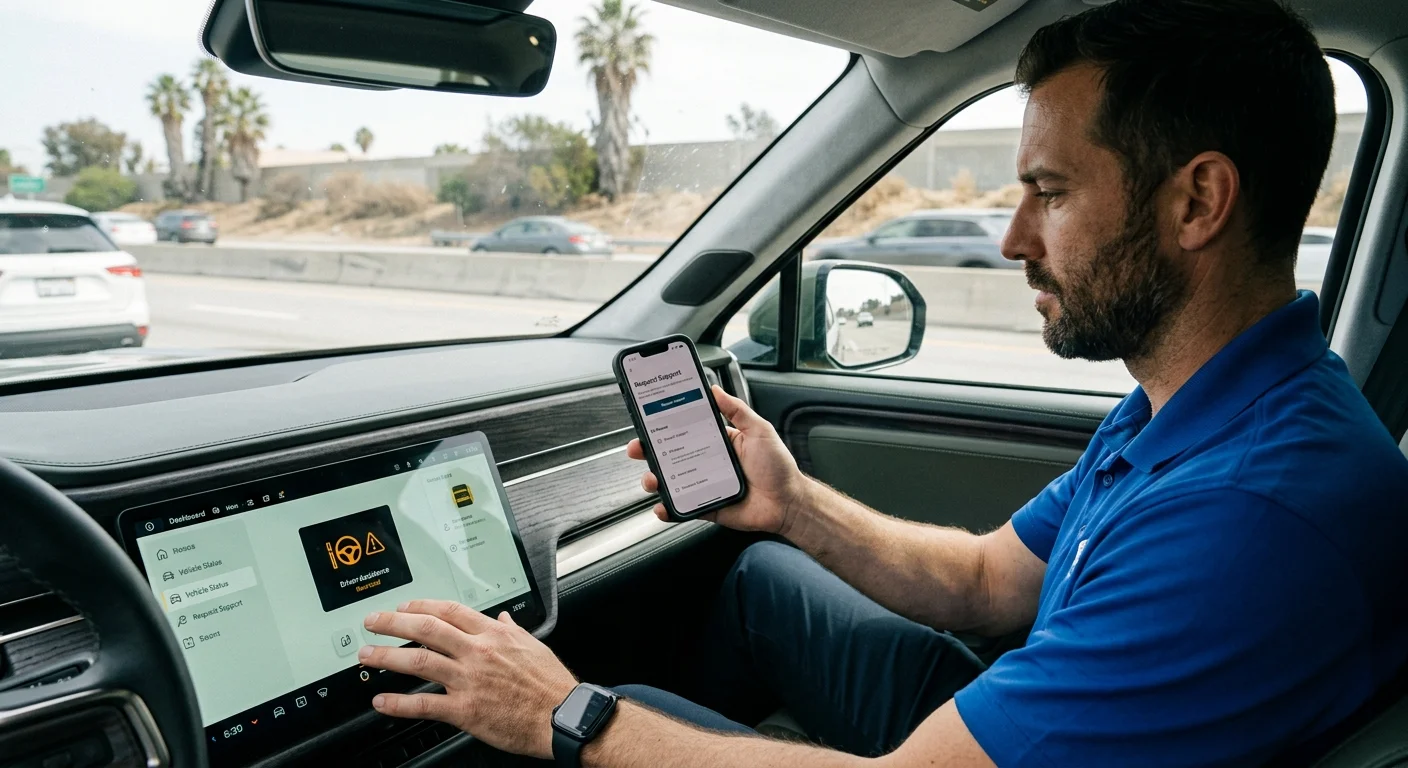
What Rivian Highway Assist actually does
Highway Assist is a Rivian driving feature. It combines adaptive cruise control with lane centering to reduce the work of long highway runs. The feature operates only when conditions allow, and the on-screen prompts tell you when it is ready, when it is hands-on, and when it asks you to take over.
Highway Assist is for the moment you are driving. It is not a roadside program. It does not bring a truck, a charge cable, a 12 volt jump pack, or a flatbed. If the Rivian cannot continue because the traction pack is empty, the 12 volt has died, or a fault has shut the truck down, Highway Assist is no longer the relevant term.
This split matters around Northern Virginia. A driver asking about Highway Assist while moving on I-66 eastbound toward the Beltway is asking a feature question. A driver stopped on the I-66 shoulder near Centreville or Manassas with a Rivian that will not wake is asking a different question. Same phrase. Different call.
For general EV background, the US Department of Energy’s electric vehicle page is a fair starting point. Rivian’s own current materials remain the right source for anything specific to your truck.
When the real question is a roadside stop
Once the truck has stopped or will not start, the question stops being about Highway Assist. The Rivian needs outside help, and the kind of help depends on what stopped it.
Empty traction pack
A Rivian that ran the traction battery down needs energy delivered to the charge port. A mobile EV charging operator brings a 240 volt Level 2 source to the truck and adds 10 to 20 miles of range in 15 to 30 minutes. That is charging time, not an arrival promise, and it is enough to get off a shoulder or out of a garage. Our mobile EV charging service connects you with a local operator who can confirm connector compatibility on scene.
A Rivian with a native NACS plug works with the operator’s standard cable. An R1T or R1S owner in Sterling or Ashburn can reach our Sterling and Ashburn coverage pages for local dispatch.
Dead 12 volt
A Rivian that will not wake but has plenty of range showing usually points to the 12 volt low-voltage battery. Screens are dark, the app cannot reach the truck, handles will not present. That is a Tesla-style 12 volt jump pattern, and operators handle it on site. A jump gets most Rivians moving again. A 12 volt battery that will not hold a charge gets replaced in the stall.
This pattern shows up in long-dwell lots. Dulles Economy Lot is one. The Metro garages in Bethesda, Silver Spring, and Arlington are others. A week in any of those lots can quietly drain a 12 volt while the traction pack still reads full.
Damage, fault code, or unknown fault
A collision, a flood, or a persistent fault code is not a mobile charge case and not a 12 volt case. Operators are not a substitute for a service center. The right move is a written estimate from Rivian and a transport plan. Confirm with the matched operator what their equipment covers before authorizing anything.
Where Highway Assist drivers stop in this metro
The I-66 corridor in Northern Virginia is the long daily run for many drivers. Weekday peak windows bring a shoulder-risking crawl that burns range without covering miles. The I-270 climb north of Rockville and the I-95 spine through Prince William add their own stationary spells.
The Capital Beltway (I-495) and the 495, 95, and 395 Express Lanes carry the rest. On the 495 Express Lanes, the lanes sit in the median, so a stopped EV pulls to the left shoulder. On the 95 and 395 Express Lanes, drivers take the nearest shoulder and stay in the car until help arrives. Transurban runs Express Assist on those lanes as a free patrol for minor mechanical issues, and the patrol will call a tow, but the published FAQs do not mention pack charging.
Garages stack up too. Bethesda Row, Pike & Rose, the Ballston Quarter, and the Springfield Town Center lots see the same long-dwell 12 volt pattern. National Airport and Dulles hold cars for a week at a time when drivers travel. Reagan National charges on Level 1 of Parking Garages 1 and 2, first-come, first-served, and the Dulles garages publish Level 2 in Garage 1 and Garage 2. Neither fixes a dead 12 volt after a long stay.
How Charge Pro DC connects drivers with operators
Charge Pro DC is a referral service. We connect drivers with licensed, independent local EV charging professionals who handle Rivians and other major EV brands. We do not perform the work, set the operator’s price, or promise an arrival window.
When you call, share what you can see:
- The Rivian model and trim
- The exact screen or dashboard message
- Whether the truck responds at all
- Whether it will accept a charge if you plug in
- Your location, travel direction, and the nearest exit or landmark
- Whether Rivian’s official support has already given instructions
The operator who takes the call confirms connector compatibility, scope, and price before work starts. They handle Rivian R1T, R1S, and other major EVs. If your situation calls for Rivian service center work instead, the operator tells you that before anything begins.
For a stranded Rivian anywhere in the District, Maryland, or Virginia, our Tesla roadside rescue and non-Tesla EV rescue pages cover the dispatch step. Local drivers near Manassas and Manassas Park have operator coverage pages listed at the Manassas Park EV roadside assistance guide.
When to call us
Call when your Rivian cannot reach charging, will not become ready, or may need transport. Save the exact display message and your location before you call. Charge Pro DC covers the District, Maryland, and Virginia. We connect you with independent operators. For a quote before work starts, call (202) 629-0844.
Frequently asked questions
Does Rivian Highway Assist charge my truck if it runs out of charge?
No. Highway Assist is a driving feature that combines adaptive cruise control and lane centering. It does not deliver energy to the traction pack or jump a 12 volt battery. A Rivian that runs out of charge on I-66 or the Beltway needs a mobile EV charging operator, not Highway Assist. The operator brings 240 volt Level 2 to the truck and adds 10 to 20 miles of range in 15 to 30 minutes of charging time.
Where can Highway Assist be used in this metro?
Highway Assist operates on roads Rivian designates as compatible. The exact list lives in your truck’s current software and in Rivian’s current owner materials. I-66, I-95, I-270, the Capital Beltway, and the Dulles Toll Road all see Rivian traffic daily, but whether Highway Assist is available on a specific segment at a specific moment is a Rivian decision, not a coverage map.
What should I tell the operator about a stranded Rivian on I-66?
Share the model and trim, the exact dashboard or screen message, whether the truck responds at all, whether it accepts a charge when plugged in, and your exact position. Include the travel direction and the nearest exit or landmark. Stay in the truck or set hazards and wait clear of traffic if you have to step out. On the 495 Express Lanes, the left shoulder is the safe spot because the lanes sit in the median.
What if Rivian’s official support is what I should call instead?
If the Rivian shows a fault code beyond a dead battery, has visible collision damage, sits in standing water from a storm, or will not accept a charge, the right move is Rivian service. Mobile operators are not a substitute for a service center in those cases. Confirm with the matched operator what their equipment covers before authorizing any work.