A renter leaves a shared lot off Euclid Avenue after work. The EV won’t wake, and there’s no home plug. Many households here speak Spanish, and that parking pattern is common. You need ev roadside assistance in Manassas Park from a local operator. Charge Pro DC connects you with that independent pro. It’s a referral line. It doesn’t own trucks or send staff techs. The independent pro quotes you before any cable goes on.
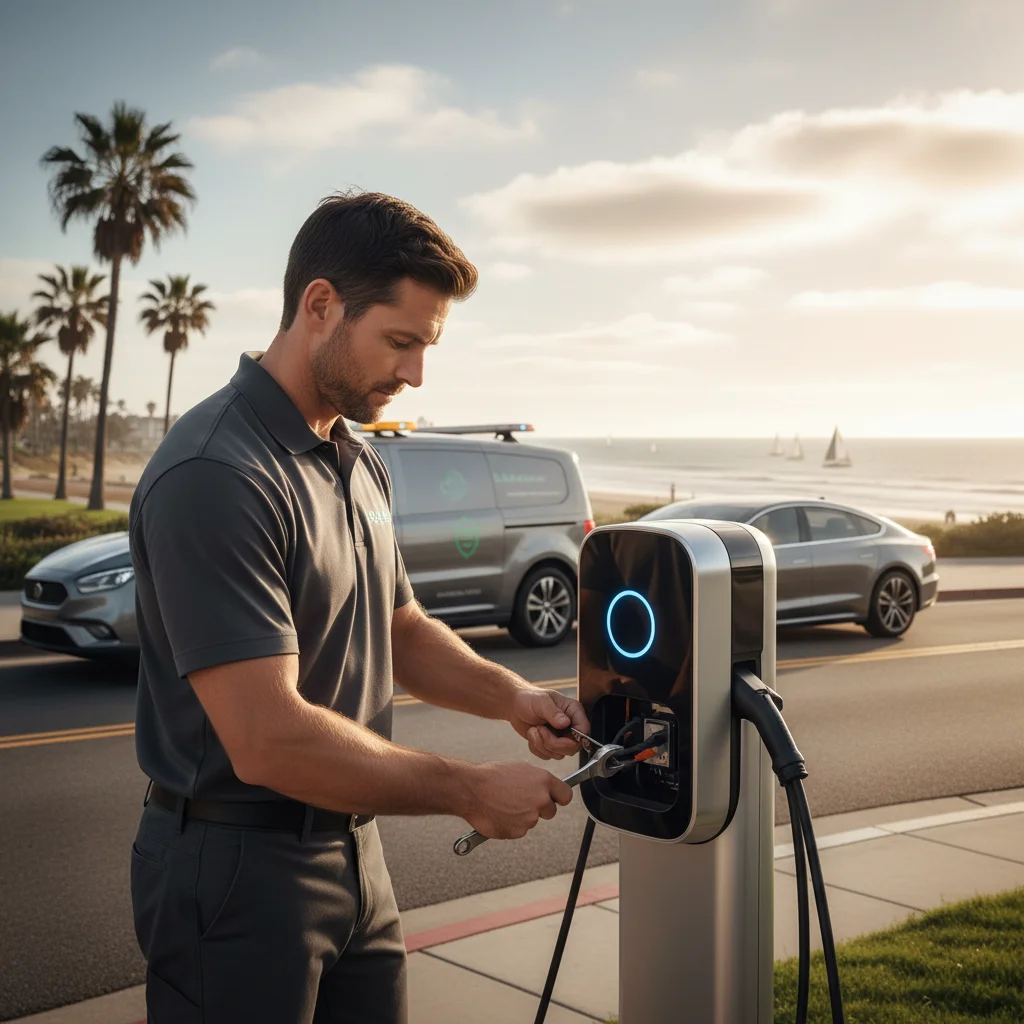
Manassas Park isn’t a neighborhood of Manassas
Manassas Park is its own independent city in Virginia. It isn’t part of Prince William County. It also isn’t a district of the City of Manassas next door. The land area is about 3.03 square miles. Census ACS 2019-2023 puts the population at 16,923. About 45.9% of residents are Hispanic or Latino. Only a handful of DC-area places post a higher share. Spanish is everyday speech in many homes here. If you’re calling for family, stay on the line with the pin. The operator still needs Manassas Park, not a vague Manassas drop.
About 28.4% of housing was built before 1980. That isn’t the oldest stock in the region. The live pattern is still a dense renter core. People park at apartments and shared lots. Most residents here lean on public charging. A garage outlet isn’t the default. You might leave the car at the Manassas Park VRE station all day. You might park overnight with no driveway charger at all. Either way, the pack works harder than it would on a home plug. The 12-volt does too.
Signal Hill Park and the city center keep many trips short. The long drain is the commute east. VA-28, signed as Centreville Road, feeds that drive. I-66 sits just beyond it. Drivers head toward Centreville, Gainesville, and Manassas, then toward the core. Slow ramps with the heat on spend miles you meant to keep.
The VRE lot often kills the 12-volt first
The Manassas Park VRE station organizes the day here. Long-dwell parking is the point of that lot. You lock up before dawn. You ride in. You return after dark. In that sit, the small 12-volt battery is often the part that fails.
Every modern EV still carries that 12-volt. Tesla does. Rivian does. Hyundai, Kia, Ford, Chevy, BMW, and others do too. It runs locks, computers, and the charge-port latch. When it dies, the traction pack can still hold energy. The car just won’t wake. The screen stays dark. The handle may not pop. Drivers assume they hit zero. Plenty of times they didn’t.
A local operator can test that on site. The pros we connect you with jump a 12-volt with EV-safe steps. They don’t treat it like a gas-car jump on a random battery. Access points differ by brand. So does the sequence. Tell them what you see. A silent cabin after a recent charge points at the 12-volt. A dash that still shows 1% points at the pack.
If the pack is empty, mobile EV charging is the other visit. The operator brings a 240-volt Level 2 source to the car. Teslas take a native NACS plug. Other EVs use a CCS or J1772 adapter. A typical stop adds 10 to 20 miles of range. Charging itself usually takes 15 to 30 minutes. That window is charge time only. It isn’t an arrival time. The operator bills you directly. Charge Pro DC doesn’t set that price.
VA-28, Manassas Drive, Euclid Avenue, and I-66
Manassas Drive is the in-town spine. It ties homes to the city center and the VRE station. Low-speed crawling still draws from the pack. Cabin heat in January does the same. Summer AC on a humid afternoon does too. The city is small and dense. You can burn range without covering many miles.
Euclid Avenue is the other everyday cut-through. Shared lots sit along routes like this. If the car dies on private pavement, stay with it when that’s safer. Disabled-vehicle rules in Virginia don’t single out EVs. The same stop-and-stand rules apply as they would to any car. Reviewed codes in DC, Maryland, and Virginia don’t add an out-of-charge rule. An empty EV is still a disabled vehicle.
VA-28 is the commute. Centreville Road is the name on the signs. Eastbound traffic toward I-66 is where a thin buffer gets thinner. You left after a public charge. Then the ramp stacked up. Heat stayed on. Percent fell faster than the map implied. If you can still reach a safe pull-off, use it. Don’t aim at a station this page can’t verify. A charging inventory wasn’t confirmed in the sources for this city. So this article won’t name a plaza or guess a distance. If you already know a working site, use it while you can still roll.
I-66 is close enough to shape the whole day. VDOT Safety Service Patrol covers the I-66 corridor in Northern Virginia. Drivers reach that help through Virginia 511. Published VDOT material talks about incidents, debris, and short-term traffic control. It doesn’t describe EV charging. A patrol can make a shoulder safer. It won’t refill the pack. Once you’re already empty on that freeway, follow stranded EV on I-66.
If you’re in a live lane, hazards on. Stay in the car if that’s the safer call. Don’t stand in traffic to watch a percent. The operator still needs a lane, an exit, or a lot pin. Give the nearest mile marker or cross street you can see.
Manassas, Gainesville, and Centreville sit next door. A pin on the city line is still in the DC-area map. The Manassas roadside guide covers that longer commute. This page stays inside the independent city.
Cold mornings and a public-charge habit
Manassas Park sits on the western exurban edge. Summers are humid. Winters run cold and snowy. Out here, the western suburbs take more snow and harder freezes. Dulles runs colder and snowier than Reagan National.
Cabin heat comes from the traction pack. A Recurrent Auto study of more than 30,000 EVs found the usual hit. At freezing, a typical EV keeps about 80% of range. At 20F it keeps about 70%. Most drivers lose 20 to 35% in real cold. Heat-pump cars averaged about 83% retained. Cars without a heat pump averaged about 75%. Those aren’t Tesla-only figures. They’re fleet study numbers from Recurrent Auto.
If you already charge in public, that cut leaves little slack. You planned a VRE day plus a stop at the city center. Overnight cold took a slice. Morning traffic on VA-28 took another. Sitting still with the heat on is the quiet drain. Miles don’t add up. Percent still falls.
AC on a short Euclid Avenue loop can surprise you. The city is only about three square miles. Range math still fails without an overnight home charge.
What the operator brings, and who bills you
Charge Pro DC doesn’t hold a trade license for this work. It owns no trucks. It employs no technicians. It sets no prices. It publishes no hours. Independent local operators do the visit. They quote you first. They bill you directly. The pros we connect you with are licensed and insured.
Here’s the shape of a mobile EV charging rescue stop.
You call and give a pin. Say Manassas Park, not only Manassas, so the map is right. Name the VRE lot, Signal Hill Park, or a Manassas Drive block. A VA-28 ramp works as a pin too. Say whether the car is silent or showing a percent. Say Tesla or another brand.
The operator confirms the job and the quote before connecting. If it’s a 12-volt death, they may jump it on site. They may replace that battery on site too. If the pack is empty, they plug in Level 2. Ten to 20 miles is usually enough to reach home. Then you drive. That path doesn’t require a flatbed.
A tow is a different trade. Virginia private-property towing sits in Va. Code § 46.2-1231, § 46.2-1233, and § 46.2-1233.1. Localities may set fee limits by ordinance. This page won’t publish a dollar figure. The person in front of you quotes the work. If a lot already called a wrecker, ask who has the keys. Don’t add a second visit until that’s clear.
Dominion Energy serves many Northern Virginia addresses. NOVEC serves parts of Prince William. Confirm the serving utility on your bill. The City of Manassas runs a municipal electric utility. That’s the neighboring independent city, not this one. Don’t assume a Manassas Park meter matches a Manassas city account. Named Dominion programs include Schedule 1EV, the Off-Peak Plan, and EV Charger Rewards. None of the utility EV pages reviewed offer to charge a stranded car. Dominion and NOVEC won’t roll to the VRE lot for that. A mobile operator will.
Tesla roadside, AAA, and insurer plans are separate calls. Mobile Level 2 to the bumper is often outside those menus. For city-level routing, use the Manassas Park charging page.
Call while you can still pick the lot
If the dash is already low, stop adding errands. Park where an operator can reach you. A city-center lot beats a thin shoulder. The VRE lot beats the fast side of VA-28. You don’t need to hit zero to justify the call.
Keep hazards on if you’re roadside. Stay with the car when that’s safer. If Spanish is easier at the scene, keep that speaker on the phone. They should be the person who knows the pin. Place names here stay in English. Manassas Park, Euclid Avenue, and VA-28 don’t get rewritten on a dispatch pin.
Can Charge Pro DC connect an operator in Manassas Park?
Yes. Manassas Park is in the Virginia service area. That includes the VRE station and the city center. It also includes Signal Hill Park, Manassas Drive, Euclid Avenue, and nearby VA-28. Charge Pro DC doesn’t drive the truck. It matches you with an independent local operator. That pro quotes you before starting.
Why did the car die overnight with no home plug?
Many households here park without a driveway charger. About 45.9% of residents are Hispanic or Latino. A dense renter core leans on public charging. A long VRE sit can also kill the 12-volt. The pack may still hold energy. Tell the operator whether the dash lights at all.
Should I wait until the pack reads zero?
No. If you can still roll to a safe lot, do that first. Then call. Waiting until the car is silent on VA-28 only makes the scene harder. Charge time on site is still 15 to 30 minutes once they’re hooked up.
If the car is already still, call (202) 629-0844. Stay with the vehicle if you can. Ask the operator to quote before any cable goes on.