Tesla roadside dispatches a contracted tow provider in most cases. The pros we connect you with are independent local operators who quote you before starting. That is the local fork in this metro. Tesla sends a contractor. Charge Pro DC matches you with an independent operator who brings a 240 volt Level 2 source to the car.
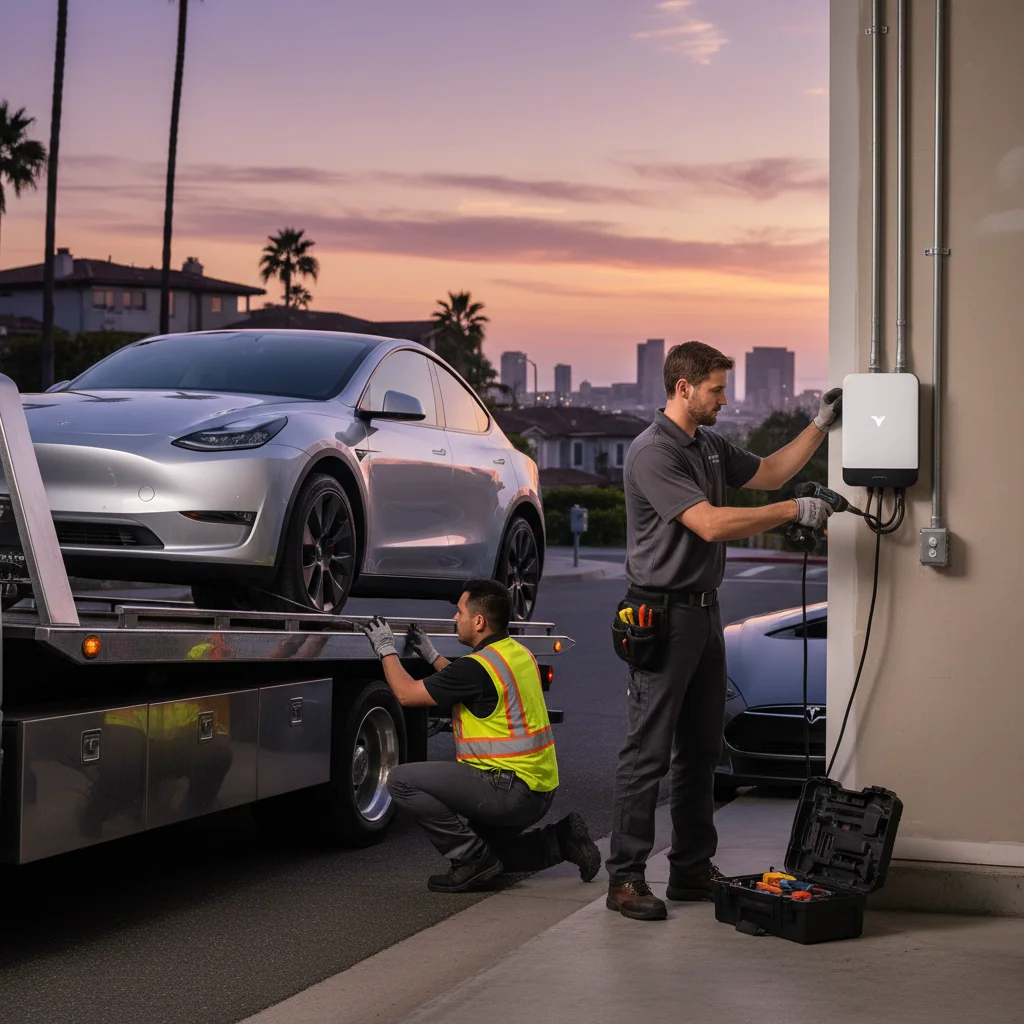
What Tesla’s dispatch is actually doing
Tesla’s roadside is the same program in every state, but the truck that rolls is local. The app or the voice agent assigns a contracted provider, and the first provider to accept the job gets routed to your location. The dispatch logic prioritizes proximity and speed. It does not ask which nearby driver has the most experience with a Model Y with a dead 12-volt. It asks who can get there the fastest.
That model covers a wide metro without Tesla operating a large branded tow fleet. It also means the person who shows up might have handled five Teslas this year or none. For most contractors in this region, EVs are a small share of daily calls. Driver turnover in the towing industry runs high, so any training Tesla provides might not reach the specific responder on your job.
The contractor is paid per job. That creates a real incentive to complete the work quickly and move on. A careful, deliberate approach to a disabled EV is sometimes at odds with that pace. The gap between the car’s needs and the responder’s training is where small problems become expensive ones.
Why a flatbed matters more than ever for EVs
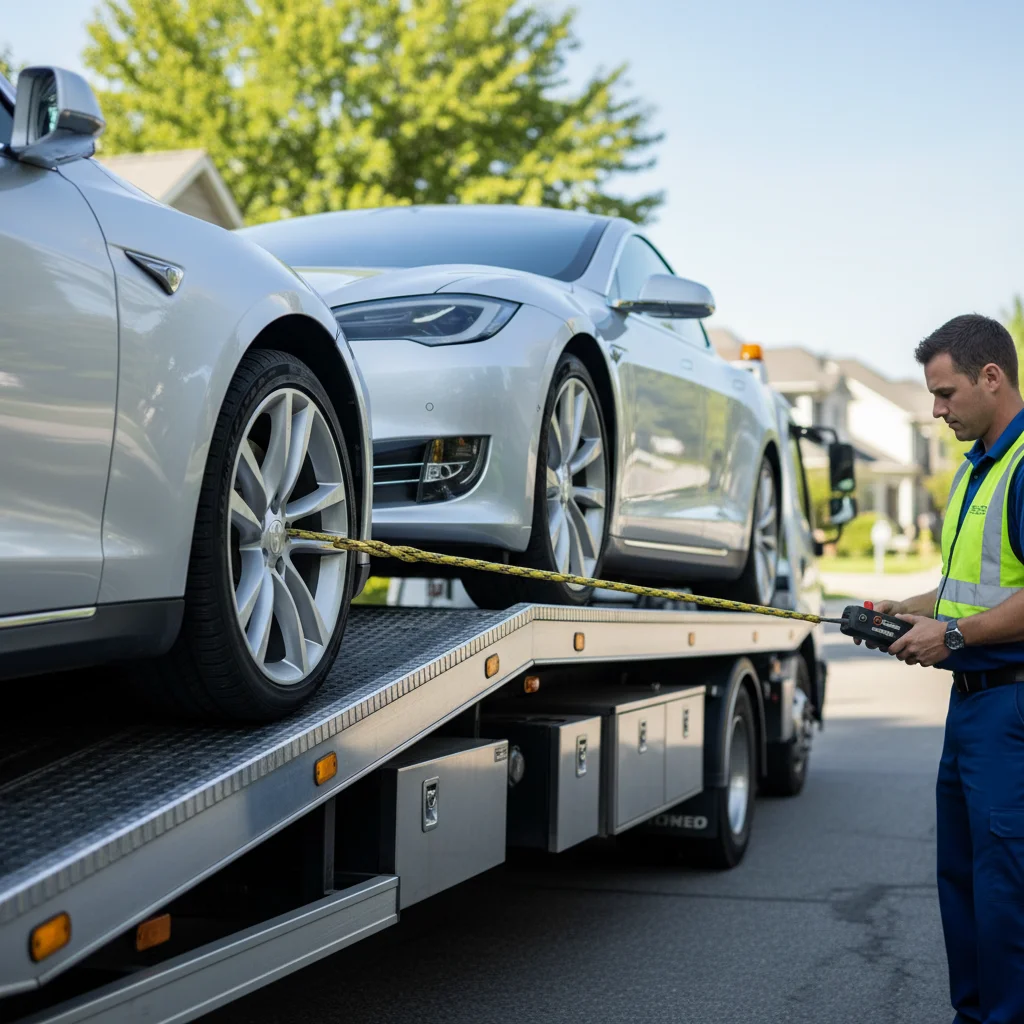
Every Tesla, without exception, must be transported on a flatbed. That is non-negotiable, especially for Dual Motor AWD models. A traditional hook-and-chain or a dolly tow can destroy the drive units, which leads to a repair bill in the tens of thousands.
The car needs to go into neutral before the flatbed winch pulls it. The proper way is through the touchscreen at Controls then Service then Towing, which activates Transport Mode and disengages the parking brake. If the responder doesn’t know that step and tries to drag the car with the parking brake engaged, it can damage the brake system and the tires.
A dead 12-volt means a dead touchscreen, which makes Transport Mode impossible electronically. A trained EV responder knows there is a manual procedure. An unprepared responder might try to drag the car onto the flatbed, which is how wheels and subframes get bent.
What a quoted local operator does differently
The pros we connect you with are licensed and insured. They typically add 10 to 20 miles of range in 15 to 30 minutes of charging. That is charging time, never an arrival time. They bring a 240-volt Level 2 source to the car. They handle Tesla and every major EV brand. They bring a native NACS plug, plus CCS or J1772 adapters for non-Tesla cars.
A 12-volt jump or replacement is also part of that visit. The operator quotes you before starting and bills you directly. Confirm the quote covers the work you accepted. If a tow is on the table, confirm the destination before the truck rolls.
Charge Pro DC is a referral line for the District, Maryland, and Virginia. We match stranded drivers with independent local operators. We don’t own trucks, employ technicians, set prices, or hold a trade license. We don’t promise an arrival time.
Where the contractor model strains in this metro
Older apartment stock across the inner ring is the common stall pattern. Census ACS figures put pre-1980 housing at 70.3 percent in Washington, 90.0 percent in Takoma Park, 79.8 percent in Annandale, 73.1 percent in Wheaton, 61.2 percent in Bethesda, and 69.1 percent in Silver Spring. Many of those blocks don’t have a dedicated home charger circuit, so cars charge in public between sessions. When the math falls short, the car sits where it died.
Tysons Corner Center, Bethesda Row, and Westfield Montgomery hold cars through long visits. A car that sat all day at any of those decks is a tired 12-volt on the way out, and sometimes a low pack as well. The pros we connect you with price both and quote you before starting. They handle Tesla and every major EV brand.
How to tell when a contractor isn’t ready for your Tesla
When the responder arrives, watch for these red flags. If the truck is not a flatbed, refuse the service immediately. If the driver asks you how to open the charge port, doesn’t know what Transport Mode is, or seems unsure how to handle the car, that’s a bad sign. If you see them trying to attach the winch hook anywhere other than the designated tow eye, stop them. If your car is completely dead and they don’t mention jumping the 12-volt or using wheel dollies, they are unprepared.
In any of those cases, you can cancel the dispatch through the Tesla app and ask for another provider. You can also call a local mobile rescue operator through Charge Pro DC for a parallel option. We match you with an independent operator who has EV-specific experience and quotes you before starting.
How the pros we connect you with cover this metro
A stall on the Woodrow Wilson Bridge sits at the meeting point of Alexandria, Oxon Hill, and the District. The American Legion Bridge is the same pinch between McLean and Montgomery County. Tell whoever you call which end you’re on, and which direction. On the 495 Express Lanes, pull to the left shoulder because those lanes run in the median. On the 95 and 395 Express Lanes, pull to the nearest shoulder. Transurban’s Express Assist runs on those lanes for minor mechanical issues and will call a tow. It doesn’t tow and doesn’t charge an EV.
NPS parkways wrap this metro. The Baltimore-Washington Parkway and the George Washington Memorial Parkway are limited-access scenic roads with narrow or absent shoulders. They ban commercial vehicles and trucks over 10,000 lb. A disabled vehicle on the Baltimore-Washington Parkway is reported to U.S. Park Police at 202-610-7500.
Maryland’s CHART patrol covers I-495, I-270, US-50, and MD-295. Dial #77 on those state primary roads. CHART technicians change tires, jump-start a 12-volt, add about a gallon of gas, and top radiator water. CHART runs around the clock in the Baltimore/Washington metropolitan area. VDOT Safety Service Patrol covers Virginia interstates including I-95, I-64, I-81, I-85, and I-66, roughly 1,079 interstate miles. Drivers reach that help through Virginia 511. None of those is a 240-volt top-up.
For the bigger picture on what manufacturer help covers and what gets billed, see our Tesla roadside policy in 2026 for DC-area drivers note.
When to call Charge Pro DC
Call us when you decide a quoted local operator fits the stall better than a long wait for a contractor, when the responder on scene isn’t EV-ready, or when a 240-volt top-up is the immediate need. Have model, pin, charge display, and warning text ready. Call (202) 629-0844 and we’ll connect you with a local EV rescue operator.