The I-95 commute into Dale City is why a home EV charger matters. You leave the Express Lanes or Dale Boulevard with the pack already thin. Overnight 240-volt charging is what rebuilds range before the next DC run.
Charge Pro DC’s a referral line, not an installer. We match stranded drivers with independent local operators. Those operators bring a 240-volt charge to the car. They don’t pull permits, and they don’t wire your garage. The query is ev charger installation dale city, and the answer starts here. We’ll tell you what a Level 2 job actually involves. We’ll also flag what we couldn’t confirm in Prince William County. We’ll cover how to keep the car moving. That matters while an electrician’s still on the calendar.
Why this commute makes the garage plug the fuel plan
Dale City’s a census-designated place in Prince William County, not an incorporated city. The Census ACS 2019-2023 5-year estimates put the population at 72,793. Land area is 14.24 square miles west of I-95. It sprawls as a bedroom community whose identity is the DC commute. That’s not a short hop across town.
Slug lines on I-95 are part of how people get downtown. The Dale City commuter lots fill for the workweek. Cars sit there all day, then they sit again overnight in the driveway. You spend charge idling on 95 with climate control on. Then you spend more on Dale Boulevard and Minnieville Road. Prince William Parkway is the other last-mile drain. Stationary drain is the Prince William problem. It’s not a mountain-pass problem.
Winter makes that drain worse out here. This part of the metro has more open land than the inner suburbs. Humid summers and icy winters both tax the pack. Dulles runs colder and snowier than Reagan National. Prince William weather tracks that western pattern more than the District core.
A Recurrent Auto study covered more than 30,000 EVs. A typical car keeps about 80 percent of range at 32°F. At 20°F that figure is about 70 percent. Cabin heat is the main reason. An EV pulls that heat from the battery. Sitting in a 95 backup with the heat on spends miles. You didn’t drive those miles.
The January 2022 I-95 shutdown is the regional memory. About 14 inches of snow and a multi-truck crash closed the road. That stretch was near Fredericksburg, just south of this commute. The road closed the evening of January 3. It reopened the evening of January 4. Hundreds of drivers spent more than 36 hours on the highway. A home charger wouldn’t have filled those cars on the pavement. It would’ve sent them out that morning with a full pack. That’s the Dale City case for a wall circuit.
If you already went empty on that corridor, start here. Read our I-95 out-of-charge guide for the corridor version. For a car that won’t move tonight, use Dale City EV roadside assistance. It walks the Express Lanes shoulder pattern.
Coming home on Dale Boulevard with the pack already thin
The last miles are local even when the day was I-95. You drop off the interstate and still have Dale Boulevard or Minnieville Road. A home Level 2 circuit is what makes that arrival boring. Without it, you’re gambling that a 120-volt outlet can rebuild the next morning. For a Dale City commute, that gamble fails a lot of weekdays. Plug in at 240 volts overnight. The slug line becomes a range problem you already solved.
What EV charger installation actually means here
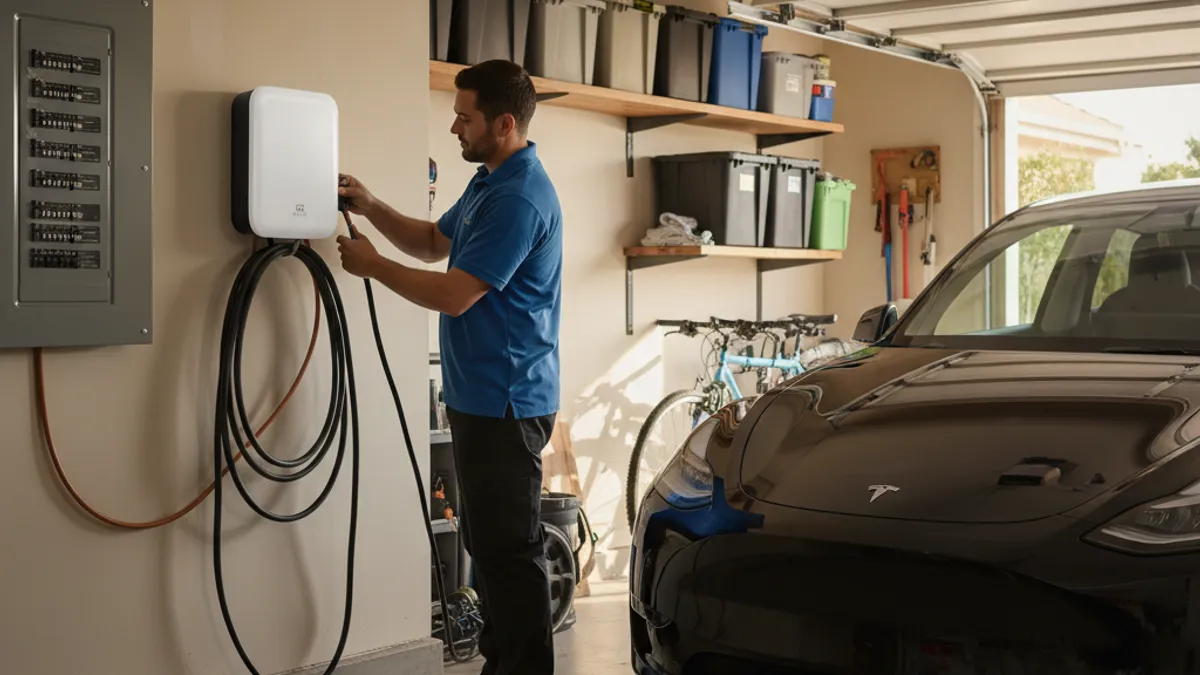
Most people picture a compact box on the garage wall. The box is the easy piece. The circuit behind it is the work.
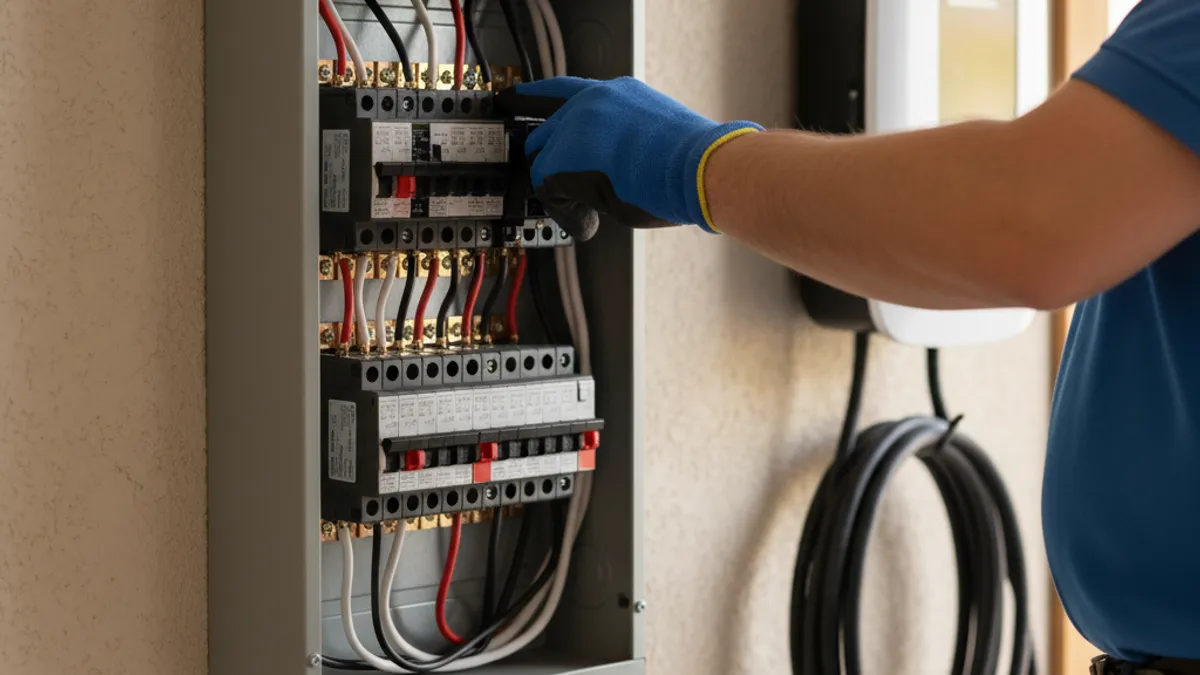
A Level 2 home charger runs on 240 volts. That’s the same kind of circuit as a dryer or an oven. An electrician adds a dedicated breaker in the panel. Then they run new cable to the spot where you park. Difficulty tracks spare panel capacity and the length of the run. The county permit is the third variable.
We couldn’t confirm a published, EV-specific permit checklist for Dale City addresses. Dale City’s unincorporated. Prince William County is the building authority to ask. Don’t copy a neighbor’s paperwork from Woodbridge, Lake Ridge, or Dumfries. Confirm the current rule with the county before you pay a deposit.
A reputable electrician pulls the permit and meets the inspector. If someone offers to skip a required permit to save money, pause. We couldn’t verify a Prince William-specific penalty in the sources we reviewed. Unpermitted electrical work is a disclosure issue when you sell. Your insurer is the party to ask about coverage. Charge Pro DC doesn’t pull electrical permits.
Older housing, mixed panels, and split quotes
About 41.5 percent of Dale City housing was built before 1980, per ACS table B25034. That’s a useful proxy. Many garages were finished before a 40- to 48-amp charging circuit was a normal request. It’s not a map of panel sizes. We don’t have verified amp ratings by subdivision. We won’t invent them.
A load calculation should come first. The electrician adds up the home’s existing demand. Then they check whether a 240-volt charger fits without overloading the service. If the math fails, there are a few paths. A load-management device can throttle the charger when the house is already drawing hard. A panel upgrade is the heavier path. Some houses can share an existing high-draw circuit. We have no verified local price for any of those paths. Ask for the calculation in writing. A low quote that never asked about the panel is incomplete.
Subdivisions here aren’t one housing type. You can have a pre-1980 ranch near an older stretch of Dale Boulevard. A later build can sit a few turns away. Two houses on the same slug-line morning can get very different electrical quotes. That’s normal. It’s about the panel and the wire run, not about the car brand.
If you’re also planning a heat pump, run the math as one project. Same goes for any other large electric load. Two sequential upgrades on a tight panel is how people pay twice. We don’t size panels. We don’t sell that work. Compare a panel wait to a mobile charge in this roadside-versus-upgrade guide.
Dominion, NOVEC, and the rates we can actually name
Most of Northern Virginia rides on Dominion Energy. Parts of Prince William County are on NOVEC. Confirm the serving utility by address. We won’t guess your meter.
Dominion publishes three named programs you should ask about. Schedule 1EV is the residential EV rate. The Off-Peak Plan is a voluntary time-of-use rate and needs a smart meter. EV Charger Rewards is a demand-response incentive. Read the live pages on dominionenergy.com before you count on any of them.
NOVEC is a separate cooperative. Dominion’s EV pages don’t apply to a NOVEC account. The City of Manassas also runs its own municipal electric utility. That’s Manassas, not Dale City. Don’t mix the three.
None of the utility EV pages we reviewed will charge a stranded car. If the wall unit is still waiting on parts or a permit, call someone else. Overnight scheduling still matters even when we can’t quote your kilowatt-hour price. A long 95 day already taxed the pack. Charging in a peak window on a hot afternoon is the expensive way to recover. Once a 240-volt circuit exists, set the car to charge after you’re asleep.
Virginia charges a Highway Use Fee on electric vehicles at registration. A Mileage Choice Program lets some drivers pay by actual miles instead. Both live on dmv.virginia.gov. Confirm the current figure with the DMV. We’re not repeating a number that may have changed.
What to ask before you hire an electrician
Charge Pro DC doesn’t install home chargers. We don’t hold a contractor license for that trade. The pros we connect you with are licensed and insured for mobile rescue. Garage wiring is a different call. Screen the electrician yourself.
Walk through this list on the phone:
- Will you run a load calculation, and can I see it in writing?
- Does this panel have headroom, or are we looking at an upgrade?
- Is the electrical permit included, and who books the Prince William County inspection?
- What amperage are you running, 40 or 48 amps?
- How long is the wire run from the panel to where I park?
- Can you set off-peak scheduling if Dominion is my utility?
Someone who answers all six is easier to compare. A quote that only prices the wall box is weaker. The cheap number that skips the load calc turns into a change order. Get at least two quotes on the same scope. Make sure the wire run is in the price.
How to charge while the install is still a future date
You still have to make the DC run. Dale Boulevard, Minnieville Road, and Prince William Parkway feed I-95 every weekday. A standard 120-volt outlet, Level 1, adds only a few miles of range per hour. That can cover short local loops. It often can’t rebuild a full slug-line morning overnight. We break that limit down in our Level 1 charger guide.
Public charging is a real option when a stall is free. The unit still has to start. We aren’t publishing a station list or a distance. Inventory wasn’t verified for this page. If a stall is taken, or the connector errors out, you still need a backup.
That backup is a mobile 240-volt visit. Independent operators we refer bring a Level 2 source to the car. They carry a native NACS plug. They also carry a CCS or J1772 adapter for non-Tesla EVs. Typical charging time is 15 to 30 minutes. That usually adds about 10 to 20 miles of range. That’s charging time, not an arrival time. The operator quotes you before starting and bills you directly. Charge Pro DC doesn’t set the price. We don’t own the truck. We don’t employ the technician.
See mobile EV charging for what that visit is. Nearby Woodbridge, Lake Ridge, Dumfries, and Manassas sit on the same I-95 logic. The install questions still belong to your panel and your county permit desk.
If a brand-new wall unit later trips a breaker, treat it as a stranded-car problem. Same if it throws a fault. Then call the electrician back on your schedule. If your home charger fails, a mobile 240-volt visit still works.
Commuter lots, slug lines, and a 12-volt that won’t wake
The Dale City commuter lots are long-dwell parking. Cars rest through the workday. A weak 12-volt battery dries out in that pattern. The traction pack can still show miles. The car still won’t wake. Sentara Lake Ridge and Andrew Leitch Park are the other local names people use. The lots are what produce the “it sat all day” call.
A home Level 2 charger doesn’t jump a dead 12-volt by itself. If the car is silent in the driveway, say that when you call. Same if it’s silent in a commuter lot. Operators we connect can jump or replace a 12-volt on site. They handle Tesla and the other major EV brands.
Don’t assume VDOT Safety Service Patrol will add range. The patrol covers Virginia interstates, including I-95. Drivers reach help through Virginia 511. Published material describes incident and debris clearance and short-term traffic control. It doesn’t describe EV charging.
If you stall on the Express Lanes before the garage circuit is live
The I-95 Express Lanes run in the median through this stretch. Transurban operates them with VDOT. If the pack hits empty in those lanes, pull to the nearest shoulder. On the 495 Express Lanes, the published rule is the left shoulder. Those lanes sit in the median. Stay in the car until help arrives.
Express Assist is a free roadside patrol on the lanes. It helps with minor mechanical issues at no charge. It will call a tow. It doesn’t tow. It isn’t a charging service.
A wall charger in a Dale City subdivision doesn’t change that median geometry. Until the 240-volt circuit is live, leave more buffer for the crawl. Count the idle on 95, not just the miles on the map.
We serve Dale City, Prince William County, and the rest of the DC area. That includes the District of Columbia, Maryland, and Virginia.
Frequently asked questions
How much does EV charger installation cost in Dale City?
We couldn’t confirm a published local price for a residential Level 2 install. That’s for Prince William County addresses. Quotes move with panel capacity, wire-run length, and whether an upgrade is required. Ask at least two electricians for a written load calculation. Charge Pro DC doesn’t bid that work.
Do I need a permit for a home EV charger in Dale City?
We couldn’t confirm Prince William County’s current EV charger permit rules. That’s from the sources we reviewed. Dale City’s unincorporated, so the county is the authority. A reputable electrician should pull whatever permit the county requires and schedule the inspection. Confirm it with the county, not with a social post.
Can I charge before the wall charger is installed?
Yes, you can charge before the wall unit is live. A 120-volt outlet adds range slowly, often too slowly for a full I-95 commute. Public stalls help when they work. Independent operators we refer can deliver a 240-volt top-up at the car. Typical charging time is 15 to 30 minutes. That usually adds about 10 to 20 miles of range. They quote before they start.
A Level 2 circuit at home is still the right long-term answer for this commute. Get the load calc, then confirm the utility and the permit. Don’t drive on hope while the job sits in the queue. If the pack is already low, call (202) 629-0844. We’ll connect you with a local operator. For more local context, start at EV charging in Dale City.