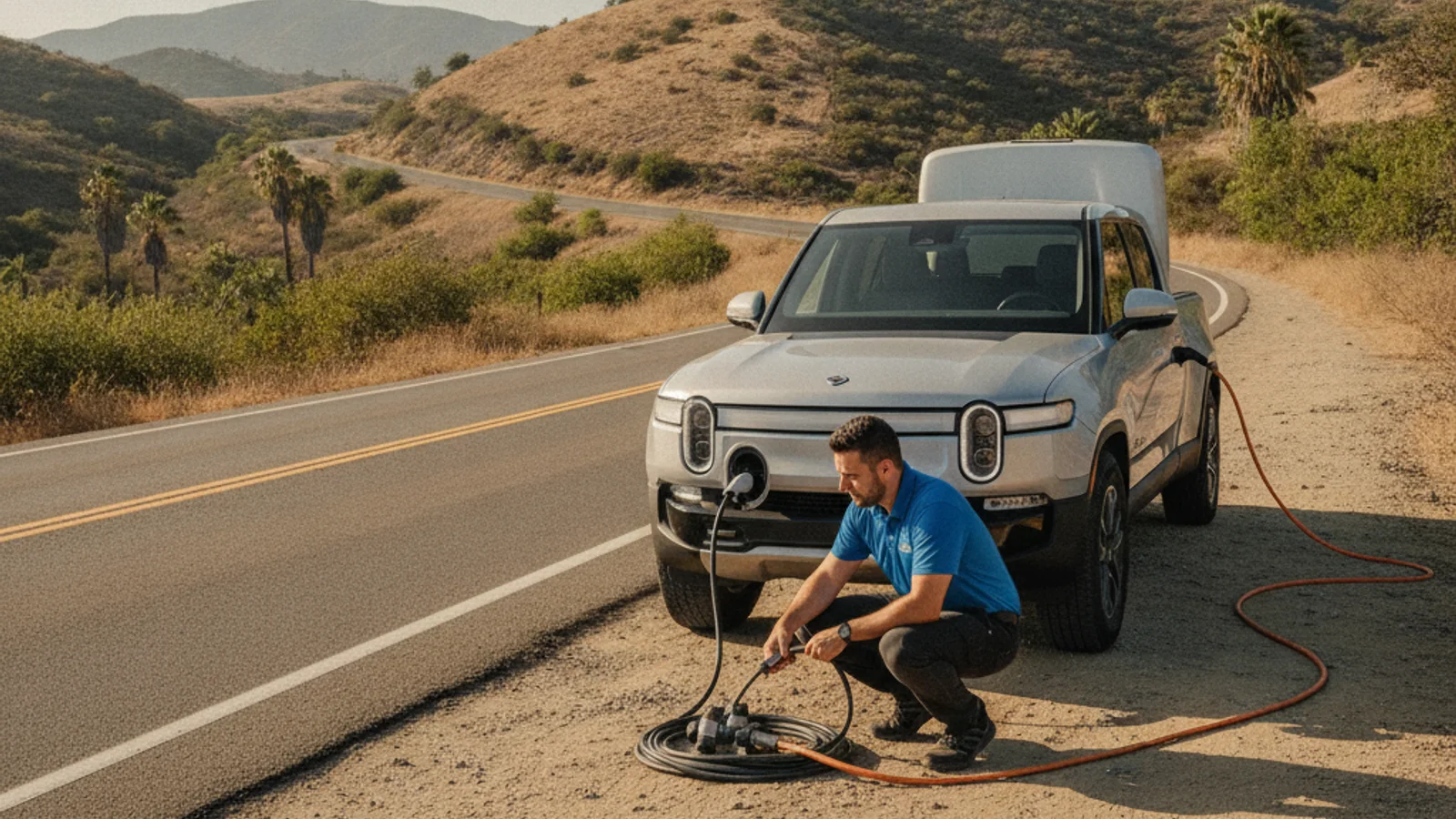
A Rivian that needs a mobile rescue gets a 240-volt Level 2 charger with the right connector. Operators bring a native NACS plug, plus CCS and J1772 adapters. For Rivian, the standard connector is CCS. The operator’s rig covers it.
A Rivian R1T or R1S in this region is most often found on a long run to a weekend trailhead, or parked at a Reston or Ashburn home charger. The calls that reach us are the cars that ran out of charge on the road, or the ones that sat too long in a lot and woke up with a dead 12-volt.
What connector a Rivian uses
Rivian uses the CCS (Combined Charging System) connector for DC fast charging and Level 2 AC charging in North America. The port sits on the driver’s side front fender on the R1T and R1S. That port accepts a CCS1 plug at public DC fast chargers and a J1772 plug at public Level 2 stations.
Rivian announced support for NACS in 2023 and began rolling out native NACS ports on newer vehicles. As of the current model year, most Rivians on the road still carry a CCS port. Operators carry both connector types to cover either version.
What a mobile rescue operator brings
The operator we connect you with brings a 240-volt Level 2 source to wherever the Rivian sits. The rig includes:
- A native NACS plug, for Teslas and newer NACS-equipped vehicles
- A CCS1 adapter, for current Rivian R1T and R1S models
- A J1772 adapter, for older Level 2 stations and some early EVs
Typical charging time adds 10 to 20 miles of range in 15 to 30 minutes. That’s charging time, never an arrival time. The operator confirms the connector type on the call and brings the right adapter.
How a Rivian visit works
Tell the operator what the dash is doing. If the cabin is dark, the 12-volt is the suspect. If the dash is up and range is gone, the traction pack is the problem. Different tools, different visit.
For an empty traction pack, the operator pulls up beside the Rivian, opens the charge port, and plugs in the CCS adapter on their Level 2 cable. They set the rate to match the truck’s onboard AC charger acceptance. They monitor the session. Once enough range is in to clear the shoulder or finish the trip, they unplug and you drive off.
For a dead 12-volt, the operator connects a lithium jump pack to the labeled under-hood jump terminals. The Rivian uses a 12-volt lithium auxiliary battery on most current builds. The jump procedure is the same as any modern EV. Never touch the orange high-voltage cables. Give the modules a minute to come alive. Then press start.
Where Rivian calls come up in this region
Reston and Ashburn lead the list. Loudoun’s newer subdivisions have widespread home charging, so trip strandings dominate over driveway calls. A driver who left home low runs short on the long I-70 run west, or the I-81 stretch south. They pull into a gas station lot and call.
Around the District, the Rivian is a curbside car for some owners. Older townhouse blocks in Capitol Hill and Cleveland Park rarely have a home charger. Cars sit at the curb through cold nights. A weak 12-volt quits by morning.
Outdoor recreation brings a specific pattern. Drivers running to Shenandoah National Park or the Monocacy River often cut range tight on the way home. The Rivian’s range estimate is honest, but the cabin heat on Skyline Drive and the climb back over the Blue Ridge eats miles. A run that looked fine at the trailhead turns into a shoulder stop near Front Royal.
What the operator does NOT do
Charge Pro DC is a referral line. We don’t perform the work, own trucks, or employ technicians. The operator quotes you before starting and bills you directly. They bring the right connectors, the right 12-volt jump gear, and the right training for an EV.
The operator doesn’t tow. They don’t replace brake pads. They don’t warranty a Rivian battery. They don’t set Rivian’s software. For anything past a 12-volt jump or a charge visit, the right call is Rivian’s own service network.
The operator doesn’t promise an arrival time. We don’t either. Charge Pro DC matches you with an operator who quotes the visit before any cable goes in.
Why a Rivian owner in this region keeps a mobile charging number handy
A Rivian in this region covers long miles. From a Reston driveway to a weekend at Deep Creek Lake is a real run, and the round trip chews more range than the dash suggests at the start. From a Bethesda townhouse to a hike at Harper’s Ferry is the same story. The cabin heat on a winter climb eats miles. The climb itself eats miles. The driver who plans on the round-trip range number arrives home fine. The driver who plans on the one-way number doesn’t.
When that happens, a mobile operator brings the missing range to the car. The driver rolls into the next charger or back to the home plug under their own power. No flatbed. No waiting at a charger.
Frequently asked questions
What connector does a Rivian use for Level 2 charging?
Current Rivian R1T and R1S models use the CCS1 connector for both DC fast charging and Level 2 AC charging. Newer models are rolling out with native NACS ports. The operator confirms which version your vehicle has and brings the right adapter.
Can a mobile rescue operator charge a Rivian on the shoulder?
Yes. The operator brings a 240-volt Level 2 source with the right adapter. They plug in where the Rivian sits. Typical charging time adds 10 to 20 miles in 15 to 30 minutes.
Will a Rivian 12-volt jump work the same as a Tesla jump?
The procedure is similar. Both cars use a small 12-volt battery to wake the modules. The labels and locations differ. Operators know the Rivian under-hood jump terminals and bring the right gear. Never touch the orange high-voltage cables.
Can the operator replace a Rivian 12-volt on site?
If the 12-volt is too far gone to hold a jump, the operator can replace it on site for many models. They quote the replacement before any work starts. You approve the price before the swap.
If the Rivian is dead anywhere we serve, from Reston to the District, call Charge Pro DC at (202) 629-0844. Tell the operator the model year and what the dash is doing.