A Level 1 EV charger is the 120-volt cord that comes with the car. It plugs into a standard household outlet. It is the slowest way to charge an EV. In DC, Maryland, and Virginia, overnight Level 1 in a garage or at a curb often leaves a driver short of the miles they need by morning.
A Level 1 charger typically adds 3 to 5 miles of range per hour of charging. Across an eight-hour overnight stay, that’s around 30 to 40 miles. That’s enough for the next day’s commute for some drivers. It is not enough for anyone who drives more than 30 miles a day, lives in an older building with only a 120-volt outlet in the garage, or needs to leave the next morning with a near-full pack.
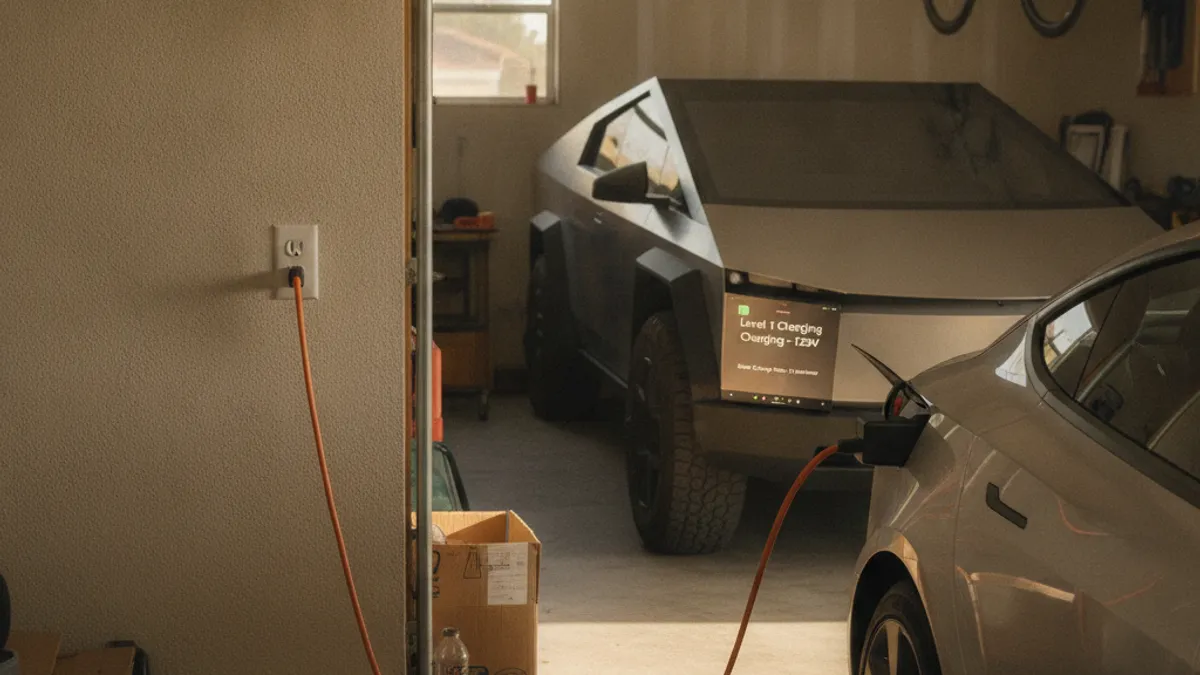
How Level 1 charging works
A Level 1 charger uses a standard 120-volt AC outlet, the same kind you plug a lamp or a vacuum into. Most EVs ship with a Level 1 cord stored in the trunk or frunk. You plug one end into the outlet, the other end into the car’s charge port, and the car starts sipping power.
The rate is governed by the car’s onboard AC charger acceptance and the current limit of the outlet. A typical 120-volt, 15-amp circuit delivers around 1.4 kilowatts to the car. Across an hour, that’s roughly 1.4 kWh of energy into the pack. An EV that averages 3 to 4 miles per kWh sees about 3 to 5 miles of range per hour of Level 1 charging.
Where Level 1 shows up in this region
Level 1 is the default in two patterns in DC, Maryland, and Virginia.
The first is apartment and condo dwellers. Older buildings in the District, Arlington, Alexandria, Bethesda, Silver Spring, and Hyattsville often have only a 120-volt outlet in the assigned parking spot. The driver plugs in the Level 1 cord at night and hopes for the best by morning.
The second is long-stay airport parking. Reagan National puts Level 1 charging on Level 1 of Parking Garages 1 and 2, complimentary for parking customers, first-come and limited. Dulles does not install EV charging in the Economy Lot, the Terminal Lot, or Valet. Garage 1 and Garage 2 at Dulles have Level 2 at no extra charge. A traveler who parks in the Dulles Economy Lot or on a Reagan level without Level 1 charging has no Level 1 source at all.
When Level 1 is not enough
Level 1 fails in a few specific cases.
Long commute drivers. A 50-mile-each-way commute is 100 miles a day. Level 1 across eight overnight hours adds 30 to 40 miles. The driver wakes up 60 miles short.
Cold weather. A typical EV keeps about 80 percent of range at freezing, per Recurrent Auto’s study of more than 30,000 EVs. Cabin heat in winter draws energy from the pack. A driver who barely covered the summer commute now runs short overnight.
Aging 12-volt battery. A Level 1 cord keeps the main pack topped up but doesn’t always keep the 12-volt healthy. A weak 12-volt quits by morning even when the pack is fine.
Older panel capacity. Many pre-1980 buildings in Takoma Park, Wheaton, Annandale, and Hyattsville have older electrical panels that don’t easily accommodate a 240-volt Level 2 circuit. The driver has no easy upgrade path without a panel upgrade.
What a quoted operator does when Level 1 isn’t enough
If you wake up short and the pack is too low for the day, the operator brings 240-volt Level 2 to wherever the car sits. A native NACS plug covers Tesla, and CCS or J1772 adapters cover other EVs. Typical charging time adds 10 to 20 miles of range in 15 to 30 minutes. That’s charging time, never an arrival time.
That visit is the cleanest answer for a one-off morning shortage. Drive into the day with enough range to reach a Level 2 charger at work, a public DC fast charger, or the home plug if you can get back to one.
For a recurring pattern, the right long-term answer is a 240-volt Level 2 home charger. A licensed electrician installs the circuit on a dedicated 40-amp or 50-amp breaker. The driver plugs in overnight and wakes up with a full pack.
Public Level 2 vs. Level 1 home charging
Public Level 2 chargers in this region run at 6 to 19 kilowatts, depending on the station and the connector. The car sips at the rate its onboard AC charger accepts, which is often 11 kW or so on modern EVs. A 30-minute public Level 2 session adds 20 to 30 miles. A 60-minute session adds 40 to 60.
Compared to a home Level 1 cord, the public Level 2 charger is roughly 5 to 7 times faster. For drivers without a home Level 2 circuit, public Level 2 sessions are the gap-filler. Charge Pro DC doesn’t operate public chargers. We match stranded drivers with operators who bring the charge to the car.
Utility programs for home Level 2
If a home Level 2 install is the right answer, the utility programs in this region can offset the cost. Pepco runs EVsmart in the District, Montgomery County, and Prince George’s County. The published Pepco Maryland residential Level 2 smart-charger rebate is up to a set dollar figure per installation in those jurisdictions. Dominion Energy Virginia runs a residential EV rate Schedule 1EV and an EV Charger Rewards demand-response incentive in Northern Virginia. Confirm current program details on the utility’s website before committing to an install.
When Level 1 is enough
Level 1 is enough for a short daily commute in mild weather, with a healthy 12-volt, and a building that has a clean 120-volt outlet near the parking spot. The driver plugs in every night, wakes up with 30 to 40 miles added, and drives under that cap daily.
For anyone else in this region, Level 1 is a thin margin. A cold snap, an extra errand, or a delayed plug-in can leave the driver short. Keep a backup plan.
Frequently asked questions
How many miles does a Level 1 charger add per hour?
Roughly 3 to 5 miles of range per hour. Across an eight-hour overnight stay, that’s about 30 to 40 miles. The exact figure depends on the car, the outlet current, and the temperature.
Is Level 1 charging bad for the battery?
No, Level 1 is gentle on the pack. The slow rate produces less heat than faster charging. The drawback is time, not wear.
Can I use an extension cord with a Level 1 charger?
Most manufacturers warn against it. A long or undersized extension cord can overheat. If you need to reach a distant outlet, have an electrician install a proper outlet near the car.
Should I install a Level 2 charger at home?
For most drivers who park an EV overnight, yes. Level 2 at home removes the morning-shortage pattern. A licensed electrician installs the circuit. Confirm utility program details on your serving utility’s website before committing.
If Level 1 left you short this morning, call Charge Pro DC at (202) 629-0844. Tell the operator where the car sits and what the dash is doing.